


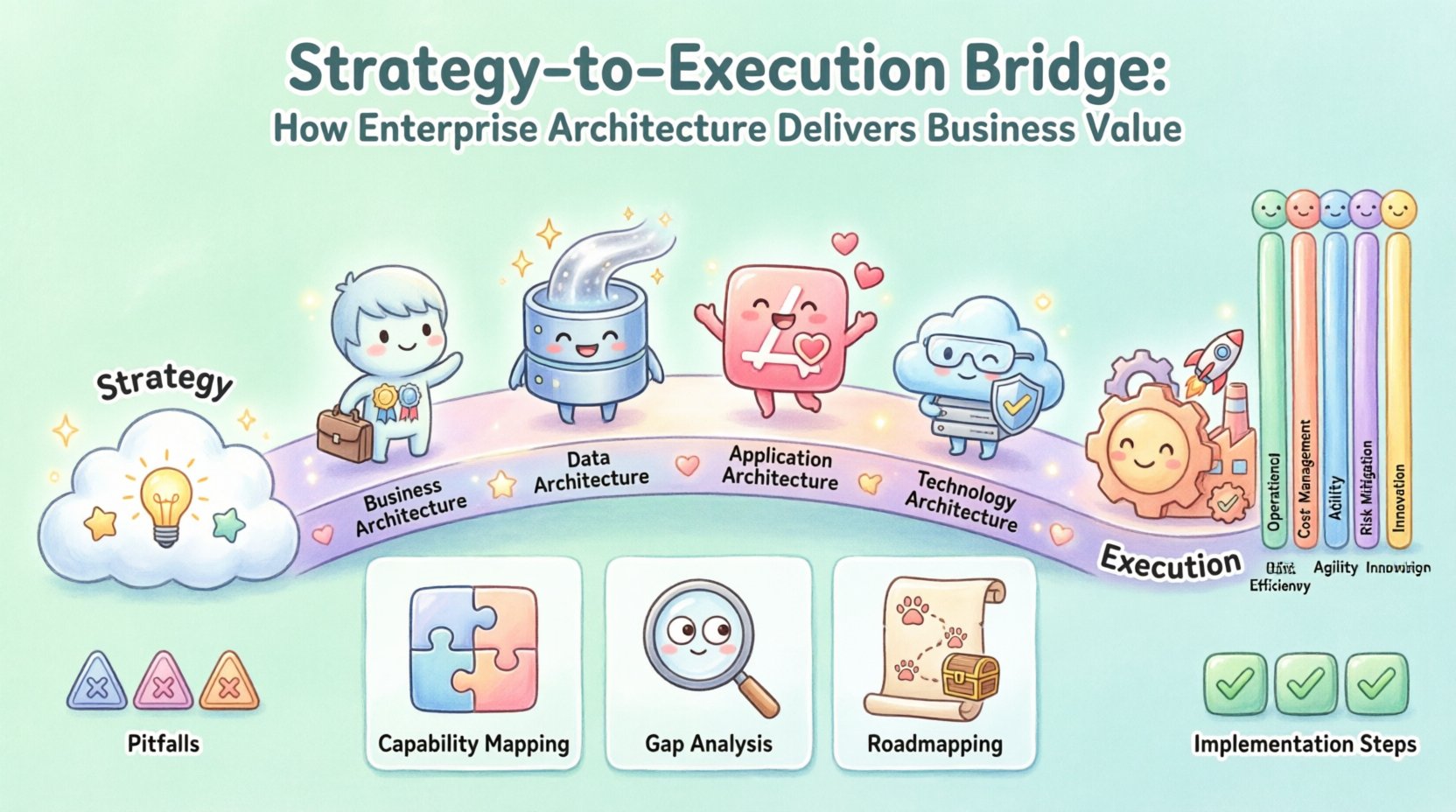
Organizations frequently invest significant resources in formulating high-level strategic plans. However, a persistent gap remains between these plans and their actual implementation. This disconnect often results in wasted budget, delayed timelines, and missed market opportunities. Enterprise Architecture (EA) serves as the critical mechanism to close this divide. It provides the structural framework necessary to translate abstract business goals into concrete technical and operational realities.
The role of EA extends beyond simple IT management. It functions as a strategic discipline that ensures every investment, process, and capability aligns with the broader organizational vision. By establishing a clear line of sight from executive decision-making to the code level, EA enables leaders to understand the impact of their choices. This guide explores the mechanics of the strategy-to-execution bridge and details how a robust architectural practice drives tangible business outcomes.
📉 The Execution Gap: Why Strategy Fails
Most organizations do not fail because they lack a good strategy. They fail because they cannot execute it. This phenomenon is often referred to as the execution gap. Several factors contribute to this breakdown:
- Disconnected Silos: Departments operate with independent goals, creating friction when cross-functional initiatives are required.
- Opaque Dependencies: Leadership often lacks visibility into how technology changes impact business capabilities.
- Inconsistent Standards: Without unified guidelines, teams build solutions that are incompatible with future growth.
- Resource Misallocation: Funds are spent on low-value projects while critical capabilities remain underfunded.
Enterprise Architecture addresses these issues by creating a unified model of the organization. It maps business capabilities to the technology that supports them. This visibility allows leaders to prioritize initiatives based on strategic value rather than political influence. When execution is aligned with strategy, the organization moves with purpose and efficiency.
🏗️ Core Components of Enterprise Architecture
To build a functional bridge, the architectural practice must cover specific domains. These domains work together to provide a holistic view of the enterprise. A comprehensive approach ensures that no critical element is overlooked during the transformation process.
1. Business Architecture
This layer defines the organization’s structure and operations. It includes:
- Business Capabilities: What the organization must do to succeed.
- Value Streams: The sequence of activities that deliver value to customers.
- Organizational Units: The groups responsible for specific functions.
2. Data Architecture
Data is the fuel for modern strategy. This layer manages information flow and integrity. Key aspects include:
- Data Models: How information is structured and related.
- Data Governance: Policies for managing data quality and security.
- Integration Standards: Methods for moving data between systems.
3. Application Architecture
This domain focuses on the software landscape. It ensures that applications support business needs effectively. Considerations involve:
- Application Portfolio: The list of active software systems.
- Interoperability: How applications communicate with each other.
- Lifecycle Management: The process of retiring or upgrading software.
4. Technology Architecture
The foundation layer supports all other components. It covers the physical and virtual infrastructure. Elements include:
- Hardware and Networks: The physical devices and connectivity.
- Cloud Strategy: Decisions regarding on-premise versus cloud hosting.
- Security Controls: Mechanisms to protect the infrastructure.
By maintaining clarity across these four layers, architects can ensure that changes in one area are reflected in the others. This prevents fragmentation and ensures cohesive execution.
🔗 Mechanisms for Alignment
Alignment does not happen automatically. It requires deliberate processes and governance structures. The following mechanisms are essential for maintaining the bridge between strategy and execution.
Capability Mapping
Mapping business capabilities to technology assets is the primary method for alignment. This process involves:
- Identifying core capabilities required for the strategy.
- Locating the systems that support these capabilities.
- Identifying gaps where capabilities lack sufficient support.
This map becomes a living document that guides investment decisions. It prevents spending on systems that do not contribute to strategic goals.
Gap Analysis
Regular assessments reveal the distance between the current state and the target state. This analysis highlights:
- Functional deficiencies in current processes.
- Technical debt that hinders performance.
- Skills shortages within the workforce.
Addressing these gaps systematically ensures steady progress toward strategic objectives.
Roadmapping
A roadmap translates long-term strategy into a phased plan. It sequences initiatives based on priority and dependency. Key features of an effective roadmap include:
- Clear timelines for delivery.
- Milestone definitions for tracking progress.
- Resource allocation plans.
This tool keeps teams focused on the most critical tasks at any given time.
📊 Measuring Value and Impact
One common criticism of architectural practices is the difficulty in proving return on investment. To counter this, organizations must define clear metrics. Value is not just cost savings; it is also agility and risk reduction. The table below outlines key performance indicators used to measure the effectiveness of the architecture practice.
| Value Dimension | Measurement Metric | Strategic Benefit |
|---|---|---|
| Operational Efficiency | Process Cycle Time Reduction | Faster delivery of products and services |
| Cost Management | IT Spend as Percentage of Revenue | Optimized resource utilization |
| Agility | Time to Market for New Features | Improved competitive responsiveness |
| Risk Mitigation | Number of Compliance Violations | Enhanced security and regulatory standing |
| Innovation | Percentage of Revenue from New Products | Sustainable growth and market relevance |
Tracking these metrics over time provides evidence of the architecture’s contribution. It shifts the conversation from abstract concepts to concrete business results.
⚠️ Common Pitfalls to Avoid
Even with the best intentions, architectural initiatives can struggle. Understanding common failures helps teams navigate challenges more effectively.
- Over-Engineering: Creating models that are too complex for stakeholders to understand. Simplicity drives adoption.
- Lack of Stakeholder Buy-in: If business leaders do not see the value, the practice will not receive support. Communication is key.
- Static Models: Architecture must evolve. Outdated models become irrelevant quickly.
- Isolation from Projects: If architects do not engage with active projects, the bridge remains theoretical.
- Focus on Tools: The methodology is more important than the software used to manage it.
Addressing these risks requires a focus on people and processes, not just documentation.
🚀 Implementation Steps for Success
Bridging strategy and execution is a journey. It requires a structured approach to ensure steady progress. The following steps outline a practical path forward.
Step 1: Assess the Current State
Begin by understanding the existing landscape. Review current documentation, systems, and processes. Identify what works and what does not. This baseline is essential for measuring future improvement.
Step 2: Define the Target State
Align with leadership to define what success looks like. Set clear goals for the architecture practice. Ensure these goals support the broader business strategy.
Step 3: Establish Governance
Create a framework for decision-making. Define who has the authority to approve changes. Set standards for technology selection and design.
Step 4: Engage the Workforce
Train teams on the new standards. Explain the benefits of alignment. Encourage collaboration between business and technology units.
Step 5: Iterate and Improve
Review the architecture regularly. Update models based on feedback and changing market conditions. Treat the practice as a continuous improvement effort.
🌱 Culture and Change Management
Technical frameworks cannot succeed in a toxic culture. Change management is critical for adoption. Leaders must foster an environment where transparency and collaboration are valued.
- Transparency: Share architectural decisions and their rationale openly.
- Collaboration: Encourage cross-functional teams to work together.
- Accountability: Ensure teams take ownership of their contributions to the strategy.
When culture supports the architecture, execution becomes smoother. Resistance decreases, and innovation increases.
💡 Future Trends in Architectural Practice
The landscape of Enterprise Architecture is evolving. Several trends are shaping how organizations build the bridge to execution.
- Continuous Architecture: Moving from periodic updates to real-time adaptation.
- AI-Driven Insights: Using data analytics to predict architectural needs.
- Customer-Centric Design: Focusing architecture on the customer journey rather than internal structures.
- Platform Engineering: Building reusable internal platforms to accelerate delivery.
Staying aware of these trends ensures the practice remains relevant. It allows the organization to adapt quickly to new opportunities.
🔍 Summary of Strategic Alignment
The path from strategy to execution is complex but navigable. Enterprise Architecture provides the map and the compass for this journey. By focusing on capabilities, governance, and value measurement, organizations can ensure their investments deliver results.
Success depends on clear communication and consistent application of principles. It requires commitment from leadership and active participation from technical teams. When these elements align, the organization gains a distinct advantage. It becomes capable of executing its vision with precision and speed.
Building the bridge is not a one-time event. It is an ongoing discipline. As the market changes, the architecture must adapt. This flexibility ensures long-term resilience and sustained business value.
✅ Key Takeaways
- Strategy fails without execution mechanisms; EA provides the structure for execution.
- Four core layers (Business, Data, Application, Technology) must be aligned.
- Capability mapping connects business goals to technical assets.
- Value must be measured using specific metrics like efficiency and agility.
- Culture and governance are as important as technical models.
- Continuous improvement ensures the architecture remains relevant.
Implementing these principles transforms architecture from a theoretical exercise into a driver of business performance. The result is an organization that delivers on its promises and thrives in a competitive environment.
Related posts:
 Enterprise Architecture Strategy Blueprint for Digital Transformation Success
 EA Guide; Aligning Business Strategy with IT Architecture – A CIO’s Actionable Framework
 Cloud-First Enterprise Architecture: Strategic Planning for Flexibility and Control
 EA Guide: Data Governance Architecture Framework – Ensuring Quality, Security, and Compliance