


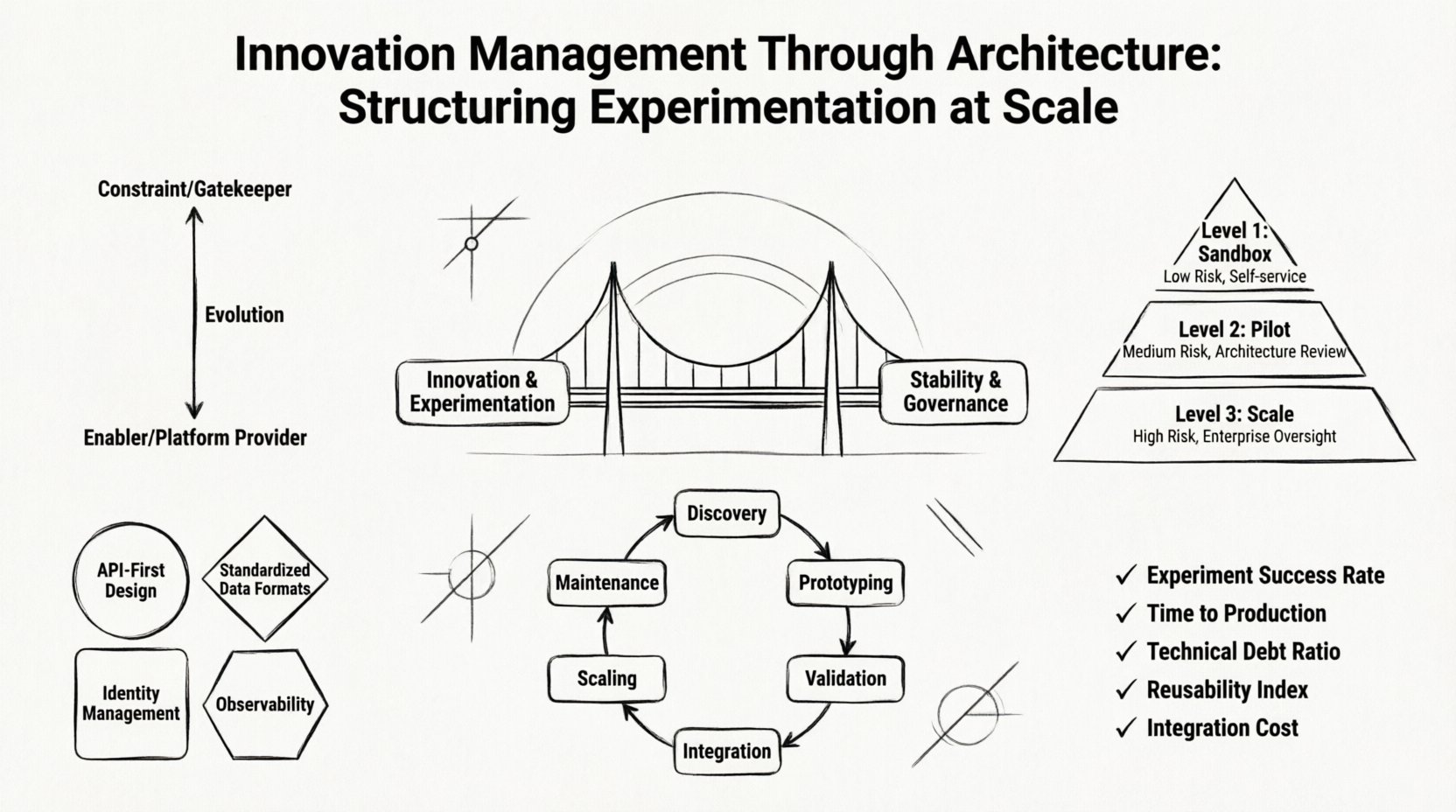
Organizations today face a fundamental tension. On one side, there is the relentless pressure to innovate, to capture new markets, and to adapt to shifting customer needs. On the other, there is the imperative of stability, security, and long-term operational efficiency. This friction often leads to a choice between speed and control, but this is a false dichotomy. Effective enterprise architecture provides the structural foundation necessary to manage innovation without sacrificing governance. This guide explores how to structure experimentation at scale, ensuring that new ideas can flow from concept to production safely and efficiently.
🧩 The Evolution of Enterprise Architecture
Traditionally, enterprise architecture was viewed as a function of constraint. Its primary purpose was to document existing systems, enforce standards, and prevent redundancy. While these roles remain relevant, the modern context demands a shift. Architecture must now act as an enabler. It needs to provide guardrails that allow teams to move quickly while ensuring their innovations do not break the core systems upon which the business relies.
This shift requires a change in mindset. Instead of asking “Can we build this?”, the question becomes “How do we build this safely and integrate it later?”. The architecture function transitions from a gatekeeper to a platform provider. It creates the environments where experimentation can happen without risk to the production landscape.
🚀 Defining Structured Experimentation
Experimentation is not random. It is a disciplined process of hypothesis testing, validation, and scaling. Without a structured approach, experiments become siloed projects that never graduate to production. They consume resources and leave behind technical debt. Structured experimentation through architecture means establishing clear pathways for these initiatives.
Key characteristics of structured experimentation include:
- Clear Boundaries: Defined scopes where new technologies or processes can be tested without impacting critical business functions.
- Defined Exit Criteria: Knowing when to stop an experiment, pivot, or proceed to production.
- Resource Allocation: Ensuring teams have the compute, data, and access they need without bypassing security protocols.
- Knowledge Retention: Capturing learnings from failed experiments so the organization does not repeat mistakes.
Architecture supports this by providing the sandbox environments. These are isolated instances of systems where teams can deploy code, test integrations, and validate data flows. Once validated, the architecture provides the migration path to the production environment.
🛡️ Governance Models for Innovation
Governance is often perceived as the enemy of innovation. In reality, governance provides the predictability required for large-scale deployment. The goal is to implement a governance model that scales with the risk level of the project. Not all experiments require the same level of oversight.
Consider the following governance maturity levels:
| Maturity Level | Risk Profile | Architectural Oversight | Approval Process |
|---|---|---|---|
| Level 1: Sandbox | Low (Internal, Non-Production) | Minimal (Self-service access) | Team Lead Approval |
| Level 2: Pilot | Medium (Limited User Base) | Standard (Architecture Review Board) | Architecture Review + Security Sign-off |
| Level 3: Scale | High (Enterprise-wide) | High (Enterprise Architecture) | Executive Sponsor + Full Compliance Audit |
Using a tiered approach allows the organization to move fast initially. As an experiment proves its value and expands its reach, the architectural scrutiny increases. This ensures that resources are not wasted on high-touch reviews for low-risk internal tools, while protecting critical assets when the project scales.
🔌 The Integration Challenge
The most common failure point in innovation is the transition from proof of concept to production. An experiment often works in isolation. It may rely on hardcoded credentials, temporary databases, or proprietary scripts that do not fit within the enterprise ecosystem. Architecture must address this integration gap early.
To manage this, the following principles should guide the development of experimental projects:
- API-First Design: Even in early stages, services should expose APIs. This ensures that when the time comes to integrate, the connection points already exist.
- Standardized Data Formats: Avoid custom data structures. Use enterprise-standard formats to ensure data can be ingested by downstream systems later.
- Identity Management: Access control should align with the enterprise identity provider from day one. This prevents security debt.
- Observability: Logging and monitoring must be enabled. You cannot manage what you cannot see.
By enforcing these standards early, the architecture team reduces the friction during the scaling phase. The integration becomes a configuration change rather than a rewrite.
📊 Metrics for Innovation Architecture
How do you know if the architectural approach to innovation is working? You need metrics that reflect both velocity and stability. Traditional metrics like time-to-market are important, but they do not tell the whole story. You must also measure the quality and sustainability of the output.
Recommended metrics include:
- Experiment Success Rate: The percentage of experiments that successfully graduate to production.
- Time to Production: The duration from initial concept to live deployment.
- Technical Debt Ratio: The amount of remediation work required post-integration.
- Reusability Index: The number of components or services from an experiment that are reused in other projects.
- Integration Cost: The effort and resources required to move an experiment from sandbox to production.
Tracking these metrics helps the architecture team identify bottlenecks. If the integration cost is high, it suggests that the sandbox environment is too disconnected from production. If the technical debt ratio is high, the standards are not being enforced effectively.
🧠 Cultural Shifts Required
Technology is only one part of the equation. Structuring experimentation at scale requires a cultural shift within the organization. Teams must feel empowered to fail, but they must also take ownership of their solutions. The architecture team must be seen as a partner, not a police force.
Key cultural enablers include:
- Shared Responsibility: Developers are responsible for the operational quality of their code. Architects are responsible for the safety of the environment.
- Transparency: Architecture decisions and standards should be visible and accessible to all teams. Documentation should be living, not static.
- Feedback Loops: Regular reviews where teams share their challenges with the architecture function. This allows the governance model to evolve.
- Talent Mobility: Encouraging architects to spend time within product teams to understand the practical constraints of development.
When culture aligns with architecture, the friction decreases. Teams stop looking for workarounds and start leveraging the platform provided by the enterprise.
🔄 The Lifecycle of an Architectural Experiment
To visualize the process, consider the lifecycle of a typical architectural experiment. It moves through distinct phases, each with specific architectural requirements.
- Discovery: Identifying the problem space. Architecture here involves assessing the current landscape to see if existing solutions can be repurposed.
- Prototyping: Building a proof of concept. Architecture provides a sandbox environment with isolated resources.
- Validation: Testing in a controlled environment with real data. Architecture ensures data privacy and security compliance.
- Integration: Connecting to core systems. Architecture reviews the API contracts and data models.
- Scaling: Deploying to production. Architecture oversees the capacity planning and high-availability configuration.
- Maintenance: Ongoing support. Architecture ensures the solution remains compliant with changing standards.
Each phase requires different levels of architectural engagement. The key is to be present where it matters most. In the discovery phase, architects can prevent duplicate efforts. In the scaling phase, they ensure stability.
🛠️ Managing Technical Debt
Innovation often comes with technical debt. When speed is prioritized, shortcuts are taken. The architecture function must manage this debt proactively. It cannot simply accumulate until it becomes unmanageable.
Strategies for managing debt include:
- Debt Registers: Maintaining a visible log of technical compromises made during experiments.
- Scheduled Refactoring: Allocating specific sprints or time blocks to address debt before it impacts new features.
- Architecture Decision Records: Documenting why certain shortcuts were taken. This provides context for future teams.
- Deprecation Policies: Clear timelines for when legacy experimental technologies will be retired.
Ignoring technical debt leads to a “snowball effect”. The cost of change increases exponentially over time. By acknowledging and managing it, the organization maintains its ability to innovate in the future.
🌐 Data Governance in Experimentation
Data is the fuel for modern innovation. Whether it is machine learning models or customer analytics, data quality is paramount. Architecture must ensure that data used in experiments is treated with the same rigor as data used in production.
Considerations for data governance include:
- Data Lineage: Tracking where data comes from and how it is transformed.
- Privacy Compliance: Ensuring experiments do not violate data protection regulations.
- Data Quality: Validating that the data used for testing is representative of the production reality.
- Access Control: Ensuring only authorized personnel can access sensitive datasets during the experiment.
Without these controls, an experiment might succeed technically but fail legally or ethically. Architecture bridges the gap between innovation velocity and regulatory compliance.
📈 Measuring Architectural Value
Finally, the architecture function must demonstrate its value to the business. This is not about counting tickets resolved or standards enforced. It is about business outcomes enabled by the architecture.
Value indicators include:
- Reduced Time to Market: How much faster are products launching due to standardized platforms?
- Increased Reuse: How many new projects are leveraging existing services?
- Reduced Incident Rates: Are fewer production issues caused by experimental integrations?
- Improved Compliance: Is the organization avoiding fines or security breaches due to better governance?
By focusing on these outcomes, the architecture team aligns itself with business goals. It moves from a cost center to a strategic partner.
🏁 Final Thoughts on Scaling Innovation
Structuring experimentation at scale is not about building walls. It is about building bridges. It is about creating the pathways that allow creativity to flow into the core business without causing disruption. Enterprise architecture provides the map for this journey.
Success requires a balance. Too much control stifles creativity. Too little control leads to chaos. The goal is a dynamic equilibrium where governance evolves as the organization matures. By implementing the frameworks, metrics, and cultural shifts discussed here, organizations can build a resilient foundation for continuous innovation.
The future of enterprise architecture is not just about stability. It is about enabling the future. Through thoughtful design and disciplined execution, the structure itself becomes a catalyst for growth.
Related posts:
 Enterprise Architecture Strategy Blueprint for Digital Transformation Success
 EA Guide; Aligning Business Strategy with IT Architecture – A CIO’s Actionable Framework
 Cloud-First Enterprise Architecture: Strategic Planning for Flexibility and Control
 EA Guide: Data Governance Architecture Framework – Ensuring Quality, Security, and Compliance