


Enterprise architecture often succeeds or fails based on human dynamics rather than technical complexity. You may have designed the perfect system structure, defined robust standards, and identified the most efficient integration patterns. However, if the decision-makers do not understand the value or the risks of your proposal, the initiative will stall. This playbook focuses on the critical intersection of technical strategy and organizational politics. It provides a structured approach to securing agreement from key stakeholders without relying on authority or jargon.
Architecture is not just about code and infrastructure; it is about enabling business capability. When you align architecture with business goals, you transform the function from a gatekeeper to an enabler. This guide outlines how to map stakeholder interests, translate technical debt into financial risk, and establish governance that feels supportive rather than restrictive.
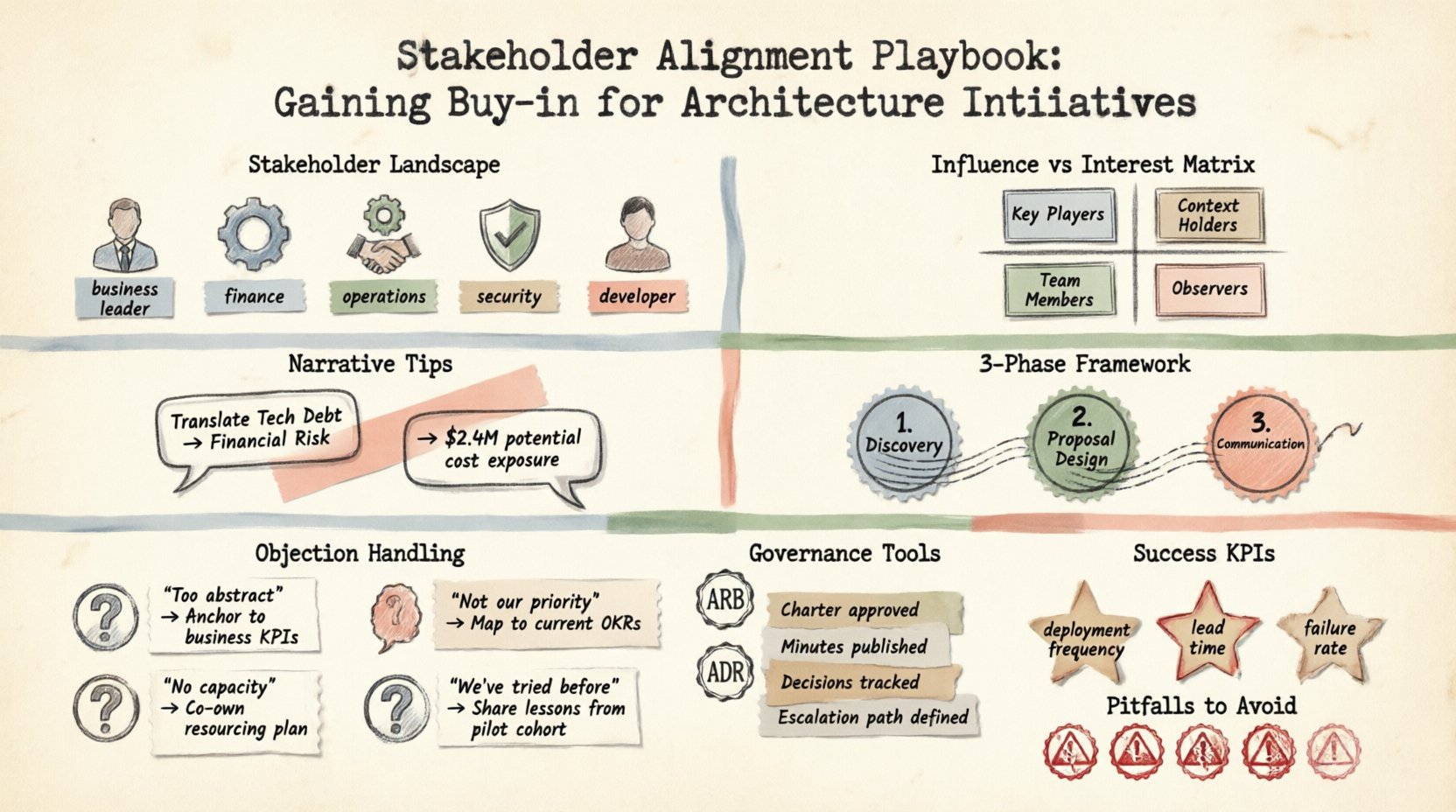
Understanding the Stakeholder Landscape 🗺️
The first step in gaining buy-in is identifying who holds influence over your initiative. Stakeholders are not a monolith; they have different priorities, pain points, and definitions of success. A generic communication strategy will fail because it does not address specific concerns.
- Business Leaders: Focus on revenue, market speed, and customer experience.
- Finance Teams: Focus on cost optimization, ROI, and budget adherence.
- Operations: Focus on stability, uptime, and ease of maintenance.
- Security & Compliance: Focus on risk mitigation, data protection, and regulatory adherence.
- Development Teams: Focus on developer experience, tooling, and code quality.
Creating a stakeholder map helps visualize these relationships. You should categorize them by their level of influence and their level of interest. High influence and high interest stakeholders require the most attention and active engagement.
Mapping Influence vs. Interest
| Category | Characteristics | Engagement Strategy |
|---|---|---|
| Key Players | High Influence, High Interest | Manage closely. Involve in decision-making. |
| Context Holders | High Influence, Low Interest | Keep satisfied. Provide high-level updates only. |
| Team Members | Low Influence, High Interest | Keep informed. Use them as champions. |
| Observers | Low Influence, Low Interest | Monitor. Minimal effort required. |
Preparing the Narrative 📢
Once you know your audience, you must craft a narrative that resonates with them. Architects often default to technical terminology, which creates a barrier to entry. The goal is to translate technical initiatives into business outcomes.
Translating Technical Debt to Financial Risk
Business leaders understand risk better than they understand legacy code. When discussing technical debt, frame it as financial liability. High maintenance costs slow down feature delivery. Security vulnerabilities expose the organization to fines. Outdated infrastructure limits scalability.
- Instead of: “We need to refactor the monolith.”
- Use: “Refactoring reduces deployment time by 40%, allowing us to launch features faster to market.”
- Instead of: “We need a new API gateway.”
- Use: “Upgrading the gateway improves security compliance and reduces latency for customer-facing apps.”
The Cost of Inaction
It is often easier to sell a problem than a solution. Paint a clear picture of what happens if the initiative is not approved. This is not fear-mongering; it is realistic risk assessment.
- Increased operational costs due to inefficient resource usage.
- Slower time-to-market for new products.
- Higher probability of service outages during peak traffic.
- Difficulty in acquiring new talent who expect modern tooling.
The Alignment Framework 🛠️
Securing agreement is a process, not a single meeting. It requires a cycle of preparation, presentation, feedback, and refinement. This framework ensures that you do not walk into a meeting unprepared.
Phase 1: Discovery
Before proposing a solution, understand the current state. Conduct interviews and gather data. Ask stakeholders about their current bottlenecks. What are they struggling with? If you can solve a problem they already know exists, you have a foundation for alignment.
- Review existing documentation and architecture diagrams.
- Interview department heads to identify pain points.
- Analyze past project failures to understand systemic issues.
Phase 2: Proposal Design
Design your initiative to fit within the current budget and timeline constraints. Do not propose a “big bang” transformation unless the organization is ready for it. Phased approaches often gain more trust because they allow for quick wins.
- Define clear milestones and deliverables.
- Identify potential risks and mitigation strategies.
- Create multiple options (e.g., low cost/low speed vs. high cost/high speed).
Phase 3: Communication
Different stakeholders prefer different communication channels. Use the table below to select the right method for the right person.
| Audience | Preferred Channel | Key Message |
|---|---|---|
| C-Suite | Executive Summary (1 Page) | Strategic impact and ROI. |
| IT Directors | Technical Review Workshop | Feasibility and integration. |
| Finance | Budget Impact Analysis | Cost breakdown and savings. |
| Engineering | Live Demo / Code Walkthrough | Developer experience and tools. |
Handling Objections 💬
Even with a strong case, objections will arise. Resistance is a natural part of change management. The key is to listen, validate, and respond with data rather than emotion.
Common Objections and Responses
- Objection: “This is too expensive right now.”
- Response: “I understand budget constraints. We can phase the implementation to fit the fiscal year, or we can prioritize the components that yield the highest immediate savings.”
- Objection: “We don’t have time for this; development is busy.”
- Response: “Continuing as is will likely slow development down further due to technical debt. We can allocate a small percentage of sprint capacity to this work to prevent future blockages.”
- Objection: “The technology is too new and risky.”
- Response: “We can mitigate risk by starting with a pilot program or a proof of concept in a non-critical environment before full rollout.”
- Objection: “We already have a similar solution in place.”
- Response: “Let’s review that solution. It might address the immediate need but could lack the scalability required for the next three years of growth.”
Governance and Decision Making 🏛️
Alignment is not a one-time event; it requires ongoing governance. You need structures in place to ensure that architectural principles are respected as the organization grows. Governance should be lightweight enough not to slow down delivery but strong enough to prevent fragmentation.
Architecture Review Boards (ARB)
An ARB brings together key representatives from different domains to review significant architectural changes. This ensures diverse perspectives are considered before decisions are finalized.
- Composition: Include architects, security leads, operations, and business representatives.
- Frequency: Monthly or bi-weekly reviews.
- Scope: Focus on cross-cutting concerns, integration points, and major infrastructure changes.
- Outcome: Documented decisions with clear owners and timelines.
Architectural Decision Records (ADR)
Decisions must be documented to maintain institutional knowledge. An ADR captures the context, the decision made, and the consequences. This prevents the “why” from being forgotten six months later.
- Context: What was the problem we were trying to solve?
- Decision: What choice did we make?
- Status: Is the decision active, superseded, or deprecated?
- Consequences: What did we gain? What did we lose?
Measuring Success 📈
To prove the value of your alignment efforts, you need metrics. Vague promises lead to skepticism. Concrete data builds credibility. Track metrics that matter to the stakeholders you engaged with.
Key Performance Indicators (KPIs)
- Deployment Frequency: Are we releasing code more often?
- Lead Time for Changes: How long does it take to go from commit to production?
- Change Failure Rate: How often do deployments cause issues?
- Mean Time to Recovery: How quickly can we fix an outage?
- Architecture Compliance: What percentage of new projects follow the agreed standards?
- Stakeholder Satisfaction: Regular surveys to gauge perception of the architecture team.
Long-term Relationship Building 🤝
Trust is the currency of influence. You cannot buy buy-in with authority; you earn it through consistency and reliability. Treat your stakeholders as partners in the journey.
- Be Accessible: Don’t wait for meetings to talk. Be available for quick questions.
- Deliver on Promises: If you say you will provide an analysis by Friday, do it by Friday.
- Admit Mistakes: If an assumption was wrong, acknowledge it immediately and propose a fix. Hiding errors destroys trust.
- Share Knowledge: Host brownbag sessions or workshops to educate stakeholders on technical trends.
Common Pitfalls to Avoid ⚠️
Even with a solid plan, there are traps that can derail alignment efforts. Awareness of these pitfalls helps you navigate them.
1. Over-Promising
Do not guarantee a timeline or budget that is unrealistic. If you say you can deliver in two weeks and it takes two months, your credibility is damaged. Under-promise and over-deliver.
2. Technical Jargon
Using acronyms and deep technical terms alienates business stakeholders. Keep language accessible. If you must use a technical term, explain its business impact immediately.
3. Ignoring Politics
Organizations have informal power structures. Ignoring a key influencer because they are not on the official org chart can lead to unexpected resistance. Map the informal network alongside the formal one.
4. Focusing Only on the Future
While vision is important, stakeholders care about today. Balance your strategic roadmap with immediate fixes that solve current problems. Show that you understand their daily struggles.
Conclusion
Securing buy-in for architecture initiatives is a continuous practice of communication, empathy, and value demonstration. It requires moving beyond the technical details to address the human and business elements of the organization. By understanding your stakeholders, translating technical concepts into business value, and establishing clear governance, you can build the support needed to drive meaningful change.
Remember that alignment is not about winning an argument; it is about building a shared vision. When stakeholders feel heard and see the direct benefit of your work, the path to successful implementation becomes clear.
Related posts:
 Enterprise Architecture Strategy Blueprint for Digital Transformation Success
 EA Guide; Aligning Business Strategy with IT Architecture – A CIO’s Actionable Framework
 Cloud-First Enterprise Architecture: Strategic Planning for Flexibility and Control
 EA Guide: Data Governance Architecture Framework – Ensuring Quality, Security, and Compliance