


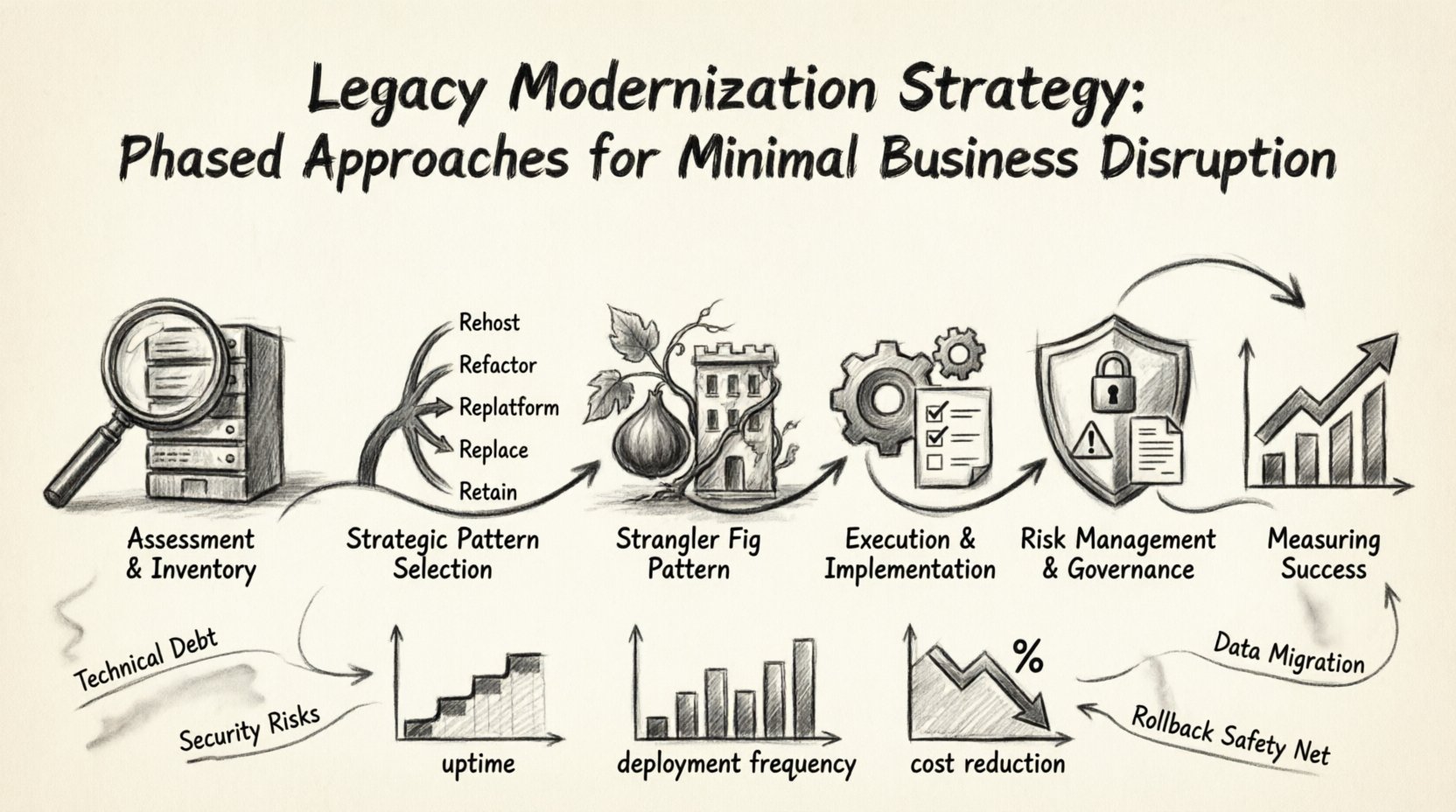
Enterprise architecture today faces a critical challenge: the tension between stability and innovation. Most large organizations rely on legacy systems that have served their operational needs for decades. These systems hold critical business logic and vast amounts of data. However, maintaining them often comes at a high cost in terms of technical debt, security vulnerabilities, and difficulty in hiring skilled personnel. Modernization is not merely a technical upgrade; it is a strategic imperative that requires careful planning to ensure business continuity.
This guide outlines a structured approach to modernizing legacy environments. We focus on phased strategies designed to reduce risk and maintain operational stability. The goal is not to replace the entire system overnight but to evolve it incrementally. This method allows the organization to adapt to market changes while keeping core services running smoothly.
🧩 Understanding the Legacy Landscape
Before initiating any changes, it is essential to understand the current state of the infrastructure. Legacy systems are not simply old code; they represent a complex ecosystem of hardware, software, data, and processes. Often, the documentation is incomplete, and the original developers have moved on.
- Technical Debt: Over time, quick fixes accumulate. This debt slows down development and increases the likelihood of errors.
- Security Risks: Older platforms may no longer receive security patches, leaving data exposed to modern threats.
- Integration Barriers: Monolithic architectures often struggle to communicate with modern APIs or cloud services.
- Talent Gap: Finding experts familiar with older technologies like COBOL or older Java versions becomes increasingly difficult.
Recognizing these factors helps stakeholders prioritize which systems require attention. Not every application needs immediate modernization. Some components are stable and cost-effective to maintain. The key is to identify which parts of the architecture are hindering growth.
🔍 Phase 1: Assessment and Inventory
The foundation of a successful modernization effort is a comprehensive assessment. This phase involves cataloging all existing applications and understanding their dependencies. Without this visibility, projects risk scope creep or unforeseen downtime.
Application Portfolio Management
Organizations must map every application to its business function. This mapping helps determine the value each system provides. Some applications are critical for revenue generation, while others serve internal administrative tasks.
- Business Criticality: How essential is this system to daily operations?
- Technical Health: What is the current state of the code? Is it stable or prone to failure?
- Cost of Ownership: What are the licensing, maintenance, and hosting costs?
- Interdependencies: Which other systems rely on this application for data or functionality?
Data Mapping and Analysis
Data is often the most valuable asset in a legacy environment. During the assessment, data structures must be analyzed to ensure they can be migrated to new formats. This includes understanding schemas, relationships, and data quality issues.
- Identify data silos that prevent a unified view of information.
- Assess data quality and cleansing requirements.
- Determine compliance requirements for data retention and privacy.
🚀 Phase 2: Selecting a Strategic Pattern
Once the inventory is complete, the organization must choose a modernization pattern. The strategy depends on the specific constraints of the system, budget, and timeline. Below is a comparison of common approaches.
| Pattern | Description | Best Use Case | Risk Level |
|---|---|---|---|
| Rehost (Lift & Shift) | Moving the application to a new infrastructure without changing code. | Quick migration to reduce on-premise costs. | Low |
| Refactor (Re-architect) | Optimizing the application for cloud-native environments. | Improving performance and scalability long-term. | Medium |
| Replatform | Making minor optimizations without changing core logic. | Reducing maintenance effort while keeping logic. | Low |
| Replace | Swapping the legacy system for a new commercial or custom solution. | When the legacy system is obsolete and unmaintainable. | High |
| Retain | Keeping the system as is because it is stable and cost-effective. | Non-critical systems with low usage. | N/A |
Many organizations find that a hybrid approach works best. For example, a company might choose to Rehost a database while Refactoring the application logic. This allows for incremental progress without halting operations.
🔄 Phase 3: The Strangler Fig Pattern
The Strangler Fig pattern is a widely accepted method for gradual modernization. It involves building a new system around the edges of the legacy one, gradually shifting functionality until the old system is no longer needed.
How It Works
- Identify a Feature: Select a specific function within the legacy application to move first.
- Build New Service: Develop the new capability using modern technologies.
- Route Traffic: Configure a gateway to direct requests for that feature to the new service.
- Verify: Ensure the new service functions correctly and does not disrupt existing workflows.
- Repeat: Continue this process for other features until the legacy system is fully replaced.
This approach minimizes disruption because the legacy system remains operational during the transition. If the new service fails, traffic can be routed back to the old system. This safety net is crucial for maintaining business continuity.
🛠️ Phase 4: Execution and Implementation
Execution requires a disciplined process. Rushing implementation often leads to data loss or service outages. The following steps outline a robust implementation workflow.
1. Infrastructure Setup
Prepare the target environment. This includes setting up networking, security protocols, and access controls. Ensure the new environment mirrors the security posture of the legacy system to prevent vulnerabilities.
2. Data Migration Strategy
Data migration is often the most risky part of modernization. A common strategy involves a phased migration:
- Historical Data: Move static, read-only data first. This can be done during off-peak hours.
- Transactional Data: Move active data in stages. This requires synchronization mechanisms to keep both systems in sync during the transition.
- Validation: Run data integrity checks to ensure nothing was lost or corrupted.
3. Integration Testing
Before going live, test the integration points thoroughly. This includes API endpoints, database connections, and user authentication flows. Automated testing suites should be employed to catch regressions early.
4. User Acceptance Testing (UAT)
Involve business users in the testing phase. They can verify that the new system meets operational needs. Feedback from this group helps identify usability issues that technical teams might miss.
🛡️ Phase 5: Risk Management and Governance
Risk management is an ongoing activity throughout the modernization lifecycle. It is not enough to fix technical issues; organizational risks must also be addressed.
Common Risks
- Downtime: Any interruption to service affects revenue and customer trust. Plan for maintenance windows and have rollback procedures ready.
- Data Integrity: Inconsistent data can lead to financial errors or compliance violations. Implement rigorous validation checks.
- Scope Creep: Projects often expand beyond their original goals. Stick to the defined scope to avoid budget overruns.
- Resistance to Change: Employees may prefer the old system. Change management strategies are needed to encourage adoption.
Governance Framework
A governance board should oversee the project. This team ensures that decisions align with business goals and technical standards. Regular status meetings help track progress and address blockers.
- Change Control: All changes to the architecture must be reviewed and approved.
- Documentation: Keep records of all decisions, code changes, and configuration updates.
- Compliance: Ensure all activities meet regulatory requirements.
📊 Phase 6: Measuring Success
Success in modernization is not just about moving code; it is about achieving business outcomes. Define clear metrics before starting the project.
Key Performance Indicators (KPIs)
| Metric | Goal |
|---|---|
| System Availability | Maintain or increase uptime percentage. |
| Deployment Frequency | Increase the rate of successful releases. |
| Mean Time to Recovery | Reduce the time taken to fix incidents. |
| Operational Costs | Reduce infrastructure and maintenance spend. |
| Employee Satisfaction | Improve developer productivity and morale. |
👥 Organizational Readiness
Technical changes require cultural shifts. Teams need to adapt to new workflows and tools. Training programs should be established to upskill staff on modern technologies.
- DevOps Culture: Encourage collaboration between development and operations teams to streamline delivery.
- Continuous Learning: Allocate time for teams to learn new frameworks and best practices.
- Feedback Loops: Create channels for teams to report issues and suggest improvements.
🛑 Handling Rollbacks
Even with careful planning, things can go wrong. A rollback plan is essential. This plan outlines the steps to revert to the legacy system if the new environment fails.
- Data Sync: Ensure data flows back to the legacy system if the switch is aborted.
- Configuration: Have the ability to switch traffic routing back to the old system instantly.
- Communication: Inform stakeholders immediately if a rollback is triggered.
Testing the rollback procedure is as important as testing the migration itself. Conduct dry runs to verify that the process works under pressure.
💡 Final Considerations
Legacy modernization is a journey, not a destination. It requires patience, discipline, and a clear vision. By adopting a phased approach, organizations can mitigate risks and ensure that business operations continue without interruption.
The path forward involves balancing innovation with stability. It is about building a foundation that supports future growth while respecting the value of the past. Success comes from meticulous planning, continuous monitoring, and a willingness to adapt to changing conditions.
Start with a clear assessment. Choose the right pattern. Execute with care. Measure the results. And remain flexible. This structured methodology provides the best chance for a smooth transition in enterprise architecture.
Related posts:
 Enterprise Architecture Strategy Blueprint for Digital Transformation Success
 EA Guide; Aligning Business Strategy with IT Architecture – A CIO’s Actionable Framework
 Cloud-First Enterprise Architecture: Strategic Planning for Flexibility and Control
 EA Guide: Data Governance Architecture Framework – Ensuring Quality, Security, and Compliance