


In the fast-paced world of enterprise technology, speed often competes with stability. While rapid delivery drives short-term value, it frequently accumulates a hidden liability known as technology debt. For enterprise leaders, this debt is not merely a coding issue; it is a strategic risk that impacts agility, cost structure, and resilience. This guide provides a comprehensive framework for identifying, quantifying, and reducing technology debt without halting innovation. We will explore how to align technical decisions with business outcomes, ensuring your architecture supports long-term growth rather than hindering it.
Understanding the Nature of Technical Debt 🧐
Technology debt is a metaphor for the implied cost of additional rework caused by choosing an easy, limited solution now instead of using a better approach that would take longer. It is not inherently negative. In fact, strategic debt can be a calculated trade-off to seize market opportunities. However, when left unmanaged, it compounds like financial interest, consuming resources that should be allocated to value creation.
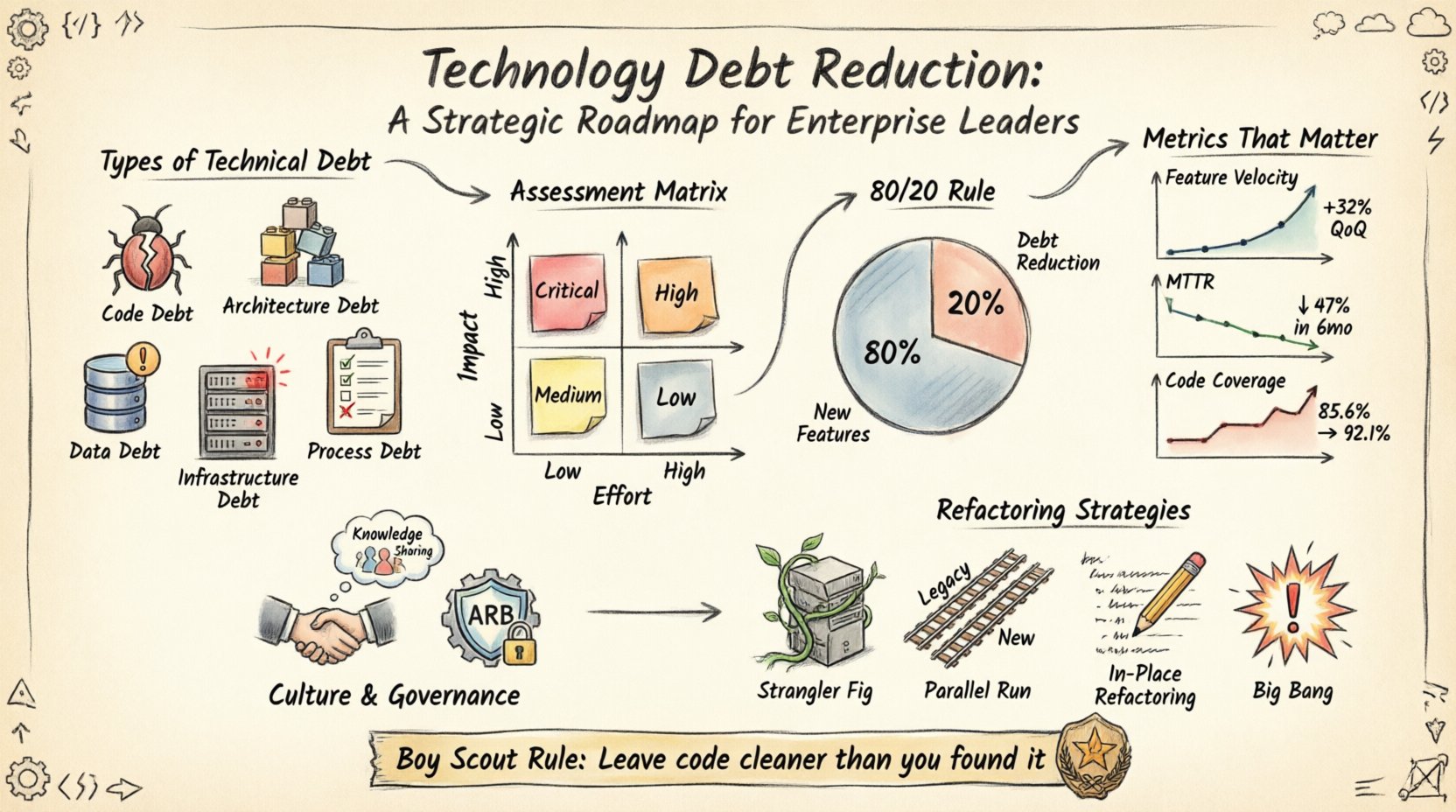
For enterprise leaders, understanding the taxonomy of debt is the first step toward reduction. Debt manifests in several forms:
- Code Debt: Poorly written logic, lack of documentation, or technical shortcuts in the source code.
- Architecture Debt: Structural decisions that limit scalability, such as monolithic designs where microservices are needed, or tight coupling between components.
- Data Debt: Inconsistent data formats, lack of governance, or siloed information that prevents accurate analytics.
- Infrastructure Debt: Outdated hardware, legacy operating systems, or environments that are difficult to automate and secure.
- Process Debt: Manual deployment steps, lack of testing automation, or documentation that is outdated.
Recognizing these distinctions allows leaders to allocate budget and resources appropriately. You cannot fix architecture debt with a code review, just as you cannot solve data debt with infrastructure upgrades. A strategic approach requires a clear diagnosis before treatment.
Assessing the Current Landscape 🔍
Before implementing a reduction strategy, you must quantify the existing debt. Guessing the scope leads to misaligned expectations and failed initiatives. A thorough assessment involves both quantitative metrics and qualitative analysis from engineering teams.
Key Assessment Areas
- System Complexity: Measure the number of dependencies, coupling points, and lines of code per module. High complexity often correlates with higher maintenance costs.
- Defect Rates: Analyze the frequency of bugs and incidents. A spike in defect rates often signals accumulating debt.
- Deployment Frequency: If deployment cycles have slowed significantly despite stable code, debt is likely blocking velocity.
- Security Vulnerabilities: Review patch levels and known vulnerabilities. Legacy systems often lack security updates, posing compliance risks.
- Knowledge Retention: Assess how many team members understand specific systems. If only one person knows how a legacy module works, that is a single point of failure risk.
The Assessment Matrix
Use the following matrix to categorize debt based on impact and urgency. This helps in creating a prioritized list for remediation.
| Priority Level | Impact | Urgency | Recommended Action |
|---|---|---|---|
| Critical | High Risk to Business Continuity | Immediate | Stop new development; allocate 100% resources to remediation. |
| High | Significant Performance or Security Issues | Next Quarter | Schedule dedicated sprints for refactoring within existing projects. |
| Medium | Maintainability Concerns | Quarterly | Address during feature development (Boy Scout Rule). |
| Low | Minor Improvements | Backlog | Include in future innovation budget if resources allow. |
This assessment should not be a one-time event. It requires a recurring cadence to track progress and identify new debt as the system evolves.
Strategic Prioritization Framework 🎯
Reducing technology debt is rarely a full-time job. If you stop all innovation to pay down debt, you lose competitive advantage. Conversely, ignoring debt leads to stagnation. The goal is balance. Leaders must integrate debt reduction into the standard delivery pipeline.
The 80/20 Rule of Delivery
Adopt a model where 80% of capacity is dedicated to new features and value delivery, while 20% is reserved for debt reduction and maintenance. This ensures continuous improvement without stalling the business. Adjust this ratio based on the criticality of the debt identified in the assessment phase.
Financial Valuation of Debt
To secure executive buy-in, translate technical issues into financial terms. Leaders understand risk and cost. Consider the following factors when prioritizing:
- Cost of Delay: How much revenue is lost per day due to system slowness or downtime?
- Maintenance Cost: Compare the cost of supporting the legacy system versus migrating to a modern architecture.
- Opportunity Cost: What new features cannot be built because the current architecture is too rigid?
- Compliance Risk: What are the potential fines or reputational damages if security vulnerabilities are exploited?
By attaching a dollar figure to technical debt, you move the conversation from “IT needs to fix code” to “the business needs to mitigate risk.”
Execution and Governance ⚙️
Once prioritized, execution requires a disciplined approach. This involves defining standards, automating checks, and ensuring governance does not become bureaucracy.
Definition of Done
Update your Definition of Done (DoD) to include debt reduction criteria. Code should not be considered complete until it meets quality standards, includes tests, and passes security scans. This prevents new debt from being created while old debt is being paid down.
Refactoring Strategies
There are different approaches to refactoring legacy systems. Choose the strategy that fits the risk profile of the application.
- Strangler Fig Pattern: Gradually replace functionality of a legacy system by building new services around it. Eventually, the old system is turned off.
- Big Bang Migration: Replace the entire system at once. This is high risk and generally discouraged unless the legacy system is completely obsolete.
- Parallel Run: Run the old and new systems simultaneously for a period. Compare outputs to ensure accuracy before switching traffic.
- In-Place Refactoring: Rewrite code within the existing system. This is best for small modules and requires strong testing coverage.
Automation and CI/CD
Automate the detection of debt. Implement Continuous Integration and Continuous Deployment pipelines that enforce code quality gates. If a pull request increases cyclomatic complexity or reduces test coverage, the build should fail. This shifts quality left, ensuring problems are caught early.
Cultivating a Sustainable Architecture Culture 🌱
Technology debt is often a symptom of cultural issues. If engineers feel pressured to ship at all costs, they will cut corners. Leadership must foster an environment where quality is valued alongside speed.
Empowering Engineering Teams
Give teams ownership over their systems. When engineers feel responsible for the long-term health of their code, they are more likely to invest in maintenance. Avoid top-down mandates that dictate specific technical solutions without context. Instead, provide guardrails and let teams choose the implementation details.
Knowledge Sharing
Combat the “bus factor” where knowledge resides with a single individual. Encourage pair programming, code reviews, and internal technical talks. Documentation should be treated as code and reviewed regularly. When knowledge is shared, the system becomes more resilient and easier to modify.
Stakeholder Communication
Business stakeholders need to understand why technical work takes time. Communicate the trade-offs clearly. If a feature requires two weeks instead of one because of necessary refactoring, explain the long-term benefit: faster delivery in the future and lower risk.
Measuring Progress and ROI 📊
You cannot manage what you do not measure. Establish key performance indicators (KPIs) to track the effectiveness of your debt reduction program. These metrics should be reviewed regularly in leadership meetings.
Technical Metrics
- Code Coverage: Percentage of code covered by automated tests. Aim for growth over time.
- Mean Time to Recovery (MTTR): How quickly the system recovers from failure. Lower is better.
- Defect Density: Number of bugs per thousand lines of code. This should trend downward.
- Deployment Lead Time: Time from code commit to production. Decreasing lead time indicates improved agility.
Business Metrics
- Feature Velocity: Rate at which new features are delivered. It should increase as debt is reduced.
- System Availability: Percentage of time the system is operational.
- Support Costs: Reduction in time spent by support teams on technical issues.
Regularly report these metrics to demonstrate the return on investment. Show stakeholders how technical stability directly correlates with business performance.
The Boy Scout Rule
Adopt the principle of leaving the campground cleaner than you found it. In software, this means every time an engineer touches a file or module, they should fix one small issue, improve a test, or update documentation. This incremental approach prevents debt from accumulating again.
Long-Term Governance and Evolution 🔄
Technology debt reduction is not a project with an end date; it is a continuous discipline. As the business evolves, so do its technical requirements. What is debt today might be the foundation for tomorrow’s innovation.
Architecture Review Boards
Establish a lightweight Architecture Review Board (ARB) to evaluate major design decisions. The goal is not to block progress but to ensure alignment with the enterprise strategy. The ARB should focus on high-level patterns, security implications, and integration points.
Technology Radar
Maintain a technology radar to track the adoption of new tools and the retirement of old ones. Categorize technologies into Adopt, Trial, Assess, and Hold. This keeps the stack modern and prevents the re-accumulation of debt through the adoption of unstable or obsolete technologies.
Continuous Learning
Encourage teams to stay updated on industry trends. Dedicate time for research and experimentation. When teams understand modern patterns and practices, they can apply them to reduce debt proactively.
Final Thoughts on Strategic Resilience 🛡️
Reducing technology debt is about building a resilient enterprise. It requires a shift in mindset from viewing maintenance as a cost center to viewing it as an investment in future capability. By assessing the landscape, prioritizing based on risk and value, and embedding quality into the culture, leaders can steer their organizations through the complexities of modernization.
The path forward is not about perfection. It is about awareness and continuous improvement. With the right roadmap, technical debt becomes a manageable variable rather than an existential threat. Focus on the metrics that matter, empower your teams, and maintain a clear vision of where the architecture needs to go. This strategic discipline ensures that technology remains an enabler of business growth, not a barrier to it.
Related posts:
 Enterprise Architecture Strategy Blueprint for Digital Transformation Success
 EA Guide; Aligning Business Strategy with IT Architecture – A CIO’s Actionable Framework
 Cloud-First Enterprise Architecture: Strategic Planning for Flexibility and Control
 EA Guide: Data Governance Architecture Framework – Ensuring Quality, Security, and Compliance