


Modern business landscapes shift at a velocity that traditional planning cycles cannot match. Markets change, customer expectations evolve, and technological breakthroughs emerge daily. In this environment, static architecture models fail to provide the necessary flexibility. Organizations require a dynamic approach to structure their systems and processes. This guide explores how Agile Enterprise Architecture serves as a critical mechanism for navigating volatility and maintaining competitive advantage.
Enterprise Architecture (EA) has historically been associated with long-term planning, heavy documentation, and rigid governance. While these elements provided stability in the past, they often created bottlenecks when rapid adaptation was needed. The integration of agile principles into architecture functions allows teams to deliver value incrementally while maintaining necessary oversight. This shift is not merely about speed; it is about resilience and alignment.
The Shift from Static to Dynamic Architecture 🔄
Traditional architecture models often followed a waterfall methodology. Architects designed the entire system before development began. This approach assumed that requirements would remain stable throughout the project lifecycle. In reality, requirements rarely remain static. Market disruptions force changes in direction that render upfront designs obsolete before implementation is complete.
Agile Enterprise Architecture addresses this mismatch. It treats architecture as an evolving capability rather than a fixed destination. The focus moves from creating comprehensive blueprints to facilitating decision-making. Architects act as enablers who provide guardrails and context, rather than gatekeepers who block progress.
Key aspects of this shift include:
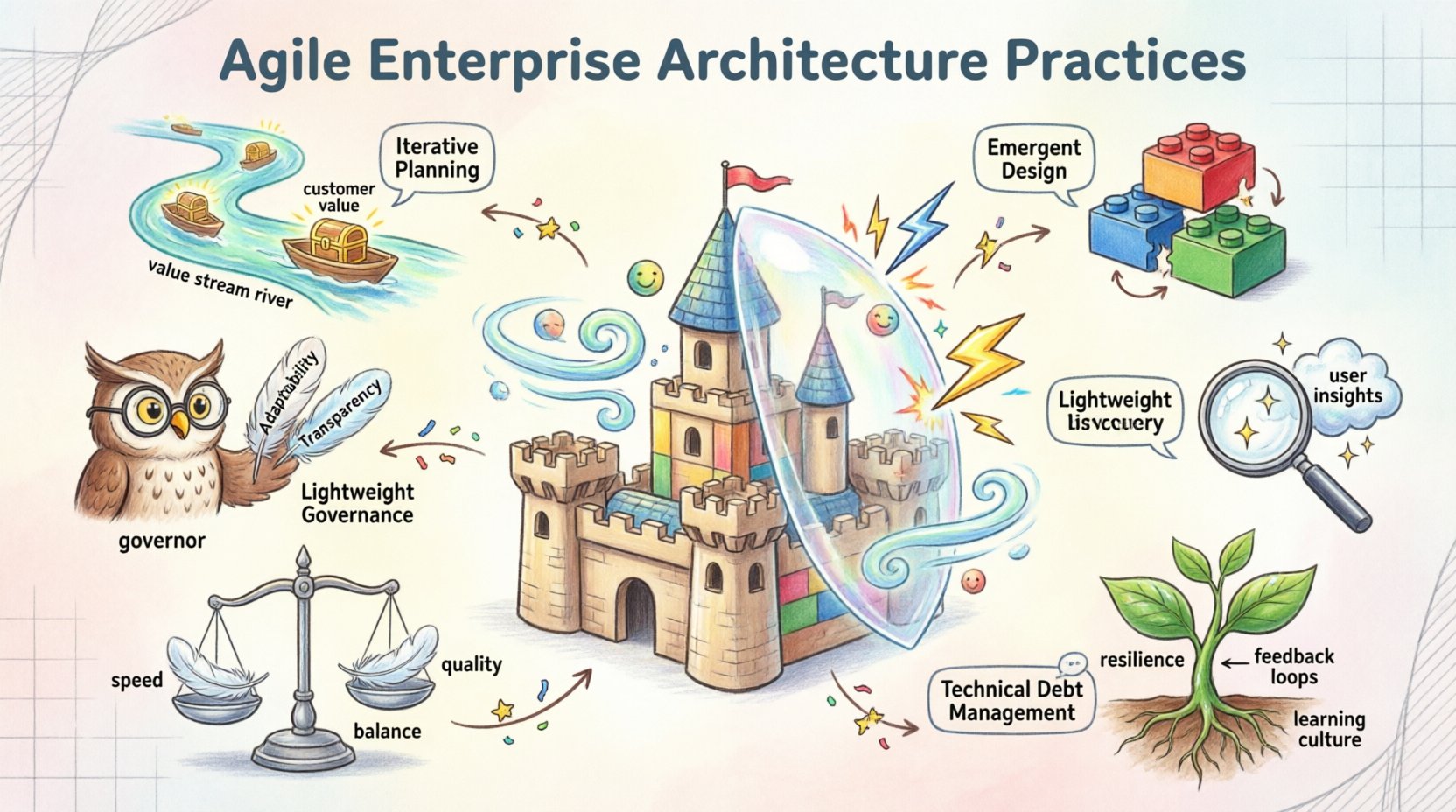
- Iterative Planning: Architectural decisions are made in small increments, allowing for feedback loops.
- Emergent Design: Structures evolve based on actual usage patterns and business needs.
- Collaborative Governance: Stakeholders participate in shaping the direction rather than receiving top-down mandates.
- Value-Driven Focus: Every architectural activity is tied directly to business outcomes.
This transition requires a change in mindset. It demands that architects accept a certain level of uncertainty. It requires trust in the development teams to make tactical decisions within strategic boundaries. The result is a system that can pivot quickly when external pressures mount.
Core Pillars of Agile Enterprise Architecture 🏛️
To effectively respond to market disruption, an organization must build upon specific foundational pillars. These principles guide how architectural work is prioritized, executed, and reviewed. Without these pillars, the effort often devolves into chaos or remains stuck in old patterns.
1. Value Stream Alignment
Architecture must serve the flow of value to the customer. This means understanding the end-to-end journey and identifying where technology supports or hinders that journey. Architects map capabilities to specific business outcomes. When a disruption occurs, the impact on the value stream is the first metric evaluated.
2. Modularity and Decoupling
Systems must be built to change. Monolithic structures resist modification and introduce high risk during updates. Agile EA promotes modular designs where components can be updated, replaced, or scaled independently. This reduces the blast radius of changes and allows specific areas of the business to innovate without affecting the whole.
3. Lightweight Governance
Heavy approval processes slow down delivery. Agile governance focuses on key decision points rather than every line of code. It establishes principles that guide behavior and checks for compliance at milestones rather than continuously. This ensures safety without sacrificing speed.
4. Continuous Discovery
Requirements are not known at the start. Continuous discovery involves constant engagement with users and market signals. Architects participate in these discovery activities to ensure technical feasibility aligns with emerging needs.
Strategic Alignment & Value Streams 🎯
One of the primary challenges in Enterprise Architecture is ensuring that technical investments match business strategy. In volatile markets, strategy itself changes frequently. Therefore, the alignment mechanism must be fluid.
Organizations should map their architectural capabilities to their strategic value streams. This creates a direct line of sight between what the architecture team builds and what the business sells. When market conditions shift, the value streams that require the most attention become the priority for architectural support.
Consider the following comparison between traditional and agile alignment methods:
| Aspect | Traditional EA | Agile EA |
|---|---|---|
| Planning Horizon | Multi-year roadmap | Quarterly or release-based |
| Strategy Link | Annual strategy review | Continuous alignment workshops |
| Execution | Project-based delivery | Value stream delivery |
| Change Management | Formal change request board | Integrated feedback loops |
This table highlights that Agile EA is not about abandoning planning. It is about adjusting the frequency and granularity of planning to match the speed of the market. By focusing on value streams, architects ensure that resources are allocated to the areas of highest potential return.
Governance in an Agile Environment ⚖️
Governance often gets a negative reputation in agile circles. It is seen as a bureaucratic hurdle. However, governance is essential for managing risk and ensuring consistency. The goal is to transform governance from a policing function to an enabling one.
In an agile context, governance happens at the right level of abstraction. It does not micromanage individual tasks. Instead, it sets boundaries and expectations. This approach allows teams to operate autonomously while staying within safe operational limits.
Effective governance practices include:
- Architecture Runway: Providing just enough architectural foundation to support upcoming features without over-designing.
- Decision Records: Documenting key decisions and their rationale to maintain context for future teams.
- Automated Compliance: Using tooling to enforce standards automatically where possible, reducing manual review.
- Community of Practice: Creating forums where architects share knowledge and resolve cross-cutting concerns collaboratively.
When governance is automated and lightweight, it becomes invisible to the daily work. It ensures that security, scalability, and maintainability are built-in rather than tested-in later. This reduces the technical debt that accumulates when speed is prioritized over quality.
Managing Technical Debt & Complexity 🛠️
Speed often leads to technical debt. In the context of market disruption, the temptation to cut corners to meet immediate deadlines is high. However, unchecked debt erodes the ability to respond to future changes. Agile Enterprise Architecture must actively manage this balance.
Technical debt should be treated as a financial liability. It incurs interest in the form of reduced velocity and increased risk. Architectural practices must include regular assessments of this debt. Teams should allocate capacity to pay down debt just as they do for new features.
Strategies for managing complexity include:
- Domain-Driven Design: Aligning software structure with business domains to reduce cognitive load.
- API-First Strategies: Defining interfaces before implementation to ensure loose coupling.
- Standardization: Reducing the number of technology choices to simplify maintenance and training.
- Refactoring Sprints: Dedicating specific timeframes to improve code quality without adding new functionality.
By acknowledging technical debt as a cost of doing business, organizations can budget for its management. This prevents the situation where a system becomes too brittle to change, effectively locking the business into legacy capabilities.
Common Implementation Challenges ⚠️
Transitioning to Agile Enterprise Architecture is not without obstacles. Organizations often face resistance from established processes and cultural norms. Understanding these challenges is the first step in overcoming them.
Resistance to Change: Many architects are trained in waterfall methodologies. They may view agile practices as lacking rigor. Training and coaching are necessary to help them understand the value of iterative design.
Measurement Difficulties: Agile metrics can differ from traditional project management metrics. It can be difficult to prove the value of architectural work when it is not directly tied to feature delivery. Leading indicators of health are needed to demonstrate progress.
Tooling Gaps: Existing tools may not support collaborative, iterative work. Organizations may need to adapt their tooling to support transparency and real-time updates.
Cultural Silos: Architecture teams often sit apart from development. Breaking down these silos requires structural changes, such as embedding architects within product teams.
Addressing these challenges requires patience and leadership support. It is a cultural transformation as much as a technical one. Success depends on the willingness of the organization to experiment and learn from failures.
Measuring Architectural Maturity 📊
To ensure the approach is working, organizations need clear metrics. These metrics should reflect the ability to respond to change rather than just the volume of work completed.
Key performance indicators for Agile Enterprise Architecture include:
- Lead Time for Changes: The time it takes to move a change from code commit to production. Shorter times indicate better architectural support.
- Change Failure Rate: The percentage of changes that cause incidents or require rollback. This measures the quality and stability of the architecture.
- Business Value Delivered: The correlation between architectural investments and business outcomes.
- Technical Debt Ratio: The proportion of effort spent on debt reduction versus new feature development.
- Architectural Coverage: The percentage of critical business capabilities that have defined architectural patterns.
These metrics provide a data-driven view of the architecture function. They help stakeholders understand the trade-offs between speed and stability. Over time, trends in these metrics indicate whether the organization is becoming more resilient or more fragile.
Building Resilience Through Architecture 🛡️
Ultimately, the goal of Agile Enterprise Architecture is resilience. Market disruptions will continue to occur. Organizations that can adapt quickly will survive and thrive. Those that cannot will struggle.
Resilience comes from the ability to maintain core functions while changing peripheral ones. It requires a system design that isolates failures and allows for rapid recovery. It also requires a culture that values learning over blame.
Architects play a pivotal role in building this resilience. They design the systems that absorb shocks. They define the processes that allow for quick pivots. They ensure that the organization does not rely on a single point of failure.
By adopting these practices, organizations move from a state of reactive defense to proactive adaptation. They stop waiting for the next disruption to hit and start building the capacity to handle it as it arrives. This is the essence of modern enterprise architecture in a volatile world.
Related posts:
 Enterprise Architecture Strategy Blueprint for Digital Transformation Success
 EA Guide; Aligning Business Strategy with IT Architecture – A CIO’s Actionable Framework
 Cloud-First Enterprise Architecture: Strategic Planning for Flexibility and Control
 EA Guide: Data Governance Architecture Framework – Ensuring Quality, Security, and Compliance