


In the modern enterprise landscape, the tension between agility and control is constant. Business leaders demand rapid deployment of capabilities to capture market opportunities, while risk and compliance teams insist on rigorous oversight to protect assets and reputation. This dynamic creates a complex environment for Enterprise Architecture (EA) teams. The goal is not to choose one over the other, but to harmonize them.
Effective architecture governance is the mechanism that allows organizations to move fast while maintaining stability. It is about creating a framework where decisions are made efficiently, standards are adhered to without unnecessary friction, and innovation is encouraged within safe boundaries. This guide explores how to build a governance model that supports velocity rather than hindering it.
🤔 Understanding the Governance Paradox
Many organizations view architecture governance as a gatekeeping function. The perception is often that the architecture team sits at the door, holding a clipboard, ready to reject proposals. This mindset creates friction and slows down delivery. However, true governance is about enabling decision-making, not stopping it.
The paradox lies in the need for structure in an environment that values flexibility. Without standards, technical debt accumulates, and systems become fragmented. Without speed, the business loses competitive advantage. The solution is a governance model that is lightweight, automated, and integrated into the development lifecycle.
Key Drivers of the Tension
- Market Velocity: Competitors can launch features in weeks. Traditional approval cycles of months are unsustainable.
- Technical Complexity: Modern systems involve microservices, cloud infrastructure, and third-party integrations, increasing the surface area for risk.
- Regulatory Compliance: Data privacy laws and industry regulations require strict adherence that cannot be compromised.
- Cost Optimization: Shadow IT and redundant systems drive up costs. Governance ensures visibility into spending.
🛠️ Principles of Modern Governance
To enable speed, the governance model must shift from a “police” approach to a “partner” approach. The following principles form the foundation of a balanced architecture governance framework.
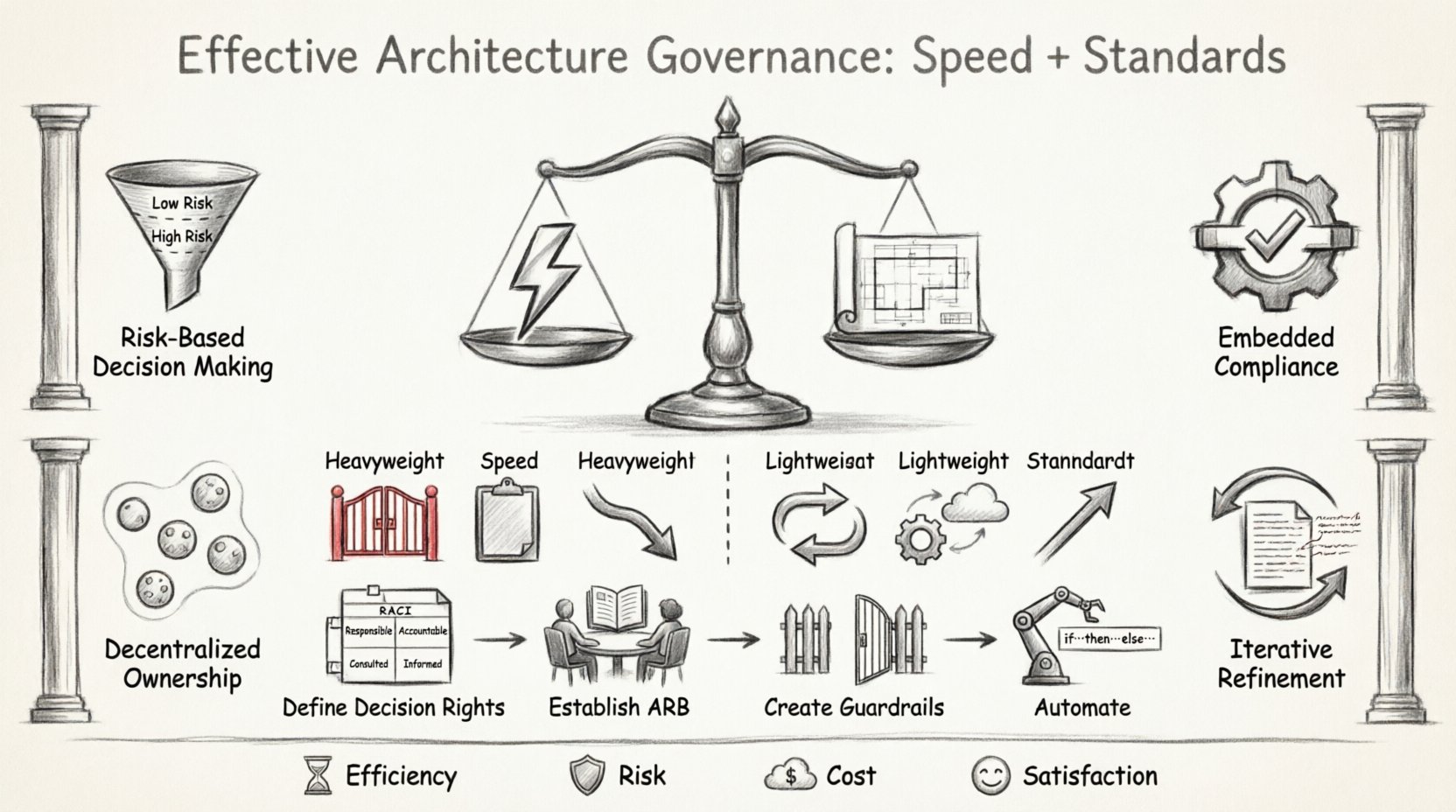
1. Risk-Based Decision Making
Not all decisions carry the same weight. A governance model should categorize decisions based on risk and impact. Low-risk changes should require minimal oversight, while high-risk changes undergo rigorous review. This ensures that architectural review capacity is focused where it matters most.
2. Embedded Compliance
Standards should be baked into the development pipeline, not reviewed after the fact. If a security policy requires encryption, the tooling should enforce this automatically. When compliance is automated, teams spend less time on manual checks and more time on value creation.
3. Decentralized Ownership
Centralized control creates bottlenecks. Empowering domain teams to own their architectural decisions, within defined guardrails, increases ownership and accountability. Architecture teams act as advisors and enablers rather than approvers.
4. Iterative Refinement
Standards should evolve. If a technology standard is consistently bypassed because it is obsolete or impractical, the standard must be updated. Governance is a living process, not a static set of rules.
📊 Framework Comparison: Heavyweight vs. Lightweight
Selecting the right level of rigor is critical. Below is a comparison of governance approaches to help determine the best fit for your organizational context.
| Feature | Heavyweight (Traditional) | Lightweight (Agile) |
|---|---|---|
| Approval Process | Gate-based, sequential | Continuous, automated |
| Decision Authority | Central Architecture Board | Distributed to Domain Teams |
| Review Frequency | Monthly or Quarterly | Per Sprint or Deployment |
| Focus | Compliance and Documentation | Value Delivery and Risk Mitigation |
| Impact on Speed | High Friction | Low Friction |
Most modern enterprises are transitioning toward the lightweight model. However, hybrid models exist. For example, strategic initiatives might require heavyweight review, while tactical feature development follows lightweight protocols.
🚀 Implementing the Governance Layer
Implementing governance requires a structured approach. It involves defining processes, establishing roles, and utilizing the right mechanisms to enforce standards. Here is a step-by-step breakdown of the implementation lifecycle.
1. Define Decision Rights
Clarity on who decides what is the first step. Create a RACI matrix (Responsible, Accountable, Consulted, Informed) for architectural decisions.
- Strategic Decisions: Cloud strategy, core platform selection. (Accountable: Chief Architect)
- Tactical Decisions: API design patterns, technology selection for a service. (Accountable: Solution Architect)
- Operational Decisions: Infrastructure configuration, coding standards. (Accountable: Development Lead)
2. Establish Architecture Review Boards (ARB)
While decentralization is key, a central body is still necessary for cross-cutting concerns. The ARB should not be a bottleneck.
- Frequency: Hold meetings frequently but keep them short. Focus on high-impact decisions only.
- Preparation: Require decision packages to be submitted 48 hours in advance. This prevents long discussions during the meeting.
- Outcome: Decisions should be documented in a central repository for future reference.
3. Create Guardrails, Not Walls
Guardrails define the boundaries of safe operation. They are clear and non-negotiable, but they allow freedom within the boundary.
- Security: No data stored unencrypted. Authentication is mandatory.
- Interoperability: All services must expose standard APIs.
- Observability: Logging and monitoring are required for all production services.
4. Automate Where Possible
Human review is expensive and slow. Automate the checks that can be codified.
- Infrastructure as Code: Use policies to prevent non-compliant infrastructure provisioning.
- Code Scanning: Integrate static analysis tools to check for security vulnerabilities and code smells.
- Dependency Checks: Automatically flag outdated or vulnerable libraries in the build pipeline.
📈 Metrics & KPIs for Governance Success
How do you know if your governance model is working? You need to measure outcomes, not just activity. Tracking the right metrics ensures that governance is adding value.
| Category | Metric | Target |
|---|---|---|
| Efficiency | Time from Request to Approval | Decrease by 50% YoY |
| Adoption | % of Projects Using Standard Patterns | >90% |
| Risk | Number of Critical Vulnerabilities in Prod | Zero |
| Cost | Cloud Resource Waste | Reduce by 20% |
| Satisfaction | Developer Feedback Score | >4/5 |
It is important to review these metrics regularly. If the time to approval increases, the process is too heavy. If vulnerability counts rise, the guardrails are too loose.
🛑 Common Pitfalls to Avoid
Even with the best intentions, governance initiatives can fail. Understanding common failure modes helps you navigate them.
1. Over-Engineering
Creating standards for every possible scenario leads to bureaucracy. Standards should cover the 80% of use cases that matter most. The remaining 20% can be handled on a case-by-case basis.
2. Lack of Executive Support
Governance requires authority. If leadership does not back the architecture team, teams will bypass the process. Ensure that C-level sponsors understand the value of governance in risk reduction.
3. Ignoring the Developer Experience
If the governance process is difficult to use, developers will find workarounds. The goal is to make the “right” way the “easy” way. Provide templates, boilerplates, and self-service tools.
4. Static Documentation
Documentation that is outdated is worse than no documentation. Maintain a living architecture repository that is updated with every significant change.
5. Focusing on Compliance Only
Compliance is the baseline, not the ceiling. Governance should focus on business value, not just ticking boxes. Ask how architecture decisions drive revenue or reduce cost.
🔄 Cultural Shift: From Compliance to Enablement
The most significant hurdle in governance is cultural. Moving from a control mindset to an enablement mindset requires change management.
Communication Strategy
- Transparency: Share the “why” behind every standard. Explain the risk that is being mitigated.
- Feedback Loops: Create channels for developers to report friction. Listen and adapt.
- Recognition: Celebrate teams that adhere to standards and achieve high quality.
Training and Upskilling
Teams often lack the skills to build compliant solutions. Architecture teams should invest in training.
- Workshops on secure coding practices.
- Guides on cloud cost optimization.
- Session on how to use the self-service tools.
🌐 The Future of Architecture Governance
The landscape of enterprise architecture is evolving. Emerging trends will shape how governance is practiced in the coming years.
AI-Driven Governance
Artificial intelligence can analyze code and architecture to suggest improvements or detect deviations. AI can predict potential bottlenecks before they occur.
Platform Engineering
Internal developer platforms provide standardized environments. Governance becomes a feature of the platform itself, invisible to the developer but enforced by the infrastructure.
Decentralized Identity
As identity management becomes more complex, governance must account for access control across hybrid and multi-cloud environments. Standards for identity will become a critical governance pillar.
🔍 Deep Dive: The Role of the Enterprise Architect
The Enterprise Architect plays a pivotal role in this ecosystem. They are the bridge between business strategy and technical execution.
- Strategic Alignment: Ensure technology investments align with business goals.
- Portfolio Management: Manage the lifecycle of applications, retiring legacy systems and integrating new ones.
- Knowledge Management: Maintain the single source of truth for the organization’s technology landscape.
- Stakeholder Management: Communicate technical constraints and opportunities to non-technical leaders.
This role requires a balance of technical depth and business acumen. The architect must understand the code, but also the P&L.
🛡️ Security and Governance Integration
Security cannot be an afterthought. It must be integrated into the governance fabric. This is often referred to as DevSecOps.
- Threat Modeling: Conduct threat modeling during the design phase.
- Vulnerability Management: Establish a process for patching and updating systems.
- Access Control: Implement the principle of least privilege across all systems.
- Data Classification: Ensure data is categorized and protected according to sensitivity.
By integrating security into the governance model, you reduce the risk of breaches without slowing down development.
🎯 Actionable Steps for Your Organization
Ready to improve your governance? Here is a checklist to get started.
- Audit Current State: Map out existing processes and identify bottlenecks.
- Define Standards: Create a concise list of non-negotiable standards.
- Build Tools: Invest in automation for compliance checks.
- Train Teams: Educate developers on the new standards and tools.
- Measure: Establish KPIs and review them monthly.
- Iterate: Adjust the model based on feedback and metrics.
Governance is a journey, not a destination. It requires continuous attention and adaptation. By focusing on enabling speed while maintaining standards, organizations can achieve sustainable growth and resilience.
Related posts:
 Enterprise Architecture Strategy Blueprint for Digital Transformation Success
 EA Guide; Aligning Business Strategy with IT Architecture – A CIO’s Actionable Framework
 Cloud-First Enterprise Architecture: Strategic Planning for Flexibility and Control
 EA Guide: Data Governance Architecture Framework – Ensuring Quality, Security, and Compliance