


In the modern digital landscape, organizations often accumulate a complex web of technology assets over time. This accumulation, while necessary for growth, frequently leads to redundancy, increased maintenance costs, and strategic misalignment. IT Portfolio Rationalization offers a structured path to simplify this complexity. When guided by Enterprise Architecture (EA), this process transforms from a simple cost-cutting exercise into a strategic lever for business agility.
This guide explores the discipline of rationalizing technology investments through the lens of EA. We will examine the frameworks, decision criteria, and governance models required to align IT capabilities with business objectives effectively.
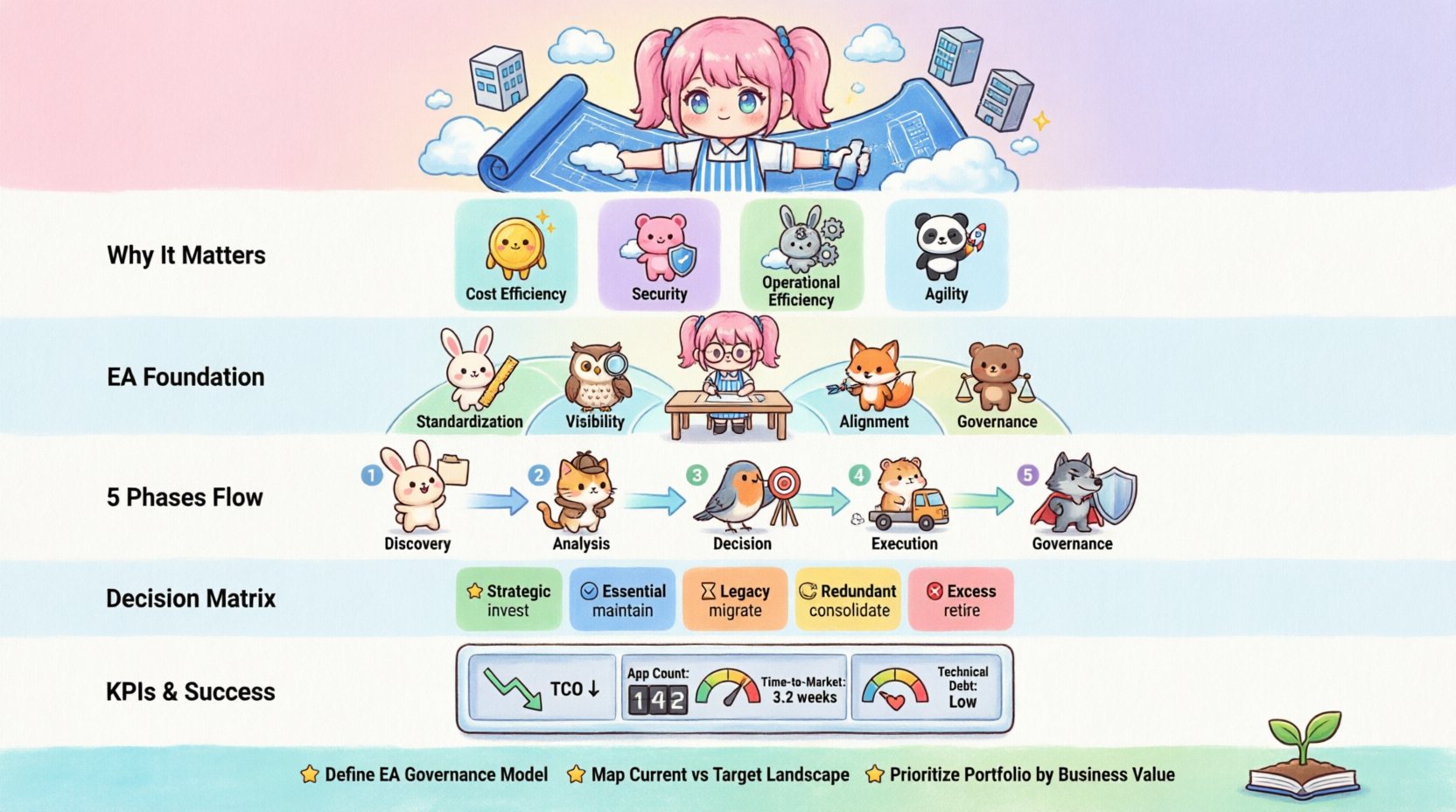
Why Portfolio Rationalization Matters 💡
Without a disciplined approach, IT environments tend to suffer from entropy. New applications are added to meet immediate needs, often without retiring legacy systems. Over years, this creates a bloated portfolio that is difficult to manage.
Key drivers for initiating a rationalization program include:
- Cost Efficiency: Reducing license fees, maintenance contracts, and infrastructure overhead.
- Security Posture: Minimizing the attack surface by retiring unsupported or vulnerable systems.
- Operational Efficiency: Streamlining processes by removing duplicate data flows and manual workarounds.
- Agility: Enabling faster time-to-market by simplifying the underlying technology stack.
Rationalization is not merely about deletion. It is about making informed decisions regarding the lifespan, function, and value of every technology asset in the organization.
The Enterprise Architecture Foundation 📐
Enterprise Architecture provides the necessary context for rationalization. It acts as the blueprint, ensuring that decisions made today support long-term strategic goals rather than solving only immediate problems.
EA disciplines bring order to the process through several key mechanisms:
- Standardization: Defining preferred technology standards and patterns.
- Visibility: Creating a complete inventory of applications, data, and infrastructure.
- Alignment: Mapping IT capabilities directly to business processes and outcomes.
- Governance: Establishing rules for how new investments are approved and existing ones are maintained.
By leveraging EA, organizations move away from siloed decision-making. Instead of individual departments purchasing software without oversight, a holistic view ensures that new acquisitions integrate smoothly with the existing ecosystem.
Phases of Rationalization ⚙️
Effective rationalization follows a structured lifecycle. Rushing this process often leads to critical business disruptions. The following phases outline a robust approach.
1. Discovery and Inventory 📋
The first step is establishing a single source of truth. You cannot optimize what you cannot measure. This phase involves gathering data on all current assets.
- Application Inventory: List every application in use, including line-of-business tools, infrastructure software, and SaaS subscriptions.
- Dependency Mapping: Understand how applications interact. Which systems feed data into others?
- Cost Attribution: Capture both direct costs (licenses) and indirect costs (support, maintenance, infrastructure).
- Business Value Assessment: Identify which business processes rely on each asset.
2. Analysis and Assessment 🧐
Once the inventory is established, each asset must be evaluated against specific criteria. This is where the EA discipline shines, applying consistent metrics across the entire portfolio.
Common assessment dimensions include:
- Business Criticality: How essential is this application to daily operations?
- Technical Health: Is the technology supported? Is it built on outdated frameworks?
- Functional Fit: Does the application still meet current business requirements?
- Redundancy: Is there another application performing the same function?
3. Decision Making 🎯
Based on the analysis, a decision must be made for each asset. This is often categorized into a set of standard actions. The goal is to reduce the total number of active assets while maintaining or improving capability.
4. Execution and Migration 🚀
Decisions must be translated into action plans. This involves coordinating with business stakeholders to ensure minimal disruption during the transition.
- Retirement Planning: Scheduling decommissioning dates.
- Migration Strategies: Moving data and users to consolidated platforms.
- Communication: Informing users of changes well in advance.
5. Continuous Governance 🛡️
Rationalization is not a one-time event. It requires ongoing governance to prevent the accumulation of new technical debt. Enterprise Architecture provides the framework for continuous monitoring.
This includes:
- Architecture Review Boards: Committees that review new investment proposals.
- Regular Audits: Periodic checks to ensure the portfolio matches the inventory.
- Policy Enforcement: Ensuring new tools adhere to established standards.
Decision Criteria Matrix 📊
To facilitate objective decision-making, organizations often use a matrix to categorize assets. The following table outlines a common framework for categorizing IT portfolio items.
| Category | Definition | Recommended Action |
|---|---|---|
| Strategic | Core capabilities that provide competitive advantage. | Invest, Innovate, Modernize |
| Essential | Operational necessities required for business continuity. | Maintain, Optimize |
| Legacy | Outdated systems with high maintenance costs. | Migrate or Retire |
| Redundant | Systems performing duplicate functions. | Consolidate or Retire |
| Excess | Unused or low-utilization assets. | Retire Immediately |
Using this matrix helps stakeholders visualize the portfolio composition. It shifts the conversation from emotional attachment to specific systems toward data-driven decisions.
Managing Technical Debt 🏗️
Technical debt is a significant factor in portfolio rationalization. It represents the implied cost of additional rework caused by choosing an easy solution now instead of a better approach that would take longer.
EA disciplines help quantify technical debt by analyzing:
- Code Complexity: Is the underlying code maintainable?
- Integration Fragility: How many custom interfaces are required to make this work?
- Vendor Support: Is the vendor still investing in the product?
- Skill Availability: Can the organization find staff with the necessary skills to maintain this technology?
Addressing technical debt during rationalization reduces the risk of future failures. It is important to distinguish between debt that is strategic (a known trade-off for speed) and debt that is accidental (poor design decisions that must be corrected).
Stakeholder Engagement and Change Management 👥
Technical decisions are often the easy part. The human element of rationalization can be challenging. Departments may resist giving up applications they rely on, fearing loss of functionality or control.
Successful programs address these concerns through:
- Early Involvement: Engage department heads during the discovery phase.
- Value Propositions: Clearly articulate the benefits of consolidation, such as better support or faster features.
- Training and Support: Ensure users are trained on new or consolidated platforms.
- Feedback Loops: Create channels for users to report issues during the transition.
Transparency is key. When stakeholders understand the rationale behind retirement decisions, resistance decreases. It helps to show the data regarding cost savings and efficiency gains that will be reinvested into innovation.
Measuring Success and KPIs 📈
To validate the effectiveness of the rationalization program, specific Key Performance Indicators (KPIs) should be tracked. These metrics provide objective evidence of progress.
- Total Cost of Ownership (TCO): Track the reduction in annual IT spend over time.
- Application Count: Monitor the reduction in the total number of active applications.
- System Availability: Ensure that reliability does not degrade during consolidation.
- Time to Market: Measure how quickly new features can be deployed post-rationalization.
- Technical Debt Ratio: Track the percentage of resources spent on maintenance versus development.
Regular reporting on these KPIs keeps the program on track and demonstrates value to executive leadership.
Common Pitfalls to Avoid ⚠️
Even with a solid plan, rationalization programs can stumble. Awareness of common pitfalls allows teams to mitigate risks proactively.
1. Cutting Without Strategy
Removing applications solely to save money can damage business operations. Every cut must be justified by a replacement or a process improvement. Never retire a critical system without a validated migration path.
2. Ignoring Data Sovereignty
When consolidating systems, data must be moved securely and legally. Compliance requirements regarding data residency and privacy must be respected throughout the process.
3. Lack of Executive Sponsorship
Without high-level support, conflicting departmental interests can stall progress. Executive sponsorship ensures that rationalization remains a priority over short-term operational demands.
4. Overlooking Cloud Dependencies
Modern portfolios often include cloud-native services. Rationalization must account for the complexities of cloud integration, API management, and subscription models.
Future-Proofing the Portfolio 🔮
The landscape of technology continues to evolve rapidly. A rationalized portfolio today may become obsolete tomorrow. Enterprise Architecture ensures that the portfolio remains adaptable.
Strategies for future-proofing include:
- Modular Design: Prefer systems that can be updated or replaced independently.
- API-First Approach: Ensure systems communicate via standardized interfaces.
- Cloud Readiness: Evaluate applications for their ability to move to cloud environments.
- Automation: Use automation tools for routine maintenance and monitoring.
By building flexibility into the architecture, organizations reduce the frequency and cost of future rationalization efforts.
Integrating with Digital Transformation 🌐
Rationalization is often a prerequisite for successful digital transformation. A cluttered, complex IT environment hinders the ability to adopt new digital capabilities like AI, analytics, or mobile platforms.
By cleaning the foundation, organizations create the bandwidth necessary to experiment and innovate. Rationalization frees up resources—both financial and human—that can be redirected toward strategic initiatives.
Consider the portfolio as a garden. You must clear the weeds and prune the overgrown branches to allow the new plants to thrive. Enterprise Architecture provides the tools for this pruning process, ensuring that the garden grows in the right direction.
Summary of Best Practices ✅
To summarize, successful IT Portfolio Rationalization relies on a disciplined approach grounded in Enterprise Architecture.
- Start with Data: Ensure you have accurate inventory and cost data.
- Align with Strategy: Every decision should support business goals.
- Use Standard Criteria: Apply consistent metrics for evaluation.
- Engage Stakeholders: Involve business units in the decision-making process.
- Monitor Continuously: Treat rationalization as an ongoing cycle, not a project.
Implementing these practices leads to a leaner, more responsive, and cost-effective IT organization. It transforms technology from a burden into a strategic asset that drives business value.
Conclusion: A Sustainable Path Forward 🌱
The journey toward a rationalized IT portfolio is complex but necessary. It requires patience, data, and strong governance. By adhering to Enterprise Architecture principles, organizations can navigate this complexity with confidence.
The result is an IT environment that is easier to manage, cheaper to operate, and better aligned with the needs of the business. This alignment is the foundation for sustainable growth and long-term resilience in a competitive market.
Focus on the discipline of architecture, and the rationalization will follow naturally. The goal is not just to cut costs, but to build a technology foundation that supports the future.
Related posts:
 Enterprise Architecture Strategy Blueprint for Digital Transformation Success
 EA Guide; Aligning Business Strategy with IT Architecture – A CIO’s Actionable Framework
 Cloud-First Enterprise Architecture: Strategic Planning for Flexibility and Control
 EA Guide: Data Governance Architecture Framework – Ensuring Quality, Security, and Compliance