


Enterprise architecture often sits in the shadows of the broader organizational narrative, perceived by many stakeholders as a technical abstraction rather than a strategic necessity. For the modern Chief Information Officer, the challenge is no longer just about maintaining uptime or managing infrastructure. It is about weaving the fabric of technology directly into the core of business strategy. When business goals and IT capabilities drift apart, organizations face inefficiency, wasted capital, and missed market opportunities.
This guide provides a structured approach to bridging that gap. It moves beyond theoretical models to offer a practical framework for leaders who must ensure their technology investments drive tangible value. We will explore how to translate high-level objectives into architectural requirements, establish governance that supports agility, and foster a culture where business and IT speak the same language.
Why Alignment Matters: The Strategic Imperative 🚀
The disconnect between business planning and technical execution is a persistent issue in large organizations. Marketing teams launch campaigns before the backend systems are ready for the traffic spike. Operations teams adopt new processes that legacy databases cannot support. These scenarios are not merely operational hiccups; they are symptoms of misalignment.
When IT architecture is not aligned with business strategy, several critical risks emerge:
- Capital Inefficiency: Investments are made in capabilities that do not support current or future business goals.
- Time-to-Market Delays: New initiatives stall because the underlying technical foundation requires significant refactoring.
- Security Vulnerabilities: Rapid changes without architectural oversight can introduce compliance gaps and data risks.
- Employee Frustration: Users are forced to work around broken processes rather than having tools that enable their work.
Conversely, a well-aligned architecture acts as an accelerator. It allows the organization to pivot quickly when market conditions change. It ensures that data flows seamlessly between departments, providing a single source of truth for decision-making. The CIO’s role evolves from a service provider to a strategic architect who designs the environment in which the business operates.
The Three Pillars of Business-IT Alignment 🧱
Achieving alignment requires attention to three distinct but interconnected areas: People, Process, and Technology. Ignoring any one of these pillars will cause the structure to wobble.
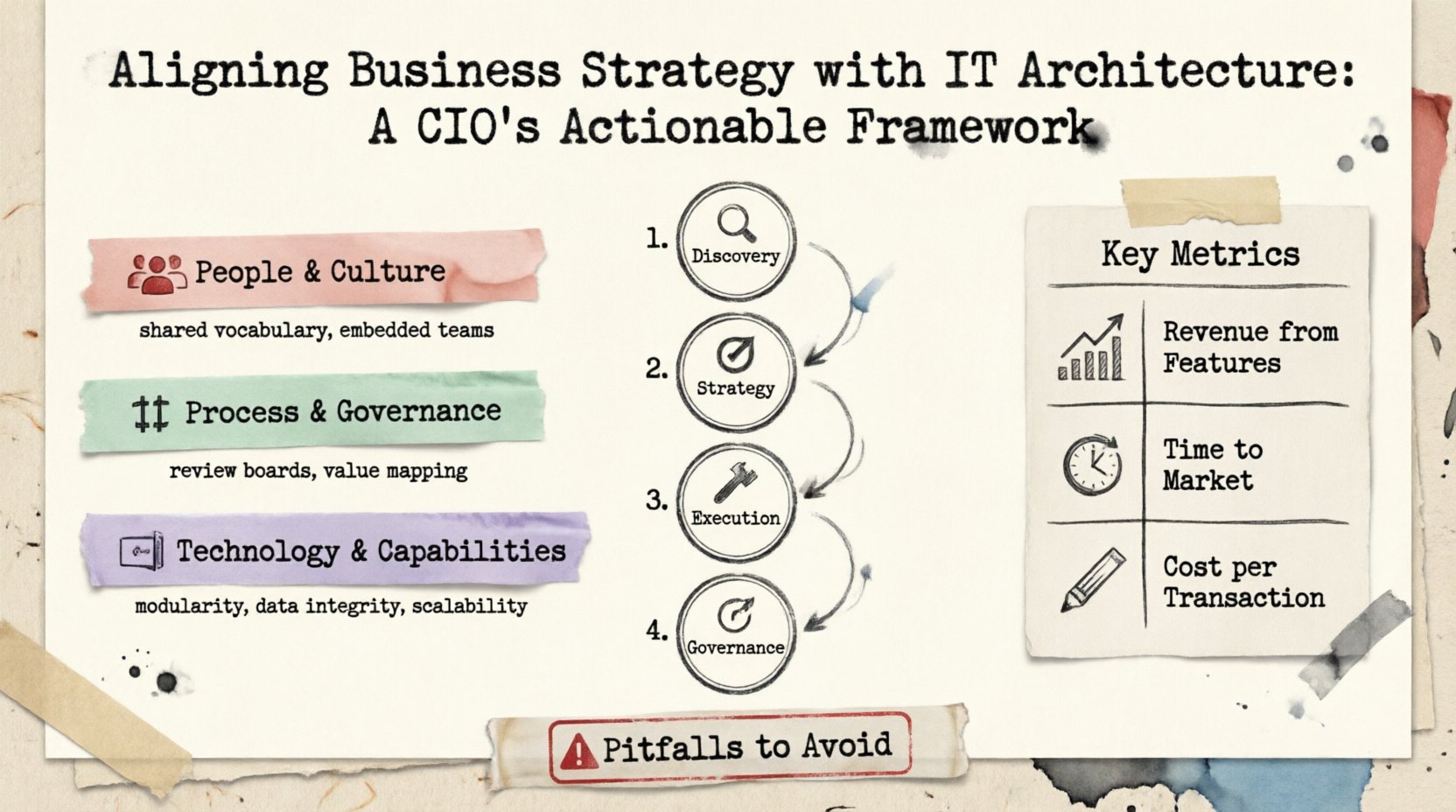
1. People and Culture 👥
Technology is built and maintained by people. If the organizational culture does not support collaboration, alignment will fail. This involves breaking down silos between business units and IT departments. It requires establishing shared goals and incentives.
- Shared Vocabulary: Business leaders and technical staff often use different terminology. A glossary of terms that defines capabilities, constraints, and goals helps bridge this gap.
- Embedding Teams: Consider placing technical architects within business units. This proximity fosters understanding and allows for real-time feedback.
- Leadership Alignment: The CIO and the CEO must agree on the vision. If the business strategy changes, the IT strategy must be ready to adapt immediately.
2. Process and Governance ⚖️
Processes dictate how decisions are made. Without a governance framework, technology decisions become ad-hoc and fragmented. A robust governance model ensures that every investment is evaluated against strategic objectives.
- Architecture Review Boards: Regular meetings to review major projects and ensure they adhere to the enterprise standards.
- Change Management: Formalizing how changes are proposed, reviewed, and implemented to minimize disruption.
- Value Stream Mapping: Analyzing the flow of value from customer request to delivery to identify where technology can optimize the journey.
3. Technology and Capabilities 🖥️
The tangible layer of alignment involves the actual systems and data structures. This is where abstract strategy meets concrete code and infrastructure.
- Modularity: Systems should be built in reusable components to allow for faster integration of new business functions.
- Data Integrity: Ensuring data is accurate, accessible, and secure across the enterprise.
- Scalability: Infrastructure must be able to grow with demand without requiring a complete rebuild.
The Alignment Framework: A Step-by-Step Guide 🗺️
To move from concept to execution, leaders can follow a phased framework. This approach ensures that alignment is not a one-time event but a continuous cycle of planning, execution, and review.
Phase 1: Discovery and Assessment 🔍
Before building a new strategy, you must understand the current state. This phase involves auditing existing capabilities and comparing them against business needs.
- Business Capability Mapping: List the key capabilities the business needs to succeed (e.g., customer onboarding, supply chain logistics).
- IT Inventory Analysis: Catalog all applications, data stores, and infrastructure components currently in use.
- Gap Analysis: Identify where the current IT state fails to support the required business capabilities.
- Stakeholder Interviews: Speak with department heads to understand their pain points and future requirements.
Phase 2: Strategy Formulation 🎯
Once gaps are identified, the next step is to define the target state. This involves creating a roadmap that links business outcomes to technical enablers.
- Define the Target Architecture: Describe what the ideal environment looks like in three to five years.
- Prioritize Initiatives: Not all gaps can be fixed at once. Rank projects based on business value and technical feasibility.
- Resource Planning: Determine the budget, skills, and time required to execute the roadmap.
- Risk Assessment: Identify potential blockers, such as regulatory changes or vendor lock-in.
Phase 3: Execution and Integration 🛠️
Implementation is where the plan meets reality. This phase requires tight coordination between project managers and architects.
- Agile Delivery: Use iterative development to release value quickly and gather feedback.
- Integration Standards: Ensure new systems communicate effectively with existing ones via defined interfaces.
- Knowledge Transfer: Document decisions and configurations so the organization retains institutional knowledge.
- Training: Ensure staff understand how to use new tools and processes effectively.
Phase 4: Governance and Monitoring 📊
The final phase is about maintaining alignment over time. Markets change, and so must the architecture.
- Key Performance Indicators: Define metrics that measure both business success and technical health.
- Regular Reviews: Schedule quarterly reviews to compare actual progress against the strategic roadmap.
- Feedback Loops: Create mechanisms for end-users to report issues that impact business outcomes.
- Adaptation: Be willing to pivot the architecture if the business strategy shifts significantly.
Measuring Success: Metrics and KPIs 📏
How do you know if alignment is working? You need metrics that reflect both technical performance and business impact. Relying solely on uptime or ticket resolution times is insufficient.
Consider the following categories of metrics to track:
| Category | Metric | Why It Matters |
|---|---|---|
| Business Value | Revenue Generated by New Features | Directly ties IT output to financial gain. |
| Operational Efficiency | Time to Market for New Products | Measures the agility of the architecture. |
| Cost Management | Cost per Transaction | Ensures technology does not become a financial burden. |
| User Experience | System Adoption Rates | Indicates if the technology is actually useful to staff. |
| Risk & Compliance | Audit Findings Resolved | Tracks the security and regulatory posture. |
These metrics should be reviewed regularly by the leadership team. They provide an objective view of whether the IT strategy is delivering on its promises.
Common Pitfalls to Avoid ⚠️
Even with a solid plan, organizations often stumble during the alignment process. Being aware of common traps can help leaders navigate them.
- Over-Engineering: Creating architectures that are too complex for the current business needs. Simplicity should be a priority unless complexity is required for scale.
- Ignoring Legacy Constraints: Disregarding the cost and risk of maintaining older systems. A realistic roadmap accounts for the technical debt that must be managed.
- Technology-First Thinking: Choosing a solution because it is trendy rather than because it solves a business problem.
- Lack of Communication: Assuming stakeholders understand technical constraints. Clear, jargon-free communication is essential.
- Static Roadmaps: Treating the strategic plan as a fixed document. Roadmaps must be living artifacts that evolve with the market.
Cultivating an Agile Mindset 🔄
Modern business environments are volatile. The architecture must be flexible enough to absorb shocks and adapt to new requirements without collapsing. This requires an agile mindset within the architecture function.
Modular Design: Breaking systems into smaller, independent services allows teams to update one part without disrupting the whole. This reduces risk and increases speed.
Automation: Automating routine tasks such as provisioning, testing, and deployment frees up human resources to focus on strategic problem-solving. It also reduces the likelihood of human error.
Data-Driven Decisions: Using analytics to guide architectural choices ensures that decisions are based on evidence rather than intuition. This builds trust with business stakeholders.
Future-Proofing the Architecture 🔮
While alignment is critical for the present, it must also consider the future. Emerging technologies and shifting market trends will require the architecture to evolve.
- Cloud Readiness: Ensuring infrastructure can leverage cloud capabilities for elasticity and cost savings.
- Data Analytics: Designing data pipelines that support advanced analytics and artificial intelligence initiatives.
- Security by Design: Embedding security controls into the architecture from the start, rather than adding them as an afterthought.
- Sustainability: Considering the energy consumption of data centers and software efficiency as part of the corporate responsibility goals.
By anticipating these trends, the CIO can position the organization to take advantage of new opportunities rather than being forced to react to them.
Building the Bridge: Final Thoughts 🌉
Aligning business strategy with IT architecture is not a destination; it is a continuous journey. It requires constant communication, rigorous governance, and a willingness to adapt. The CIO plays a pivotal role in this process, acting as the translator between technical possibility and business ambition.
Success in this area is measured by the organization’s ability to execute its strategy with speed and precision. When the technology supports the business, teams can focus on innovation rather than maintenance. When the business understands the technology, expectations are realistic, and resources are allocated wisely.
Start by assessing your current state. Identify the gaps. Build a roadmap that addresses those gaps while keeping the long-term vision in sight. Engage your stakeholders early and often. Measure your progress against clear metrics. By following this framework, you can build an architecture that is robust, responsive, and truly aligned with the future of your organization.
Related posts:
 Enterprise Architecture Strategy Blueprint for Digital Transformation Success
 Cloud-First Enterprise Architecture: Strategic Planning for Flexibility and Control
 EA Guide: Data Governance Architecture Framework – Ensuring Quality, Security, and Compliance
 EA Guide: IT Portfolio Rationalization Through Enterprise Architecture Discipline