


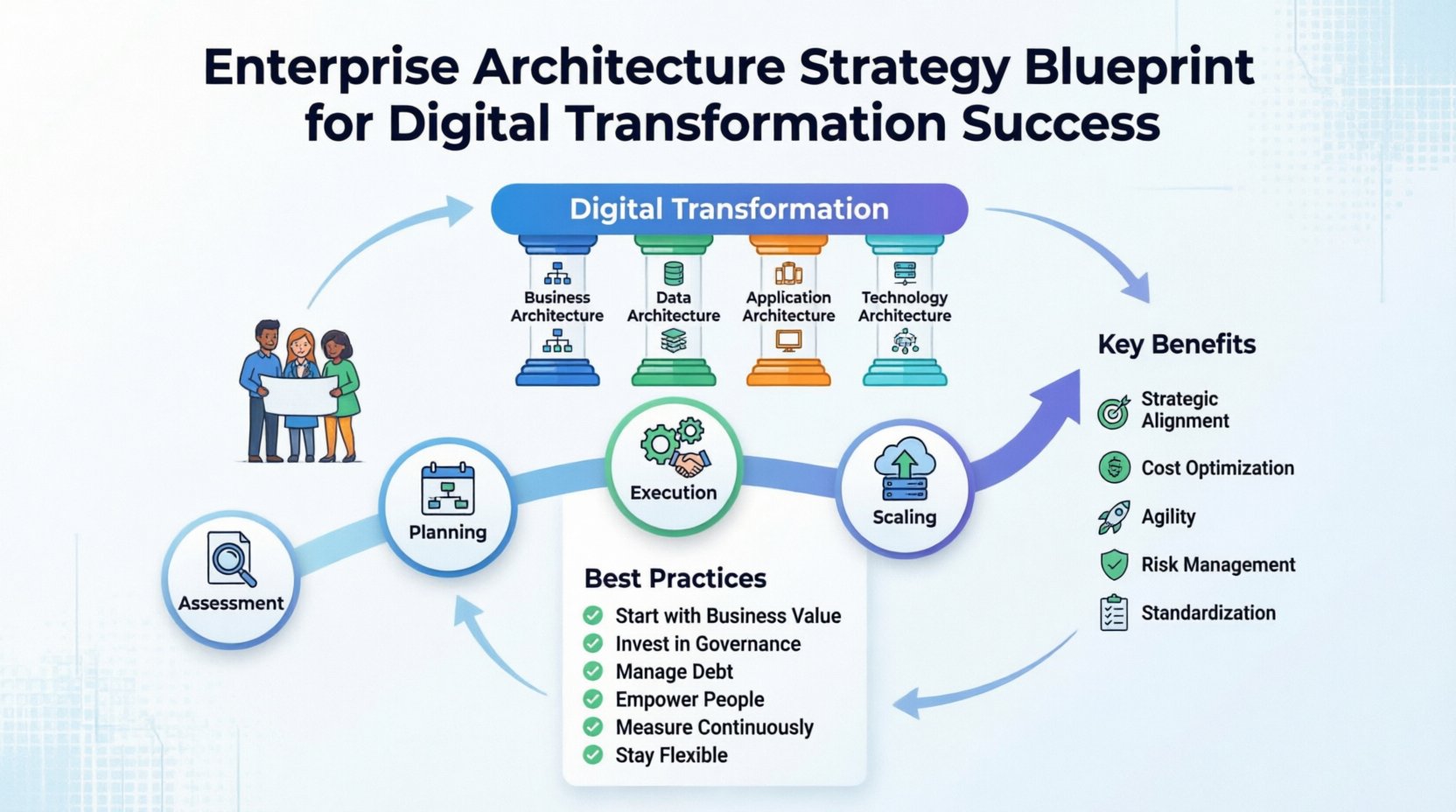
Digital transformation is not merely about adopting new tools or migrating to the cloud. It is a fundamental shift in how an organization operates, delivers value, and engages with its customers. At the heart of this shift lies Enterprise Architecture (EA). Without a coherent strategy, digital initiatives often become isolated silos, leading to wasted investment and fragmented user experiences. This guide outlines a robust blueprint for aligning architecture with business goals to ensure sustainable growth.
Success in this domain requires a clear vision, disciplined execution, and a willingness to adapt. We will explore the structural elements necessary to build a resilient digital ecosystem. By focusing on alignment, governance, and continuous improvement, organizations can navigate complexity with confidence.
Why Enterprise Architecture Matters in Digital Transformation 📊
Many organizations struggle with the pace of change. Technology evolves faster than legacy systems can be updated. Enterprise Architecture provides the framework to manage this evolution. It acts as the bridge between business strategy and IT execution.
Consider the following reasons why a structured approach is critical:
- Strategic Alignment: Ensures technology investments directly support business objectives rather than operating in a vacuum.
- Cost Optimization: Identifies redundancies in applications and infrastructure, reducing unnecessary spend.
- Agility: Enables faster response to market changes by creating modular and reusable components.
- Risk Management: Provides visibility into security, compliance, and operational dependencies.
- Standardization: Establishes common patterns and protocols across the organization.
Without this foundation, digital transformation efforts often result in “shadow IT,” where departments build their own solutions without oversight. This leads to integration nightmares and security vulnerabilities.
Core Components of the Strategic Blueprint 🧱
A comprehensive architecture strategy is built on four primary pillars. These layers work together to create a cohesive view of the organization.
| Pillar | Focus Area | Key Deliverables |
|---|---|---|
| Business Architecture | Processes, Organizational Structure, Strategy | Capability Maps, Value Streams |
| Data Architecture | Information Flow, Standards, Governance | Data Models, Integration Patterns |
| Application Architecture | Software Systems, Interactions, Services | Service Catalogs, API Standards |
| Technology Architecture | Infrastructure, Networks, Hardware | Deployment Models, Security Standards |
Each pillar must be defined with clarity. For instance, the Business Architecture defines what the organization does. The Application Architecture defines what software enables those actions. The Technology Architecture defines the physical or virtual environment where the software runs.
Aligning Technology with Business Objectives 🤝
The most common failure in digital transformation is a disconnect between what the business wants and what IT delivers. Architecture strategy must begin with the business questions, not the technical solutions.
To achieve alignment, follow these principles:
- Start with Capabilities: Map out what the business needs to be able to do. For example, “Real-time Customer Personalization” is a capability. “CRM System” is a tool to achieve it.
- Value Stream Mapping: Visualize the flow of value from customer need to fulfillment. Identify bottlenecks where technology can add efficiency.
- Investment Prioritization: Use architectural views to justify spending. If a project does not advance a strategic capability, it should be paused.
- Continuous Feedback: Establish loops where business leaders review architectural decisions regularly.
This approach ensures that every line of code written or server provisioned contributes to the broader mission. It moves the conversation from “cost center” to “value driver”.
Governance and Decision Making Structures ⚖️
Great strategies fail without governance. Governance ensures that standards are followed and that deviations are managed. It is not about bureaucracy; it is about control and consistency.
Key elements of an effective governance model include:
- Architecture Review Boards: A cross-functional team that evaluates proposed solutions against standards.
- Decision Rights: Clear definitions of who has the authority to make decisions regarding technology choices.
- Standards and Guidelines: Documented rules for coding, security, data handling, and infrastructure.
- Compliance Checks: Automated or manual checks to ensure regulatory requirements are met.
Effective governance balances control with speed. If the process is too slow, innovation stalls. If it is too loose, technical debt accumulates. The goal is a lightweight framework that enables decisions without requiring excessive paperwork.
Managing Technical Debt and Legacy Systems 🔄
Legacy systems are often the biggest hurdle to transformation. They may be stable, but they are rarely flexible. Addressing technical debt requires a proactive strategy rather than a reactive fix.
Consider these approaches for modernization:
- Inventory and Assessment: Catalog all existing systems. Identify which are critical, which are redundant, and which are at risk.
- Encapsulation: Wrap old systems with modern APIs to expose functionality without rewriting the core immediately.
- Incremental Replacement: Replace functionality module by module rather than attempting a “big bang” migration.
- Data Liberation: Prioritize moving data out of legacy silos into accessible formats that support analytics.
Debt management is an ongoing process. It requires budget allocation specifically for maintenance and refactoring, not just new development.
People, Culture, and Skills Development 👥
Architecture is not just about diagrams; it is about people. The best blueprint fails if the team lacks the skills to implement it. Cultural resistance is often a larger barrier than technical limitations.
To foster a supportive environment:
- Upskilling: Invest in training for current staff on new methodologies and tools.
- Roles and Responsibilities: Clearly define who owns the architecture. Avoid ambiguity between development and operations.
- Communication: Translate technical concepts into business language. Stakeholders need to understand the impact of architectural decisions.
- Collaboration: Break down silos between development, security, and business units. Encourage shared ownership of the platform.
A culture of continuous learning is essential. Technology changes rapidly, and the architecture team must remain curious and adaptable.
Implementation Phases and Roadmap 🗺️
A transformation journey is rarely a straight line. It requires a phased approach to manage risk and demonstrate value early.
| Phase | Focus | Outcome |
|---|---|---|
| Assessment | Current State Analysis | Gap Analysis Report |
| Planning | Future State Design | Strategic Roadmap |
| Execution | Proof of Concepts & Pilots | Validated Solutions |
| Scaling | Enterprise Rollout | Standardized Platform |
Starting with small pilots allows the organization to test assumptions before committing significant resources. Success in a pilot builds confidence for wider adoption.
During the execution phase, maintain a backlog of architectural tasks. Prioritize based on business value. Do not attempt to fix everything at once. Focus on the capabilities that deliver the highest return.
Measuring Impact and ROI 📈
How do you know if the strategy is working? You need measurable indicators. Traditional IT metrics like uptime are necessary but not sufficient for transformation success.
Consider these metrics:
- Time to Market: How quickly can new features be deployed?
- System Interoperability: How many manual integrations are required between systems?
- Cost Per Transaction: Does the architecture reduce the cost of processing business activities?
- Developer Productivity: Are developers spending more time on features and less on maintenance?
- Customer Satisfaction: Does the improved backend result in better user experiences?
Regularly review these metrics. If progress stalls, revisit the strategy. Adjustments are part of the process.
Navigating Risks and Challenges ⚠️
Every transformation faces obstacles. Being prepared for them reduces their impact.
Common risks include:
- Resistance to Change: Employees may fear job loss or increased workload. Address this through transparent communication and involvement.
- Scope Creep: Projects often grow beyond their original intent. Enforce strict change management processes.
- Talent Shortages: Skilled architects are in high demand. Build internal talent pipelines or partner with external experts.
- Security Breaches: Modernization expands the attack surface. Embed security into the design phase (Shift Left).
Risk management is not a one-time activity. It requires continuous monitoring and adaptation.
Future-Proofing Your Architecture 🔮
Technology trends evolve quickly. What is cutting-edge today may be obsolete tomorrow. A good strategy anticipates these shifts.
To build resilience:
- Modularity: Design systems to be decoupled. If one component changes, others should remain unaffected.
- Cloud Agnosticism: Avoid hard dependencies on a single vendor’s infrastructure where possible.
- Automation: Use infrastructure as code to reduce manual errors and speed up provisioning.
- Observability: Build systems that provide deep insights into performance and behavior in real-time.
Focus on principles rather than specific technologies. Principles endure longer than tools. For example, the principle of “loose coupling” is valid regardless of whether you use microservices or monolithic structures.
Summary of Best Practices ✅
To conclude this guide, here are the essential takeaways for building a successful strategy:
- Start with Business Value: Align every technical decision with a business outcome.
- Invest in Governance: Establish clear processes for review and compliance.
- Manage Debt Proactively: Dedicate resources to maintenance and modernization.
- Empower People: Train staff and foster a collaborative culture.
- Measure Continuously: Use data to validate progress and guide adjustments.
- Stay Flexible: Design for change, not static requirements.
Digital transformation is a marathon, not a sprint. It requires patience, discipline, and a long-term vision. By adhering to these architectural principles, organizations can build systems that support growth for years to come.
Related posts:
 EA Guide; Aligning Business Strategy with IT Architecture – A CIO’s Actionable Framework
 Cloud-First Enterprise Architecture: Strategic Planning for Flexibility and Control
 EA Guide: Data Governance Architecture Framework – Ensuring Quality, Security, and Compliance
 EA Guide: IT Portfolio Rationalization Through Enterprise Architecture Discipline