The landscape of technology development has shifted dramatically over the last two decades. What once worked for manufacturing and construction often breaks when applied to software and digital innovation. Organizations continue to invest heavily in project management methodologies, yet failure rates remain stubbornly high. This disconnect stems from a fundamental misunderstanding of how value is created in the tech sector.
Traditional frameworks assume predictability. They assume that requirements are static, costs are fixed, and timelines are rigid. In the world of engineering code, these assumptions are often false. When a project fails, it is rarely due to a lack of effort. It is usually due to a mismatch between the methodology and the environment. This guide explores the structural weaknesses of traditional approaches and outlines how modern, adaptive systems provide a viable path forward.
The Waterfall Illusion 🏗️
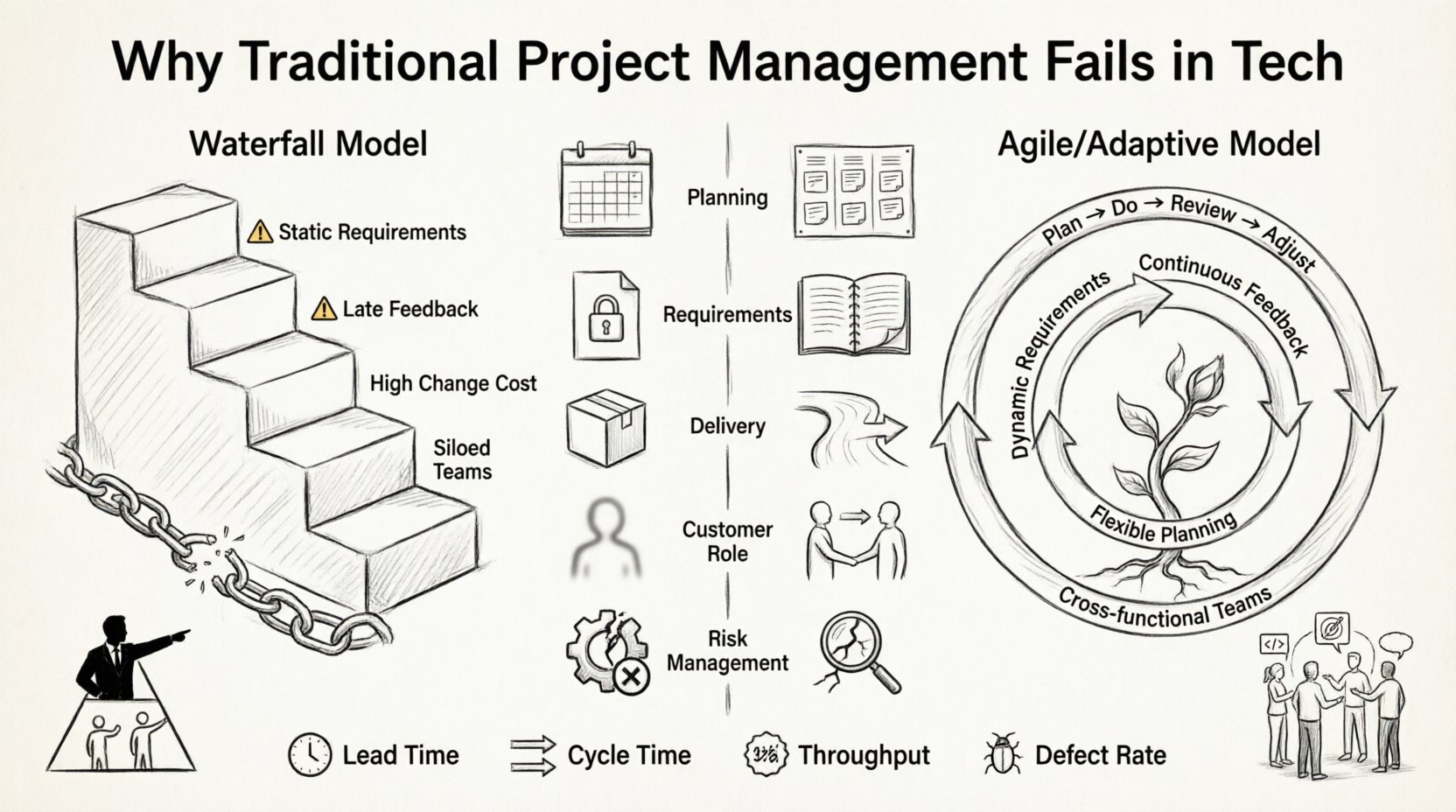
For decades, the Waterfall model was the standard. It divides a project into distinct phases: requirements, design, implementation, verification, and maintenance. The logic is linear. You complete one phase before moving to the next. This works well when the end product is fully understood before work begins. However, technology is inherently uncertain.
- Requirements Change: Stakeholder needs evolve as the market shifts. By the time a requirement is documented and approved, the market context may have changed.
- Discovery Happens Late: Technical constraints often only become apparent during the implementation phase. Catching these late in a linear process is expensive.
- Feedback Loops are Long: Users do not see a working product until the very end. If the product misses the mark, the entire project may need to be rebuilt.
This rigidity creates a false sense of security. A project plan looks solid on paper, but it does not reflect the reality of development. Teams spend months building features that may no longer be relevant.
Why Tech Needs Flexibility 📉
Software development is not a manufacturing assembly line. It is a process of discovery. When you write code, you are solving problems that may not have existed when the project started. The complexity of modern systems requires an approach that accommodates change rather than resisting it.
Consider the cost of change. In traditional models, changing a requirement late in the cycle incurs a massive penalty. This penalty discourages necessary pivots. In tech, pivoting is often the difference between success and obsolescence. Teams need the autonomy to adjust direction without navigating a labyrinth of change control boards.
The Hidden Costs of Rigidity
When organizations force rigid processes onto creative work, they incur hidden costs that are not always visible in the budget.
- Technical Debt: Rushing to meet a fixed deadline often leads to shortcuts. This debt compounds over time, slowing down future development.
- Team Morale: Developers know when a plan is unrealistic. Being forced to follow a broken plan reduces engagement and increases turnover.
- Opportunity Cost: While the team builds the old product, competitors may release a better version based on new insights.
Common Pitfalls of Rigidity 🚧
Identifying why traditional methods fail requires looking at specific friction points. These are not minor issues; they are systemic flaws that undermine project success.
1. The Planning Fallacy
Humans are notoriously bad at estimating time. We tend to focus on the best-case scenario. Traditional planning relies on these estimates to set dates. When estimates are wrong, the project is doomed from the start. Modern approaches acknowledge uncertainty by using ranges rather than fixed dates.
2. Siloed Communication
Traditional models often separate roles. Analysts write specs, developers write code, testers verify code. This handoff culture creates gaps in information. Developers may not understand the “why” behind a feature, leading to implementation errors. Cross-functional collaboration breaks down when the structure enforces barriers between teams.
3. The “Done” Trap
In Waterfall, “done” means the project is finished. In tech, value delivery is continuous. A project is not done when the code is deployed; it is done when it solves the user’s problem. Traditional metrics focus on output (lines of code, features shipped) rather than outcome (customer satisfaction, revenue generated).
Modern Methodologies Explained 🔄
Several frameworks have emerged to address the limitations of linear planning. These are not magic bullets, but they provide structures that support adaptability.
Agile Principles
Agile is not a single method but a mindset. It prioritizes individuals and interactions over processes and tools. It values working software over comprehensive documentation. It emphasizes customer collaboration over contract negotiation. Most importantly, it values responding to change over following a plan.
- Iterative Development: Work is done in small cycles called iterations. Each cycle produces a potentially shippable increment.
- Continuous Feedback: Stakeholders review work frequently. This allows for course correction before significant resources are wasted.
- Self-Organizing Teams: Teams decide how to do the work. Management provides the context, not the commands.
Scrum Framework
Scrum is a popular implementation of Agile. It structures work into Sprints, usually lasting two to four weeks. Key roles include the Product Owner, who defines value, and the Scrum Master, who removes obstacles. Daily stand-up meetings keep the team aligned on progress and blockers.
Kanban Systems
Kanban focuses on flow rather than time-boxed cycles. Work is visualized on a board with columns representing status (To Do, In Progress, Done). The goal is to limit work in progress (WIP). By preventing multitasking, teams finish tasks faster and identify bottlenecks immediately.
Comparative Analysis: Traditional vs. Modern ⚖️
To understand the shift, it helps to compare the two approaches side by side. This table highlights the fundamental differences in philosophy and execution.
| Aspect | Traditional (Waterfall) | Modern (Agile/Adaptive) |
|---|---|---|
| Planning | Upfront, detailed, fixed | Just-in-time, iterative, evolving |
| Requirements | Static, documented early | Dynamic, refined continuously |
| Delivery | One big release at the end | Continuous, frequent releases |
| Customer Role | Passive, reviews at milestones | Active, involved in every iteration |
| Risk Management | Identified at start, mitigated later | Identified continuously, mitigated early |
| Team Structure | Functional silos | Cross-functional, collaborative |
The Human Element 🧠
Methodologies are tools, but people are the operators. The biggest barrier to modern project management is often culture, not process. If leadership demands rigid reporting and micromanagement, no framework will save the project.
Psychological Safety
Teams need to feel safe to admit mistakes. In traditional models, errors are often punished. In adaptive models, errors are viewed as data points for improvement. If a developer hides a bug because they fear repercussions, the team suffers. Leaders must foster an environment where transparency is rewarded.
Empowerment vs. Control
Control implies that the manager knows better than the team. Empowerment implies the team knows how to solve the problem best. When managers stop controlling and start serving, productivity often increases. The goal of leadership shifts from assigning tasks to removing impediments.
Implementation Strategies 🚀
Moving away from traditional methods is not a switch; it is a transition. Organizations need a strategy to migrate without causing chaos.
1. Start Small
Do not attempt to transform the entire organization at once. Pick a pilot team. Allow them to experiment with new workflows. Measure the results. Use the success of the pilot to build momentum for wider adoption.
2. Redefine Metrics
Stop measuring success solely by budget and schedule. Start measuring value delivery. Ask: Did we solve the user problem? Did we reduce time to market? Are we learning?
3. Invest in Training
Teams need to understand the new way of working. Workshops on collaboration, communication, and iterative planning are essential. Without understanding the “why,” teams will revert to old habits under pressure.
4. Adapt Tools to Process
Software tools should support the workflow, not dictate it. Many tools are designed around traditional tracking. Ensure your stack allows for visibility into work in progress, not just task completion. Dashboards should show flow, not just status.
Metrics That Matter 📊
How do you know if the new approach is working? Traditional metrics like “percentage complete” are misleading. Instead, focus on flow metrics that reveal the health of the system.
- Lead Time: How long does it take from idea to production? Shorter is better.
- Cycle Time: How long does work stay in progress? This identifies bottlenecks.
- Throughput: How many items are completed per unit of time? This measures capacity.
- Defect Rate: How many bugs are found in production? This measures quality.
Tracking these metrics over time provides a clear picture of improvement. It moves the conversation from “who is at fault” to “what is broken in the system”.
Final Thoughts on Adaptation 🌱
The shift from traditional to modern project management is not about abandoning structure. It is about choosing a structure that fits the work. Technology is volatile. Requirements are fluid. Teams are human. A methodology that assumes stability will fail when faced with volatility.
Success lies in the ability to learn. It lies in the willingness to inspect and adapt. Organizations that cling to rigid plans in a changing world will eventually become irrelevant. Those that embrace flexibility and focus on delivering value will thrive.
There is no one-size-fits-all solution. Some projects require heavy governance. Others require total autonomy. The key is to understand the context. Assess the risk. Choose the approach that minimizes waste and maximizes learning. By doing so, teams can navigate uncertainty with confidence and deliver results that truly matter.