
Every project begins with a promise. A promise that resources align with goals, timelines are realistic, and the team has the clarity to execute. Yet, countless initiatives stumble before the finish line. The gap between the initial blueprint and the final delivery is often where value is lost. When a project plan fails, it is rarely a single event. It is usually a cascade of small misalignments that compound over time. Understanding why these plans collapse is the first step toward building resilience.
This guide moves beyond surface-level symptoms to examine the structural and human elements that drive project failure. We will explore how to diagnose the underlying issues and implement practical fixes without relying on new tools or complex methodologies. The focus remains on core principles of planning, execution, and adaptation.
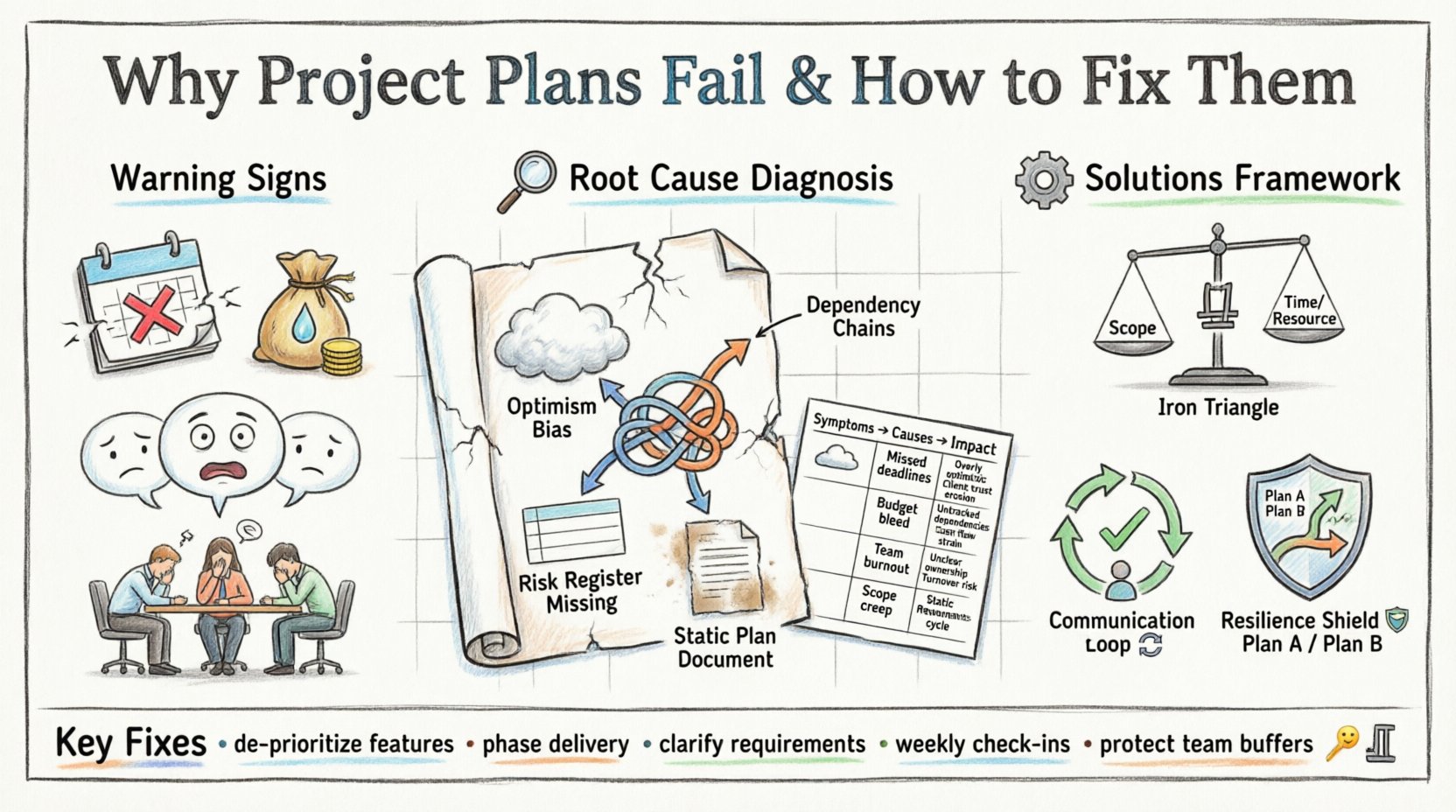
1. Recognizing the Warning Signs 🚦
Before fixing a plan, you must admit it is broken. Often, teams continue down a failing path because they mistake movement for progress. You can identify a struggling plan by observing specific patterns. These signals appear early if you know where to look.
- Chronic Deadline Misses: When milestones are consistently pushed back by small increments, the baseline estimate is flawed.
- Budget Bleed: Spending outpaces the timeline. If you have spent 50% of the budget at 25% completion, the cost model is incorrect.
- Stakeholder Ambiguity: Decision-makers express confusion about the current state of deliverables frequently.
- Team Burnout: Sustained overtime indicates scope or capacity miscalculations.
- Feature Creep: New requirements are added without adjusting the timeline or resources.
Ignoring these indicators leads to a crisis point where recovery becomes difficult. Early detection allows for course correction while there is still flexibility in the schedule.
2. The Anatomy of a Broken Plan 🛠️
A project plan is a hypothesis. It predicts the future based on current data. When that prediction fails, it is because the assumptions were wrong. Common structural flaws include:
- Optimism Bias: Teams tend to estimate best-case scenarios rather than accounting for inevitable friction.
- Hidden Dependencies: Tasks are scheduled without understanding how they rely on external teams or deliverables.
- Missing Risk Registers: Potential blockers are not identified until they become actual problems.
- Static Documentation: Plans are created once and forgotten, rather than treated as living documents.
- Unclear Ownership: Tasks are assigned to “the team” rather than specific individuals.
These flaws create a fragile environment. A single disruption can cause the entire structure to collapse. Robust planning anticipates disruption rather than assuming it will not happen.
3. Diagnosing the Root Causes 🔍
When a project goes off track, the immediate reaction is often to add more hours or pressure the team. This rarely works. Instead, use a diagnostic framework to pinpoint the specific failure mode. The table below outlines common symptoms and their underlying causes.
| Symptom | Potential Root Cause | Impact Level |
|---|---|---|
| Missed Deadlines | Unrealistic estimation or scope creep | High |
| Quality Issues | Rushed testing phases or unclear acceptance criteria | Medium |
| Team Conflict | Unclear roles or resource contention | High |
| Budget Overruns | Unplanned resource costs or rework | Medium |
| Low Morale | Excessive workload or lack of autonomy | Medium |
Identifying the correct cause requires honest conversation. Blame should not be assigned to individuals. The goal is to fix the process, not the person. When you find a root cause, address it directly.
4. Fixing the Foundation 🏗️
Once the root cause is identified, you must re-baseline the plan. This does not mean starting over from scratch. It means adjusting the constraints to match reality.
Adjusting Scope and Time
If time is fixed, scope must move. If scope is fixed, time must move. If neither can move, resources must increase. This is the iron triangle. You cannot change one without affecting the others. Communicate this trade-off clearly to stakeholders.
- De-prioritize: Identify features that are nice-to-have and move them to a backlog.
- Phase Delivery: Deliver the core value first, then add enhancements in subsequent stages.
- Re-estimate: Ask the people doing the work to provide estimates, not managers.
Clarifying Requirements
Ambiguity is the enemy of execution. If a task can be interpreted in two ways, it will be done wrong. Ensure every deliverable has a clear definition of done. This includes functional requirements, performance metrics, and acceptance criteria.
- Write requirements in plain language, avoiding jargon.
- Use visual aids like diagrams or wireframes to clarify complex flows.
- Confirm understanding with the assignee before work begins.
5. Communication Breakdowns 🗣️
Information flow is the lifeblood of a project. When communication fails, plans fail. This often happens due to too many channels or too few updates.
- Over-communication: Too many meetings drain energy needed for actual work.
- Under-communication: Critical decisions are made without informing the team.
- Wrong Channels: Urgent matters are buried in long email threads.
To fix this, establish a communication rhythm. Define what information needs to be shared, when, and how. Use status reports to highlight risks and blockers rather than just listing completed tasks. This shifts the focus from activity to outcome.
Key Communication Rules
- Single Source of Truth: Maintain one central location for project data.
- Meeting Discipline: Have an agenda for every meeting and a summary after.
- Transparency: Share bad news early. Problems are easier to fix when they are small.
6. Resource & Capacity Mismatches ⚖️
Plans often fail because they assume resources are infinite or perfectly available. In reality, people have other responsibilities, sick days, and varying levels of productivity.
- Part-Time Allocation: Assigning a task to someone who is 20% allocated to the project creates bottlenecks.
- Skill Gaps: Assigning complex work to someone without the necessary training.
- Burnout: Assuming the team can sustain 100% capacity indefinitely.
To address this, map resources against actual availability. Do not schedule work during known low-productivity periods. If resources are constrained, you must reduce the scope of work or extend the timeline.
7. Implementing a Feedback Loop 🔄
A plan is useless if it does not reflect reality. You need a mechanism to check the plan against actual performance regularly. This is the feedback loop.
- Weekly Check-ins: Review progress against milestones every week.
- Metric Tracking: Measure velocity, burn rate, and defect rates.
- Retrospectives: After every phase, ask what went well and what went wrong.
Use this data to update the plan. If a task takes twice as long as estimated, update the future estimates accordingly. Do not ignore the data to maintain a false sense of optimism.
8. Building Resilience into Your Workflow 🛡️
Even with perfect planning, things will go wrong. The goal is not to prevent all errors, but to build a system that absorbs shock. This is resilience.
- Buffer Management: Add contingency time to critical paths. Protect this buffer from scope creep.
- Risk Mitigation: Identify top risks and create a plan B before the problem occurs.
- Decoupling: Design work streams so that a failure in one area does not stop the entire project.
Resilience requires a culture that accepts failure as a learning opportunity. When a plan breaks, the team should not panic. They should analyze, adjust, and continue.
9. The Role of Leadership 👔
Leadership sets the tone for planning. If leaders treat plans as binding contracts rather than guides, the team will hide problems. Leaders must model transparency and adaptability.
- Protect the Team: Shield the team from external pressure that forces unrealistic deadlines.
- Remove Obstacles: Focus on clearing roadblocks rather than micromanaging tasks.
- Empower Decisions: Allow the team to make decisions within their domain.
When leadership trusts the team, the team takes ownership. Ownership is the strongest motivator for delivering on a plan.
10. Preventing Future Failures 🛑
Once you have fixed the current issues, you must prevent recurrence. This involves institutionalizing the lessons learned.
- Standardize Templates: Use consistent planning templates for all future projects.
- Training: Ensure all project managers understand the new processes.
- Review Historical Data: Use past project data to improve future estimates.
Continuous improvement is not a one-time event. It is a habit. By treating project management as a discipline that evolves, you reduce the likelihood of repeating past mistakes.
11. Final Thoughts on Adaptability 🧭
Project management is not about sticking to a rigid plan. It is about navigating toward a goal despite changing conditions. When your plan fails, it is an opportunity to learn how your organization works. Diagnose the cause, fix the process, and move forward with clarity.
Success is not the absence of problems. It is the ability to solve them efficiently. By focusing on root causes and maintaining open communication, you can steer your projects through uncertainty and deliver value consistently.