
Enterprise Architecture often feels like a distant discipline, reserved for IT specialists and architects buried in diagrams. However, the foundation of any successful digital transformation lies in business alignment. This is where TOGAF Phase B, known as the Business Architecture phase, becomes critical. For non-technical leaders, understanding this phase is not about learning to draw diagrams; it is about ensuring that the strategic goals of the organization are translated into a coherent operational reality.
When leaders engage deeply with Phase B, they move beyond high-level strategy and begin to define the capabilities the organization needs to deliver value. This guide breaks down the specifics of TOGAF Phase B, its deliverables, and how leaders can actively contribute without needing a technical background. We will explore how to align business processes, governance, and strategy to create a robust framework for future growth.
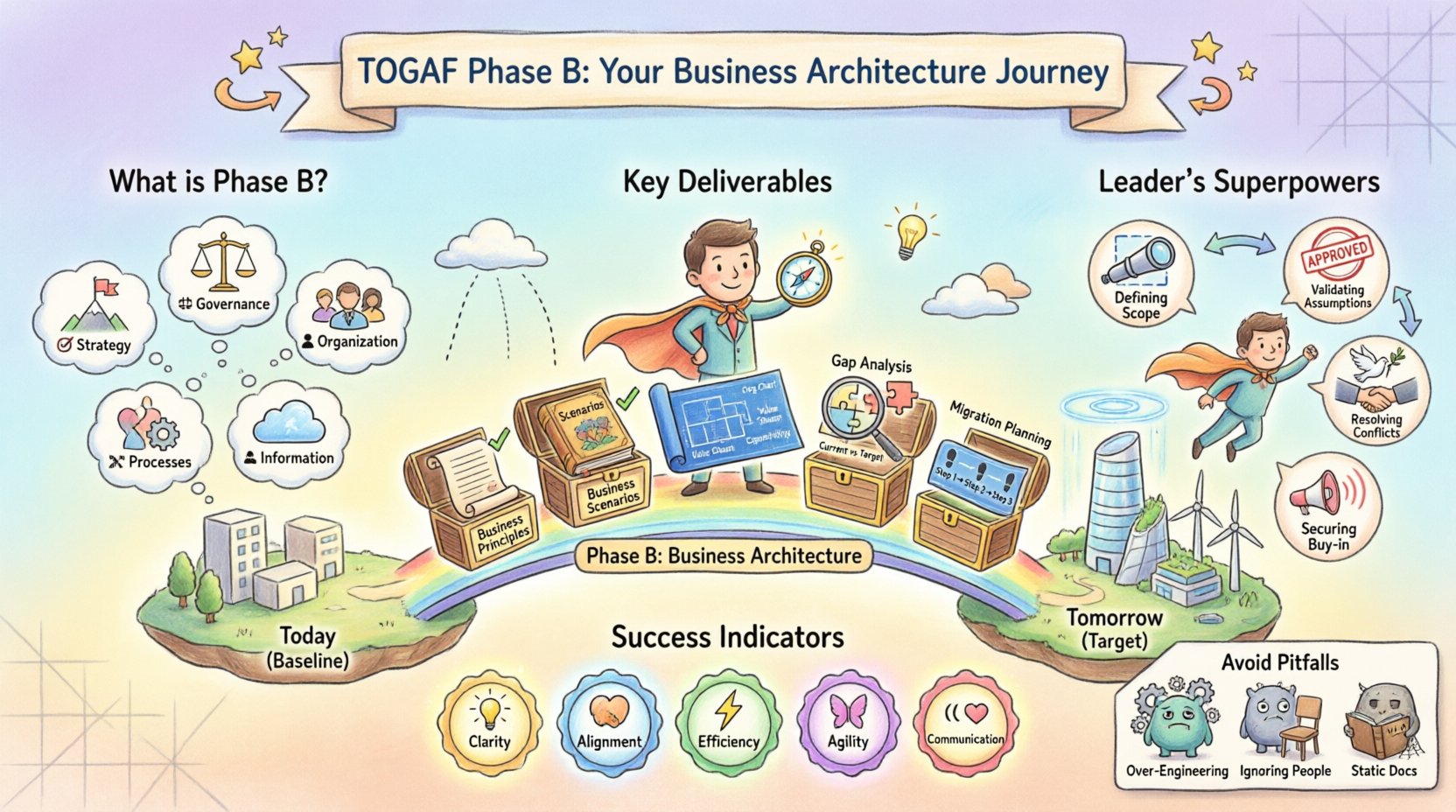
What is TOGAF Phase B? 🤔
The TOGAF Architecture Development Method (ADM) is a cyclical process used to design, plan, implement, and govern enterprise information architecture. Phase B sits early in this cycle, immediately following the Preliminary Phase and the Architecture Vision (Phase A). Its primary purpose is to define the baseline and target business architecture.
In simpler terms, Phase B answers the question: What does the business look like today, and what does it need to look like to achieve its goals? It focuses on:
- Business Strategy: How the organization intends to succeed.
- Business Governance: How decisions are made and controlled.
- Business Organization: The structure, roles, and responsibilities.
- Business Processes: The activities that create value.
- Business Information: The data required to run the business.
For a non-technical leader, this phase is the bridge between the boardroom and the execution floor. It ensures that the technology investments made in later phases (Information Systems and Technology) actually support the business needs identified here.
Why This Phase Matters to You 👔
Many organizations fail to deliver value from their IT investments because they skip the business architecture work. They jump straight to selecting software or building infrastructure without defining the business capabilities required. Phase B prevents this misalignment.
Here is why non-technical leaders must prioritize this phase:
- Strategic Clarity: It forces the organization to articulate its goals in concrete terms.
- Risk Reduction: Identifying capability gaps early prevents costly rework later.
- Resource Allocation: It helps prioritize where money and time should be spent based on business value.
- Communication: It provides a common language between business units and technical teams.
Without a clear Business Architecture, the organization risks building solutions that do not solve the right problems. Phase B ensures the problem definition is accurate before the solution design begins.
Key Deliverables Explained 📄
TOGAF defines specific outputs for Phase B. These are not just documents for archives; they are tools for decision-making. Below is a breakdown of the critical deliverables and what they mean for a leader.
| Deliverable | Description | Leader’s Benefit |
|---|---|---|
| Business Principles | Guiding rules that shape decision-making. | Ensures consistency across the organization. |
| Business Scenarios | Specific use cases that define the business environment. | Helps visualize how the business operates in practice. |
| Business Architecture | The baseline and target state of the business. | Provides a roadmap for capability development. |
| Gap Analysis | Comparison between baseline and target. | Highlights immediate priorities and missing capabilities. |
| Migration Planning | Initial roadmap for moving from baseline to target. | Supports high-level budgeting and timeline estimation. |
Business Principles
These are the guardrails. For example, a principle might state: “All customer data must be stored in compliance with regional privacy laws.” As a leader, you review these principles to ensure they reflect the organization’s values and risk tolerance. They prevent contradictory initiatives from different departments.
Business Scenarios
Scenarios describe specific situations where the architecture is applied. This helps leaders understand the context. Instead of abstract goals, you see the business in action. For instance, a scenario might detail the process of onboarding a new client, including all required approvals and data checks.
Gap Analysis
This is arguably the most important tool for leadership. It compares where the business is now against where it needs to be. The gap analysis identifies:
- Capabilities that are missing.
- Processes that are inefficient.
- Skills that are lacking.
This directly informs the investment strategy. If the analysis shows a gap in customer service automation, the leader knows to prioritize automation technologies.
The Leader’s Role in Business Architecture 🗣️
Non-technical leaders often assume architects handle Phase B alone. This is a misconception. Architects provide the framework, but leaders provide the context and authority. Your involvement is essential for the following reasons:
- Defining Scope: You decide which parts of the business are in scope for the architecture effort.
- Validating Assumptions: Architects model the business based on data and interviews. You validate if these models reflect reality.
- Resolving Conflicts: Different departments may have competing priorities. You arbitrate to ensure the architecture supports the overall strategy.
- Securing Buy-in: Your endorsement signals to the rest of the organization that this work is important.
During workshops, do not hesitate to ask questions. Ask about the impact on customer experience, operational costs, and compliance. These are the metrics that matter to your role.
Aligning Strategy with Architecture 🎯
Phase B is the first step where Strategy meets Execution. The Architecture Vision from Phase A sets the direction. Phase B defines the destination. To align them effectively, follow these steps:
- Review Strategic Goals: Revisit the organizational mission and strategic objectives.
- Map Capabilities: Identify the business capabilities required to achieve those goals.
- Assess Current State: Determine which capabilities already exist and their maturity level.
- Identify Gaps: Pinpoint the difference between current capabilities and required capabilities.
- Define Target State: Describe what the business looks like when the gaps are closed.
This alignment ensures that every dollar spent on architecture supports a strategic objective. It prevents “shadow IT” or isolated projects that do not contribute to the main goals.
Common Pitfalls and How to Avoid Them ⚠️
Even with the best intentions, Phase B can go off track. Awareness of common pitfalls helps you steer the process successfully.
1. Over-Engineering
Architects may create models that are too complex for the organization to use. Avoid this by: Focusing on the essentials. If a model does not help decision-making, it should be simplified. Keep the deliverables practical.
2. Ignoring People
Architecture often focuses on processes and systems, neglecting the people who execute them. Avoid this by: Including human resource implications in the business architecture. Consider skills, roles, and training needs.
3. Lack of Stakeholder Engagement
If key stakeholders are not involved, the architecture will lack credibility. Avoid this by: Inviting representatives from all major business units to review and validate the architecture.
4. Static Documentation
Business architecture is not a one-time activity. Markets change, and so does the business. Avoid this by: Treating the architecture as a living asset. Schedule regular reviews to update the baseline and target states.
Measuring Success in Phase B 📊
How do you know if Phase B was successful? Look for these indicators:
- Clarity: Stakeholders can articulate the business goals and capabilities clearly.
- Alignment: IT projects map directly to business capabilities.
- Efficiency: Redundant processes are identified and eliminated.
- Agility: The organization can adapt to changes faster because the architecture is well-understood.
- Communication: There is a shared vocabulary between business and IT teams.
Success is not just about producing a document. It is about the change in how the organization operates. If decision-making becomes faster and more informed, the phase has delivered value.
Integrating Phase B with the Rest of the ADM 🔄
TOGAF is an iterative cycle. Phase B does not exist in isolation. It feeds into the subsequent phases:
- Phase C (Information Systems): The business architecture defines the data and application requirements for Phase C.
- Phase D (Technology): The capabilities defined in Phase B drive the technology infrastructure needs.
- Phase G (Migration): The gap analysis from Phase B informs the migration plan.
- Phase H (Change Management): Understanding the target business state helps manage the transition.
Leaders must ensure that the outputs of Phase B are accessible to the teams working on these later phases. This continuity ensures that the original business intent is preserved throughout the implementation.
Preparing for the Future 🚀
Investing in Phase B prepares the organization for future challenges. As markets evolve, the business architecture allows you to pivot without rebuilding everything from scratch. By understanding your capabilities and gaps, you can assess the impact of new opportunities quickly.
For example, if you want to enter a new market, you can check the architecture to see if you have the necessary distribution channels, compliance frameworks, and customer service capabilities. If not, you know exactly what to build or acquire.
Frequently Asked Questions ❓
Who leads Phase B?
Typically, an Enterprise Architect facilitates the process, but the Business Architect or Business Lead often drives the content. Leaders provide the direction and approval.
How long does Phase B take?
Duration varies based on organizational size and complexity. It can take anywhere from a few weeks to several months. The focus should be on quality, not speed.
Can we skip this phase?
Skipping Phase B is risky. It may lead to misaligned technology investments. While you can run a lighter version, completely omitting the business architecture analysis often results in failure.
What if the business strategy changes?
The architecture is not set in stone. If strategy changes, the architecture should be updated. Phase B provides the baseline to measure the impact of strategic shifts.
Does this apply to small organizations?
Yes. While large enterprises have complex architectures, smaller organizations also benefit from understanding their capabilities and gaps. The scale may be smaller, but the logic remains the same.
Conclusion on Implementation
TOGAF Phase B is a strategic asset for non-technical leaders. It transforms abstract goals into concrete business capabilities. By engaging with this phase, you ensure that the organization builds the right things, in the right way, to achieve its mission. It reduces risk, improves clarity, and aligns resources with value.
Start by reviewing your current strategic goals and asking how well they are supported by your current business structure. If the answer is unclear, Phase B offers the methodology to find clarity. Use the tools, engage your stakeholders, and treat the architecture as a living guide for your organization’s future.