
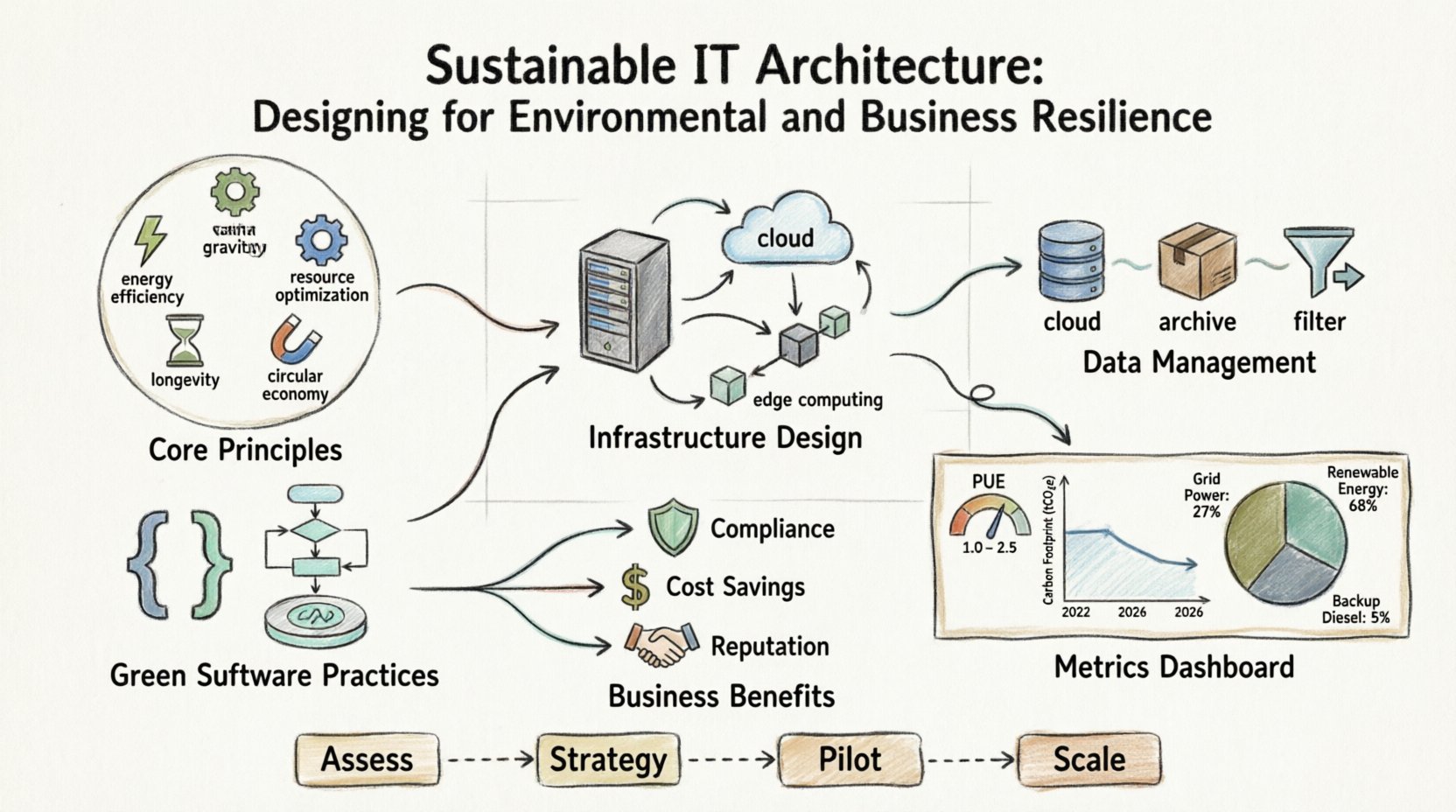
The digital infrastructure supporting modern enterprise operations is experiencing exponential growth. This expansion brings significant energy consumption and carbon emissions into focus. Sustainable IT architecture addresses this challenge by integrating environmental responsibility with robust business strategy. It is not merely about reducing power usage; it is about designing systems that endure, perform efficiently, and align with long-term ecological and financial goals.
Enterprises are increasingly pressured by regulators, investors, and customers to demonstrate tangible progress toward net-zero targets. Information technology accounts for a substantial portion of organizational energy use. By rethinking how systems are built, data is managed, and hardware is procured, organizations can reduce their carbon footprint while simultaneously improving operational resilience.
Understanding the Core Principles
Sustainable IT architecture relies on several foundational pillars. These principles guide decision-making from the initial design phase through to decommissioning. The goal is to maximize utility while minimizing resource expenditure.
- Energy Efficiency: Systems should operate using the least amount of power possible for the task at hand. This applies to both hardware components and the algorithms driving software logic.
- Resource Optimization: Computing resources, storage, and network bandwidth should be utilized fully rather than sitting idle. Over-provisioning leads to wasted energy.
- Longevity and Durability: Hardware and software should be designed for extended lifecycles. Reducing the frequency of replacements lowers the embodied carbon associated with manufacturing and disposal.
- Data Gravity: Moving data to where it is needed reduces transmission energy. Architectural decisions regarding data locality impact overall network efficiency.
- Circular Economy: Components should be repairable, upgradable, and recyclable. Designing for end-of-life is as critical as designing for initial operation.
These concepts shift the focus from pure performance metrics to holistic efficiency. A system that runs faster but consumes double the energy may be less sustainable than a slightly slower system with optimized power draw.
Strategic Infrastructure Design
The physical and logical infrastructure forms the backbone of any sustainable strategy. Decisions made here have compounding effects on energy consumption over years of operation.
Hardware Lifecycle Management
Server farms and data centers require significant cooling and power. When selecting hardware, architects should evaluate the energy efficiency ratings of components. Processors that deliver higher performance per watt are preferable to those with higher peak performance but lower efficiency.
- Procurement Standards: Establish strict criteria for vendors. Require documentation on power consumption, material sourcing, and recyclability.
- Virtualization: Consolidate workloads onto fewer physical machines. This reduces the number of active servers and the associated cooling load.
- Dynamic Scaling: Implement systems that can scale resources up or down based on demand. Idle resources should consume minimal power.
Network Architecture
Data transmission consumes electricity across routers, switches, and cabling. Optimizing the network reduces this overhead.
- Edge Computing: Process data closer to the source. This reduces the volume of data traveling across the core network, saving bandwidth and energy.
- Compression: Use efficient data compression techniques before transmission. Smaller packets require less energy to move.
- Protocol Efficiency: Choose communication protocols that minimize handshake overhead and data payload size.
Data Management and Efficiency
Data is the lifeblood of enterprise architecture, but it is also a heavy resource consumer. Storing, processing, and moving data requires energy at every stage. Effective data governance is essential for sustainability.
Data Reduction Strategies
Not all data requires equal attention. Some information becomes obsolete quickly, while other data is valuable for years. Categorizing data based on value and lifespan allows for tailored storage solutions.
- Deduplication: Eliminate redundant copies of files to save storage space and energy.
- Archiving: Move cold data to high-density, low-power storage tiers. Active data should reside on faster, energy-intensive media.
- Retention Policies: Define clear rules for how long data is kept. Automatically delete data that no longer serves a business purpose.
Database Optimization
Databases often consume more energy than the applications interacting with them. Indexing, query optimization, and schema design play a major role.
- Query Efficiency: Write queries that retrieve only necessary data. Full table scans consume excessive I/O and CPU cycles.
- Partitioning: Split large databases into manageable sections. This allows for targeted maintenance and reduced scanning.
- Indexing: Use indexes strategically. While they speed up retrieval, they also require storage space and write overhead.
Software Development Practices
Code is not just logic; it is instructions that consume electricity. Green software engineering practices focus on writing code that is efficient and resource-conscious.
- Algorithm Efficiency: Choose algorithms with lower time and space complexity. A faster algorithm finishes sooner and releases resources.
- Language Selection: Some programming languages are more efficient than others for specific tasks. Consider the runtime overhead.
- Lazy Loading: Load resources only when they are needed. This prevents unnecessary processing and network requests.
- Caching: Store frequently accessed data locally or in memory to avoid repeated database calls or network fetches.
Measuring Impact and Performance
You cannot improve what you do not measure. Establishing clear metrics allows organizations to track progress and identify areas for improvement.
| Metric | Description | Target |
|---|---|---|
| Power Usage Effectiveness (PUE) | Ratio of total facility energy to IT equipment energy. | Below 1.5 |
| Carbon Usage Effectiveness (CUE) | Carbon emissions per unit of IT load. | Lower is better |
| Energy per Transaction | Energy consumed to process a single business transaction. | Trending down |
| Hardware Utilization Rate | Percentage of time hardware is actively processing. | Above 70% |
| Renewable Energy Percentage | Portion of energy sourced from renewable providers. | 100% |
These metrics should be integrated into regular reporting cycles. They provide visibility into how architectural decisions impact the environment.
Business Resilience and Risk Management
Sustainability is often viewed as an environmental initiative, but it is fundamentally a business resilience strategy. Climate change poses physical risks to infrastructure, such as extreme weather events affecting data centers.
- Regulatory Compliance: Governments are introducing stricter reporting requirements for carbon emissions. Proactive architecture ensures compliance and avoids fines.
- Cost Stability: Energy prices are volatile. Reducing consumption insulates the organization from price spikes.
- Brand Reputation: Customers and partners prefer organizations that demonstrate environmental stewardship. This builds trust and loyalty.
- Supply Chain Security: Efficient resource use reduces dependency on scarce materials. This mitigates risks related to supply chain disruptions.
Implementation Roadmap
Transitioning to a sustainable architecture requires a structured approach. It is not a one-time project but an ongoing evolution.
Phase 1: Assessment
Begin by understanding the current state. Conduct an audit of energy consumption across all IT assets. Identify high-consumption areas and legacy systems that are inefficient.
- Inventory all hardware and software assets.
- Map energy consumption to specific business units.
- Identify shadow IT and unmanaged resources.
Phase 2: Strategy Definition
Set clear goals based on the assessment. Define what success looks like in terms of carbon reduction and cost savings. Align these goals with broader corporate sustainability targets.
- Create a roadmap for infrastructure modernization.
- Establish procurement policies that prioritize efficiency.
- Train development teams on green coding practices.
Phase 3: Pilot and Scale
Test changes in a controlled environment before rolling them out enterprise-wide. Monitor the impact on performance and energy usage. Adjust the strategy based on findings.
- Select a specific department or application for the pilot.
- Implement virtualization and consolidation in the pilot area.
- Measure results against baseline metrics.
- Scale successful patterns to other areas of the organization.
Overcoming Common Barriers
Implementing sustainable architecture faces several obstacles. Recognizing these early helps in developing effective mitigation strategies.
Legacy Systems
Older systems are often less efficient and harder to modify. Replacing them entirely can be costly and risky.
- Refactoring: Modernize code to improve efficiency without changing the underlying architecture.
- Encapsulation: Wrap legacy systems with modern interfaces that optimize data flow.
- Decommissioning: Plan for the eventual retirement of legacy hardware and software.
Skill Gaps
Teams may lack the knowledge to design for sustainability. Training is essential.
- Provide workshops on energy-efficient design patterns.
- Encourage certification in green IT practices.
- Incentivize innovation in resource optimization.
Short-Term Costs
Upfront investment for efficient hardware or software can be higher than cheaper alternatives.
- Focus on Total Cost of Ownership (TCO) rather than initial price.
- Calculate energy savings over the asset lifecycle.
- Highlight risk reduction benefits to secure budget approval.
The Role of Cloud Computing
Cloud providers often offer more efficient data centers than on-premises facilities due to scale. However, migrating to the cloud does not automatically guarantee sustainability.
- Provider Selection: Choose cloud partners committed to renewable energy and high efficiency standards.
- Region Selection: Deploy applications in regions with cleaner energy grids.
- Right-Sizing: Do not over-provision cloud resources. Cloud waste contributes to emissions just as on-prem waste does.
- Serverless Architecture: Use serverless functions to ensure code runs only when triggered, eliminating idle server costs.
Future Trends and Considerations
The landscape of IT architecture continues to evolve. Several trends will shape sustainability efforts in the coming years.
- AI and Automation: Artificial intelligence can optimize cooling systems and resource allocation in real-time. Machine learning models can predict demand to prevent over-provisioning.
- Hardware Innovation: New chip architectures are focusing on energy efficiency. Quantum computing may eventually solve complex problems with less power.
- Carbon Accounting Standards: Standardized methods for measuring IT carbon emissions will emerge. This will simplify reporting and benchmarking.
- Edge Ecosystems: As IoT grows, the edge will require decentralized energy management. Local power generation and storage will become integral to edge nodes.
Final Thoughts on Architecture
Designing for sustainability is a continuous process. It requires collaboration between architects, developers, operations teams, and business leaders. By embedding environmental considerations into the DNA of the IT architecture, organizations build systems that are not only resilient to business challenges but also responsible to the planet.
The path forward involves balancing performance with efficiency. It demands a shift in mindset where every line of code and every server rack is evaluated for its energy impact. This approach ensures that digital growth does not come at the expense of ecological stability. Through careful planning, measurement, and innovation, enterprises can lead the way in creating a greener digital future.
Organizations that prioritize sustainable architecture today will be better positioned for the regulatory and economic realities of tomorrow. The integration of environmental goals into technical strategy is no longer optional. It is a fundamental requirement for long-term success and resilience in a resource-constrained world.