In the modern enterprise landscape, technology is not merely a support function; it is the backbone of business transformation. However, without a structured approach, technology investments can become fragmented, costly, and misaligned with organizational goals. This is where the The Open Group Architecture Framework (TOGAF) steps in. For Chief Executive Officers, Chief Information Officers, and other C-Level leaders, TOGAF offers more than just technical guidelines; it provides a blueprint for aligning strategy with execution.
This guide explores the strategic significance of TOGAF, detailing why leadership teams prioritize this framework to drive efficiency, manage risk, and ensure sustainable growth. We will examine the core components, the business value proposition, and the practical application of the Architecture Development Method in high-level decision-making.
🔍 Understanding the Framework: What is TOGAF?
TOGAF is a framework for developing enterprise architecture. It is not software, nor is it a specific product. Instead, it is a set of tools, techniques, and best practices designed to help organizations structure their business and IT environments. The framework is vendor-neutral, meaning it applies equally to organizations using cloud services, on-premise infrastructure, or hybrid models.
At its core, TOGAF addresses the complexity of large-scale organizations. It provides a common language for stakeholders to discuss architecture. This shared vocabulary is critical when the C-Suite needs to communicate with technical teams. Without a standard, misunderstandings arise, leading to projects that fail to meet business needs.
- Vendor Neutrality: No preference for specific technology providers.
- Modular Design: Organizations can adopt parts of the framework relevant to their size and needs.
- Iterative Process: Architecture is not a one-time event but a continuous cycle of improvement.
The framework is built around the Architecture Development Method (ADM). While often viewed as a technical workflow, its true power lies in its ability to translate business intent into technical reality. For executives, this means understanding how a strategic decision ripples down through the infrastructure.
👔 The Executive Perspective: Why C-Level Demand This Approach
Leadership teams are increasingly pressured to deliver value quickly while managing resources efficiently. TOGAF supports this by offering a structured way to evaluate initiatives before they begin. It forces a discipline of planning that prevents “shadow IT” and redundant spending.
Alignment Between Business and IT
One of the primary challenges in modern management is the gap between business goals and technical capabilities. TOGAF bridges this gap by requiring that all architectural work starts with business strategy.
- Business Capability Mapping: Identifying what the organization needs to do to succeed.
- Information Systems: Defining how data and applications support those capabilities.
- Technology Infrastructure: Ensuring the hardware and platforms are robust enough.
When executives see this alignment, they gain confidence that IT investments are directly tied to revenue generation or cost reduction, rather than being abstract technical exercises.
Risk Mitigation and Governance
Large-scale projects often fail due to poor planning or scope creep. TOGAF introduces governance checkpoints throughout the development lifecycle. These checkpoints ensure that projects remain viable and aligned with the original strategic intent.
- Compliance: Ensuring architecture meets regulatory requirements.
- Security: Building security into the design phase, not as an afterthought.
- Change Management: Managing how the organization adapts to new technologies.
This governance structure reduces the likelihood of catastrophic failures that can damage reputation and financial stability.
💼 Strategic Benefits: A Comparative View
To understand the tangible impact of adopting a TOGAF-based approach, it helps to compare organizations with structured architecture against those without. The following table outlines the key differences in operational focus and outcome.
| Aspect | Without Structured Architecture | With TOGAF Framework |
|---|---|---|
| Project Success Rate | Variable; often dependent on individual team performance. | Higher; driven by standardized planning and validation. |
| Cost Efficiency | High risk of duplicate systems and redundant spending. | Optimized; shared services and standardized platforms reduce waste. |
| Time to Market | Slower due to rework and integration issues. | Accelerated; reusable components and clear roadmaps speed delivery. |
| Scalability | Difficult to scale; architecture becomes fragile over time. | Robust; designed to grow with business demand. |
| Decision Making | Reactive; decisions made under pressure. | Proactive; decisions based on long-term architectural vision. |
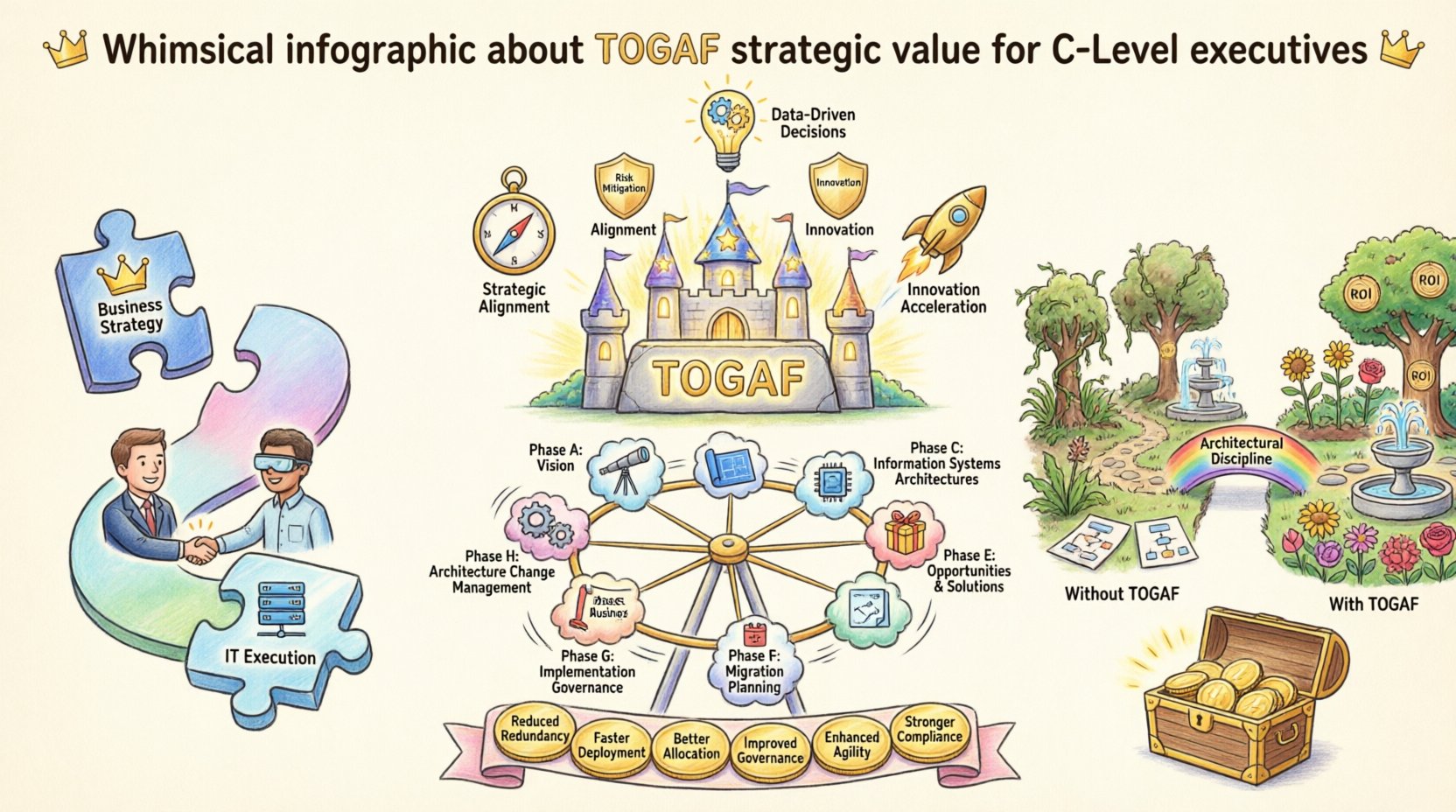
🚀 The Architecture Development Method (ADM): A Strategic Cycle
The heart of TOGAF is the Architecture Development Method (ADM). While technically detailed, executives should view the ADM as a strategic management cycle. It ensures that every project undergoes rigorous scrutiny before resources are committed.
Phase A: Architecture Vision
This phase sets the scope and direction. Leaders define the business drivers for the project. It answers the question: “Why are we doing this?” This prevents teams from building solutions that do not solve actual business problems.
Phase B: Business Architecture
Here, the organization maps its business processes and capabilities. This ensures that any technology change supports the actual way work gets done, rather than disrupting it.
Phase C: Information Systems Architectures
This covers the data and application layers. It ensures that data flows correctly between systems and that applications integrate seamlessly. For executives, this means better data visibility and reduced silos.
Phase D: Technology Architecture
This defines the hardware and network infrastructure. It ensures that the foundation is capable of supporting the applications and data requirements.
Phase E: Opportunities and Solutions
This phase identifies the best path forward. It evaluates different solutions against cost, risk, and benefit. It is a critical decision point for leadership.
Phase F: Migration Planning
How do we get from the current state to the target state? This phase creates a realistic roadmap. It acknowledges that transformation takes time and resources.
Phase G: Implementation Governance
During the actual build, this phase ensures that the implementation matches the design. It prevents drift and ensures quality.
Phase H: Architecture Change Management
Once the architecture is live, changes must be managed. This phase ensures the architecture evolves as the business changes, maintaining its integrity over time.
For C-Level executives, the ADM is not about managing code. It is about managing the lifecycle of business capability. It ensures that every dollar spent moves the organization toward its strategic vision.
⚖️ Managing Risk and Compliance
In an era of increasing regulation and cyber threats, architecture is a key component of risk management. TOGAF provides mechanisms to identify and mitigate risks early in the process.
- Data Privacy: By mapping data flows, organizations can identify where sensitive information resides and ensure it is protected.
- Regulatory Compliance: Architecture can be designed to meet specific industry standards (e.g., GDPR, HIPAA) from the start.
- Business Continuity: The framework encourages the design of resilient systems that can withstand disruptions.
When an organization uses TOGAF, it does not treat compliance as a checklist item at the end of a project. Instead, compliance is baked into the architectural requirements. This proactive stance reduces the cost and effort of audits and regulatory reviews.
💰 Return on Investment (ROI) and Value Realization
Executives are rightfully focused on financial outcomes. While TOGAF is a framework, not a direct revenue generator, it creates the conditions for financial efficiency.
Reduced Redundancy: By identifying overlapping systems, organizations can consolidate licenses and infrastructure, lowering operational costs.
Faster Deployment: Standardized components allow teams to build new solutions faster. This agility translates to competitive advantage.
Better Resource Allocation: With a clear roadmap, resources are directed to high-priority initiatives rather than firefighting daily issues.
However, realizing this value requires commitment. It is not an overnight fix. It requires a shift in culture towards long-term planning over short-term wins.
🛑 Common Implementation Challenges
Adopting a framework like TOGAF is not without challenges. Leaders must be aware of potential pitfalls to ensure success.
- Over-Engineering: The framework can become too bureaucratic if applied rigidly. It should be tailored to the organization’s size and complexity.
- Lack of Buy-in: If stakeholders do not understand the value, they may resist the process. Communication is key.
- Resource Intensity: Maintaining architecture requires skilled personnel. Organizations must invest in training or hiring.
- Static Documentation: Architecture documents can become outdated quickly. They must be living artifacts updated regularly.
Success depends on finding the right balance. The framework should serve the business, not the other way around.
🌐 Future Proofing the Enterprise
Technology evolves rapidly. Artificial Intelligence, cloud computing, and IoT are reshaping industries. TOGAF provides the stability needed to navigate these changes.
By establishing a stable core architecture, organizations can plug in new technologies without destabilizing existing operations. The framework encourages modularity, which allows for the swapping of components as technology advances.
- Adaptability: The ability to pivot quickly when market conditions change.
- Innovation: A clean architecture provides a safe sandbox for testing new ideas.
- Sustainability: Efficient systems consume less energy and resources, supporting environmental goals.
Leaders who prioritize TOGAF are positioning their organizations to handle whatever comes next. They are building a foundation that supports growth rather than hindering it.
📊 The Role of the Enterprise Architect
Within this structure, the Enterprise Architect plays a pivotal role. They act as the bridge between the boardroom and the server room. They translate strategic intent into technical requirements.
For this role to be effective, it requires authority and influence. The architect must have a seat at the table where decisions are made. This ensures that technical constraints are considered before strategies are finalized.
Key responsibilities include:
- Maintaining the enterprise architecture repository.
- Facilitating communication between business and IT units.
- Ensuring adherence to architectural principles.
- Identifying opportunities for improvement.
🏁 Final Thoughts on Strategic Alignment
The strategic value of TOGAF lies in its ability to bring order to chaos. It provides a disciplined approach to managing complexity. For C-Level executives, it offers a way to ensure that technology investments deliver measurable business value.
It is not about following rules for the sake of rules. It is about creating a sustainable environment where innovation can flourish without compromising stability. By adopting this framework, organizations build the resilience needed to thrive in a volatile market.
The journey requires dedication and investment. However, the payoff is an organization that is agile, efficient, and aligned with its strategic goals. In a competitive landscape, this alignment is not just an advantage; it is a necessity.