
Walking into a senior project management interview is different from stepping into an entry-level role. The conversation shifts from “Can you manage a schedule?” to “Can you steer the organization through uncertainty?”. Senior project managers are expected to bring a level of strategic foresight, political acumen, and leadership depth that goes beyond simple task tracking. This guide breaks down exactly how experienced professionals demonstrate this expertise without relying on buzzwords or generic answers.
When interviewers for senior positions ask questions, they are often looking for patterns in your decision-making. They want to know how you handle ambiguity, how you influence without authority, and how you align project outcomes with business value. The following sections outline the core pillars of a successful senior project management interview.
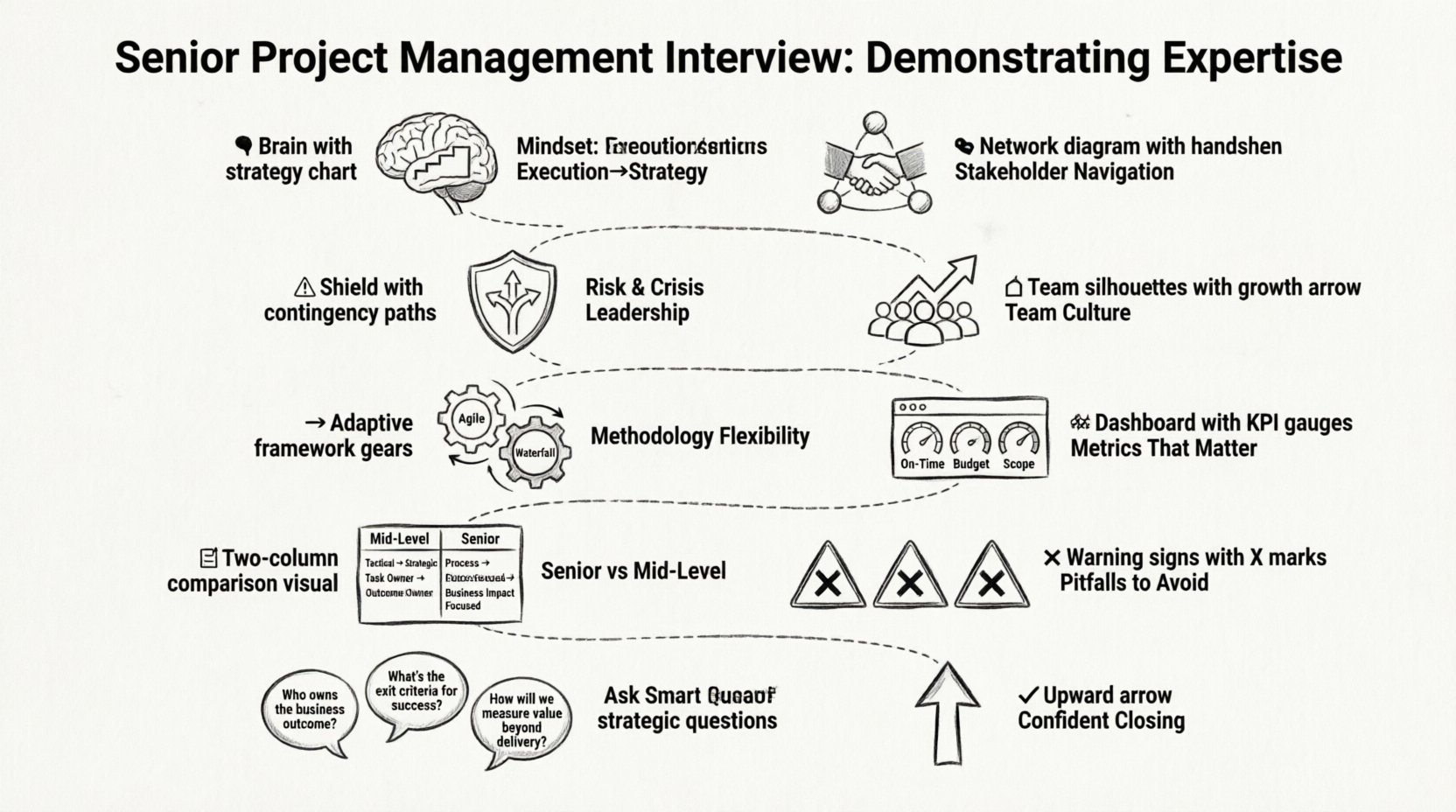
1. The Mindset Shift: From Execution to Strategy 🧠
Junior and mid-level managers often focus heavily on the how. They talk about Gantt charts, resource allocation, and daily stand-ups. Senior managers, however, must pivot the conversation toward the why. You need to demonstrate that you understand the business context driving the project.
To show this expertise, avoid listing every tool you have used. Instead, frame your experience around outcomes. For example:
- Business Alignment: Explain how you ensure project goals match the company’s fiscal year objectives.
- Portfolio View: Discuss how you manage dependencies between multiple projects to maximize overall resource efficiency.
- Value Delivery: Focus on the return on investment (ROI) and how you measure success beyond time and budget.
When describing past projects, start with the business problem. “The organization needed to reduce time-to-market by 20%. We initiated a hybrid delivery model to achieve this.” This immediately signals that you think about the bottom line, not just the deliverables.
2. Stakeholder Management and Political Navigation 🤝
At a senior level, the most difficult part of the job is rarely the technical work. It is managing the people and the politics. Interviewers want to know how you navigate complex organizational structures where stakeholders often have conflicting interests.
Do not simply say you are a good communicator. Provide specific examples of conflict resolution. Consider the following areas where expertise is demonstrated:
- Expectation Management: How do you handle a situation where leadership expects a feature in two weeks, but the team needs two months? You explain the negotiation process, the trade-offs offered, and the final agreement reached.
- Influence Without Authority: Senior managers often lead teams they do not directly hire or fire. Describe how you build trust and leverage relationships to get work done.
- Escalation Paths: Show you know when to solve a problem yourself and when to bring it to the executive level. Mention specific criteria you use to determine the severity of an issue.
A strong answer involves the who, the what, and the outcome. Who was the stakeholder? What was the conflict? What was the result of your intervention?
3. Risk Management and Crisis Leadership ⚠️
Everyone talks about risk management, but few do it effectively. Junior managers often list risks in a register and hope they do not happen. Senior managers demonstrate expertise by having contingency plans ready and by proactively mitigating threats before they become issues.
When discussing risk, avoid generic statements like “I monitor risks closely.” Instead, describe your framework:
- Identification: How do you gather input from the team and stakeholders to find hidden risks?
- Assessment: Explain how you quantify risk. Is it based on probability? Impact? Cost? Reputational damage?
- Mitigation: What specific actions do you take? Do you assign owners? Do you adjust the budget?
- Crisis Response: Describe a time a project went off the rails. How did you stabilize the situation? What communication protocol did you use?
If you can discuss a specific crisis where you saved a project through decisive action, that is powerful. It shows you remain calm under pressure and can make tough calls quickly.
4. Team Leadership and Culture Building 🏗️
Senior project managers are leaders first. They build environments where teams can thrive. This goes beyond managing tasks; it involves managing morale, productivity, and growth.
Discuss your approach to team dynamics:
- Remote and Hybrid Teams: How do you maintain cohesion when the team is distributed? What tools or rituals do you use to keep everyone aligned?
- Performance Management: How do you handle underperformance? Do you coach, document, or escalate? Show that you are fair but firm.
- Mentorship: Senior managers often mentor junior staff. Mention how you help others grow within the organization.
- Psychological Safety: Create a culture where team members feel safe to admit mistakes. Explain how you handle errors without assigning blame.
Interviewers are looking for emotional intelligence. They want to know if you can read the room and adjust your leadership style to fit the team’s needs.
5. Methodologies: Frameworks vs. Flexibility 🔄
You should be familiar with various delivery frameworks. However, a senior manager knows that no single methodology fits every situation. The ability to adapt is key.
Do not claim to be a pure Agile or pure Waterfall advocate. Instead, explain your philosophy of tailored delivery:
- Agile: When do you use sprints? How do you manage scope creep in an iterative environment?
- Waterfall: When is a linear approach better? (e.g., compliance-heavy industries, fixed-price contracts).
- Hybrid: How do you combine methodologies? For example, using Agile for development but Waterfall for regulatory approval.
Emphasize that the methodology serves the project, not the other way around. This shows maturity and practical experience.
6. Measuring Success: Metrics and KPIs 📊
How do you know if you have succeeded? Senior managers define success through data, not just feelings. You must be able to articulate the metrics you track and why they matter.
Consider including these metrics in your discussion:
- Delivery Velocity: How consistently does the team meet commitments?
- Budget Variance: Are you over or under budget, and why?
- Quality Metrics: Defect rates, bug counts, or customer satisfaction scores.
- Stakeholder Satisfaction: Net Promoter Score (NPS) from internal or external clients.
- Team Health: Retention rates, burnout indicators, or engagement survey results.
Be prepared to explain how you balance these metrics. For instance, pushing for higher velocity might hurt quality. How do you find the balance?
7. Comparison of Senior vs. Mid-Level PM Behaviors 📋
To clarify the distinction, here is a breakdown of how senior managers differ from mid-level managers in typical scenarios.
| Area | Mid-Level PM Focus | Senior PM Focus |
|---|---|---|
| Scope | Single project delivery | Portfolio alignment and interdependencies |
| Risk | Tracking known risks | Proactive threat identification and mitigation |
| Stakeholders | Reporting status updates | Negotiating priorities and managing expectations |
| Team | Assigning tasks | Coaching, mentoring, and removing blockers |
| Tools | Using software for tracking | Designing processes that fit the tool, not vice versa |
| Success | On time and on budget | Business value realized and strategic impact |
8. Common Pitfalls to Avoid ❌
Even experienced professionals can stumble during interviews. Watch out for these common mistakes that undermine your authority.
- Over-reliance on Tools: If you spend half the interview talking about specific software features, you may appear too tactical. Focus on the process, not the platform.
- Blaming Others: Never say a project failed because the team was lazy or stakeholders were difficult. Take ownership. Discuss what you could have done differently.
- Being Too Vague: Avoid phrases like “I managed the project”. Be specific about your role, the size of the budget, the number of people, and the complexity.
- Ignoring Culture: If you do not research the company’s values, your answers may not resonate. Align your examples with their culture.
- Answering Too Quickly: Senior roles require thought. It is okay to pause before answering. It shows you are considering the nuance of the question.
9. The Art of the Question 🤔
Interviewing is a two-way street. Asking smart questions demonstrates your strategic thinking. It shows you are evaluating them just as much as they are evaluating you.
Ask questions such as:
- “How does the organization currently measure the success of a project beyond delivery?”
- “What are the biggest challenges facing the department right now?”
- “How is decision-making structured when priorities conflict between projects?”
- “What is the maturity level of the current project management office (PMO)?”
These questions show you are thinking about the bigger picture and how you will fit into the existing ecosystem.
10. Closing the Interview with Confidence 🚀
How you end the interview matters. You want to leave a lasting impression of competence and readiness. Summarize your key strengths without repeating your resume verbatim.
Reiterate your value proposition:
- Alignment: “I bring a track record of aligning project delivery with strategic business goals.”
- Leadership: “I have successfully led distributed teams through complex transformations.”
- Stability: “I am skilled at navigating risk and maintaining team morale during high-pressure periods.”
End with a clear next step. Express your enthusiasm for the opportunity and ask about the timeline for the next phase. This shows you are organized and eager to move forward.
Remember, the goal of the interview is not just to prove you can do the job. It is to prove you can do the job better than anyone else in the room. By focusing on strategy, leadership, and value, you position yourself as the expert candidate. Good luck.