
Choosing the right framework for project management is a foundational decision that impacts every aspect of delivery, from team morale to final product quality. When stakeholders ask about Scrum vs. Waterfall, they are often seeking clarity on how work gets structured, how changes are handled, and when value is actually delivered to the user. Both methodologies have distinct origins, philosophies, and operational rhythms.
This guide provides an objective breakdown of both approaches. We will explore the mechanics of sequential planning versus iterative development, analyze where each fits best, and examine the cultural shifts required to implement them effectively. No hype, just practical insights to help you navigate project management landscapes with confidence.
Understanding the Waterfall Model 📉
Waterfall is a traditional project management approach that treats development as a linear sequence of phases. It originated in manufacturing and construction industries, where changes to a design after the foundation is poured are prohibitively expensive. In software and digital projects, this rigidity can sometimes be a liability, but in regulated environments, it offers necessary stability.
The Sequential Phases
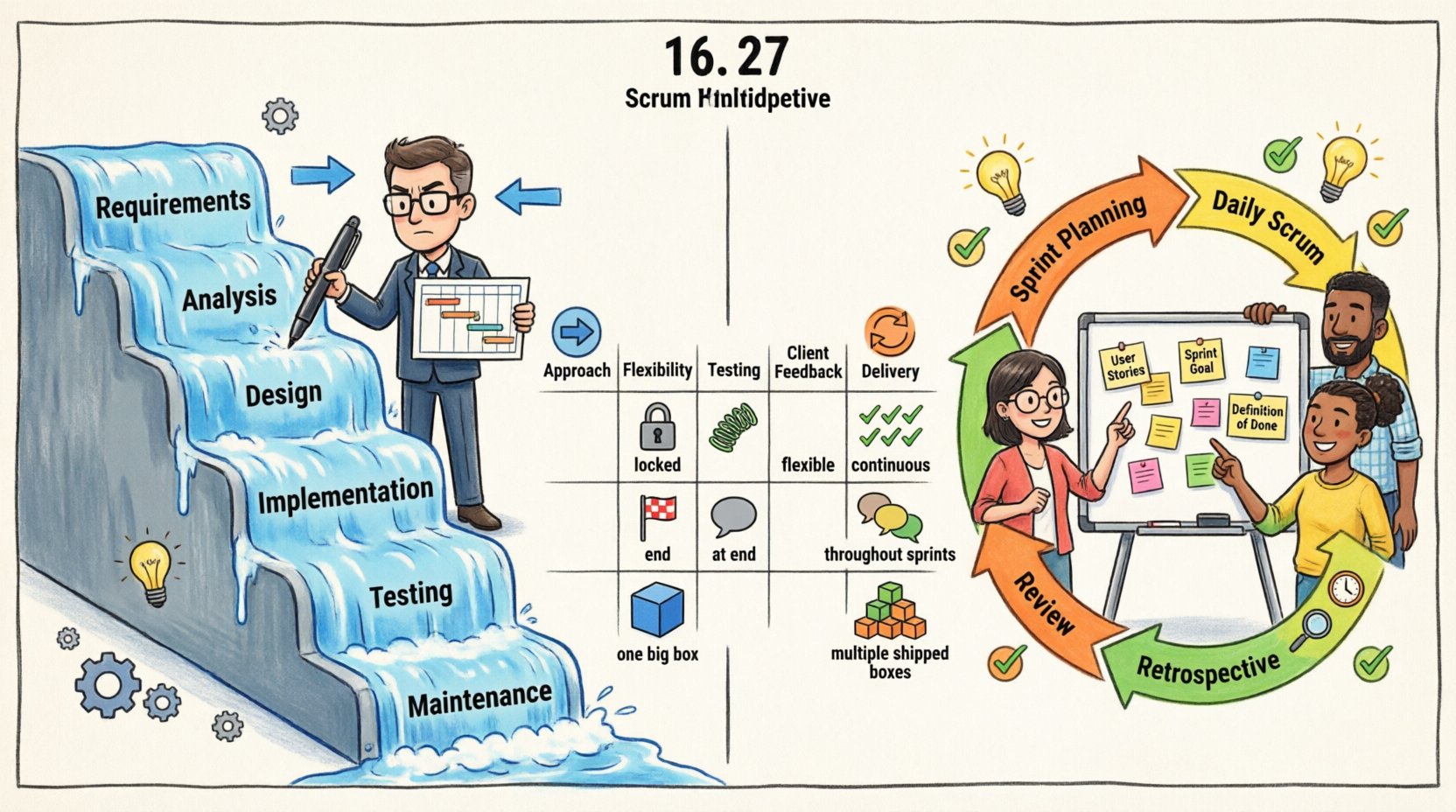
Waterfall operates on the principle that one phase must be completed and signed off before the next begins. You cannot start coding before the design is finalized, and you cannot test before the code is written. The typical lifecycle includes:
- Requirements: Gathering all necessary specifications upfront. Stakeholders define exactly what the system must do.
- Analysis: Understanding how the requirements translate into technical needs.
- Design: Creating the architecture, database schemas, and user interface mockups.
- Implementation: The actual coding or building of the product.
- Testing: Verifying that the built product matches the initial requirements.
- Maintenance: Ongoing support and bug fixes after deployment.
In this model, documentation is paramount. If a requirement is not written down, it is often considered out of scope. This ensures that everyone agrees on the deliverables before a single line of code is executed.
Key Characteristics of Waterfall
- Fixed Scope: The goal is to deliver exactly what was promised at the start.
- Heavy Planning: A significant portion of time is spent planning and designing before execution.
- Sequential Flow: Work moves from left to right in a single direction.
- Role Specialization: Teams are often organized by function (e.g., analysts, designers, developers, testers).
- Client Involvement: Stakeholders typically review deliverables at major phase gates, not continuously.
Understanding the Scrum Framework 🏎️
Scrum is an Agile framework that focuses on iterative progress, collaboration, and flexibility. It acknowledges that requirements often change as the market evolves or as users interact with the product. Instead of predicting the future, Scrum adapts to the present.
Scrum divides work into short cycles called Sprints, usually lasting two to four weeks. At the end of every Sprint, the team produces a potentially shippable increment of the product. This allows for frequent feedback and course correction.
The Three Pillars
To function correctly, Scrum relies on three pillars that support empirical process control:
- Transparency: The work, the progress, and the problems must be visible to all team members and stakeholders.
- Inspection: Frequent checks on the progress toward the goal to detect variances early.
- Adaptation: Adjusting the process or the product based on what is learned during inspection.
Core Roles
Scrum defines three specific accountabilities to ensure clarity and focus:
- Product Owner: Responsible for maximizing value. They manage the Product Backlog, prioritizing items based on business needs and user feedback.
- Scrum Master: A servant leader who ensures the team follows the Scrum theory and practices. They remove impediments and facilitate meetings.
- Development Team: A cross-functional group of professionals who do the work. They are self-managing and decide how to turn backlog items into value.
Scrum Events and Artifacts
Structure is provided through specific events and artifacts designed to create rhythm and transparency:
- Sprint Planning: A meeting to select items from the backlog to work on during the upcoming Sprint.
- Daily Scrum: A short daily sync for the Development Team to plan the next 24 hours.
- Sprint Review: A demonstration of the work done to stakeholders for feedback.
- Sprint Retrospective: A session for the team to reflect on their process and identify improvements.
Scrum vs. Waterfall: Core Differences 📊
Comparing these two methodologies requires looking at how they handle uncertainty, change, and delivery. The table below outlines the fundamental distinctions.
| Feature | Waterfall | Scrum (Agile) |
|---|---|---|
| Approach | Sequential / Linear | Iterative / Incremental |
| Flexibility to Change | Low (Changes are costly) | High (Changes welcomed) |
| Testing | Occurs after development | Continuous throughout |
| Client Feedback | At the end of the project | At the end of every Sprint |
| Documentation | Comprehensive upfront | Just enough for current need |
| Risk Management | High risk of late failure | Risks identified early |
| Delivery | Single release at the end | Frequent releases |
Deep Dive: Waterfall Mechanics and Risks 🛑
While Waterfall is often criticized in modern software circles, it remains the standard for industries where safety and compliance are non-negotiable, such as healthcare, aviation, and construction. The logic is sound: if a bridge collapses, you cannot “iterate” your way to a fix.
Advantages of Waterfall
- Clear Structure: Everyone knows what is expected at every stage. There is little ambiguity about the process.
- Discipline: The requirement for sign-offs ensures that decisions are deliberate and documented.
- Cost Estimation: Budgets and timelines can be estimated more accurately at the start because the scope is fixed.
- Regulatory Compliance: The heavy documentation trail satisfies auditors and regulators who need proof of process.
Disadvantages of Waterfall
- Delayed Feedback: If the product does not meet user needs, it is discovered only at the very end, often after significant resources have been spent.
- Inflexibility: Adapting to new market conditions mid-project requires revisiting previous phases, which is expensive and difficult.
- High Risk: A critical error in the requirements phase can cascade through the entire project, leading to total failure.
- Team Morale: Developers may feel disconnected from the final product, working on tasks without seeing immediate results.
Deep Dive: Scrum Mechanics and Culture 🚀
Scrum is not just a set of meetings; it is a cultural shift. It requires a move from command-and-control management to servant leadership. The team is trusted to solve problems, which can be intimidating for organizations used to strict hierarchy.
Advantages of Scrum
- Early Value: The most important features are built first. Stakeholders see value early in the project timeline.
- Adaptability: If the market changes or a competitor launches a new feature, the Product Owner can adjust the backlog immediately.
- Quality: Testing happens continuously. Bugs are found and fixed in the same Sprint they are introduced.
- Transparency: Progress is visible daily through the Daily Scrum and Sprint Reviews. There are no surprises.
- Team Engagement: Self-managing teams often report higher satisfaction and ownership over their work.
Disadvantages of Scrum
- Less Predictable Scope: It is difficult to guarantee a fixed delivery date or price for a large project upfront because the scope evolves.
- Dependency on Culture: It fails in environments where micromanagement is the norm or where teams are not cross-functional.
- Documentation Gaps: The focus on working software over comprehensive documentation can lead to knowledge loss if not managed carefully.
- Meeting Overhead: The rhythm of Scrum requires discipline. If ceremonies are rushed or skipped, the framework loses its benefits.
When to Choose Waterfall vs. Scrum 🧭
There is no universal best method. The choice depends entirely on the nature of the project, the stability of requirements, and the organizational culture.
Scenarios Favoring Waterfall
- Fixed Regulations: Projects subject to strict government or industry regulations that require extensive documentation and sign-off.
- Clear Requirements: When the client knows exactly what they want, and the solution is well-understood.
- Hardware Integration: Projects involving physical hardware where changes are physically impossible or too costly after production begins.
- Short Duration: Small projects with a fixed deadline where the effort is predictable.
Scenarios Favoring Scrum
- Innovation: When creating a new product where the market is unknown and requirements will evolve based on user behavior.
- Complexity: Projects with high technical complexity where problems are likely to be discovered only during development.
- Urgency: When getting a Minimum Viable Product (MVP) to market quickly is more important than perfecting the entire scope.
- High Stakeholder Availability: When the Product Owner and stakeholders can dedicate time to regular reviews and feedback.
Risk Management and Cost Implications 💰
Financial risk is a major differentiator between these two frameworks. In Waterfall, the risk is front-loaded in the planning phase. If you misjudge the cost or time, you are committed to that path until the end. This can lead to “death marches” where teams work overtime to meet a fixed deadline that was set on flawed data.
In Scrum, the risk is distributed. By delivering in increments, you can cancel a project at any time. If the market shifts or the budget runs dry, you stop the Sprint. You have not wasted money on features that are no longer valuable. This is often referred to as “fail fast, learn fast.” However, this requires a different financial mindset from leadership. Stakeholders must be comfortable with a variable budget and timeline in exchange for higher probability of value.
Team Dynamics and Organizational Culture 👥
Methodologies do not exist in a vacuum. They interact with the people executing them. Waterfall often aligns with traditional organizational charts where managers assign tasks to specialists. A project manager acts as the commander, ensuring each department meets its deadlines.
Scrum requires a flatter structure. The Development Team is responsible for their own output. The Scrum Master does not assign tasks but facilitates the team’s ability to work together. This shift can be challenging for middle management. Leaders must transition from directing work to enabling it.
- Communication: Waterfall relies on formal reports and documents. Scrum relies on face-to-face conversation and visible boards.
- Accountability: In Waterfall, accountability is individual (did you finish your task?). In Scrum, accountability is collective (did the team deliver the Sprint goal?).
- Feedback Loops: Waterfall has long feedback loops. Scrum has short feedback loops.
Common Misconceptions About Scrum and Waterfall 🚫
As these frameworks have become popular, myths have emerged that obscure their true utility.
- Myth: Scrum has no planning. Truth: Scrum involves extensive planning, but it is just-in-time. You plan the Sprint, not the whole year.
- Myth: Waterfall is outdated. Truth: Waterfall is still effective for many types of work, particularly construction and regulated manufacturing.
- Myth: Scrum means no documentation. Truth: Documentation is needed, but it is focused on what is necessary for the current iteration, not a 500-page manual.
- Myth: You can mix them easily. Truth: While some teams try a hybrid approach, the underlying philosophies are often contradictory. Mixing them without understanding can lead to “Agile-washing”—doing the meetings without the mindset.
Final Thoughts on Project Methodology 🌟
Selecting between Scrum and Waterfall is not about finding the perfect system; it is about aligning your process with your reality. If you need predictability, compliance, and fixed scopes, Waterfall provides a sturdy foundation. If you need agility, innovation, and responsiveness to change, Scrum offers the necessary flexibility.
The best project managers understand both. They know when to apply rigid structure to ensure safety and when to embrace uncertainty to drive value. Regardless of the choice, success comes from clarity of purpose, effective communication, and a commitment to delivering quality work. Evaluate your constraints, understand your team, and choose the path that serves your specific goals.
By understanding the mechanics of each, you can avoid common pitfalls and build a delivery process that supports both your business objectives and your team’s well-being. The journey from requirements to delivery is complex, but the right framework makes the path clearer.