
In the world of Agile development, few metrics generate as much debate as velocity. On one hand, it promises clarity: a predictable rate of delivery. On the other, it threatens the team’s well-being: a weapon for micromanagement. When implemented poorly, velocity tracking transforms from a helpful compass into a source of stress. 🛑
Scrum teams often find themselves caught between the need for predictability and the desire for a sustainable pace. This guide explores how to track velocity accurately without sacrificing team health. We will look at the mechanics of velocity, the psychological impact of measurement, and how to use data to empower rather than dictate.
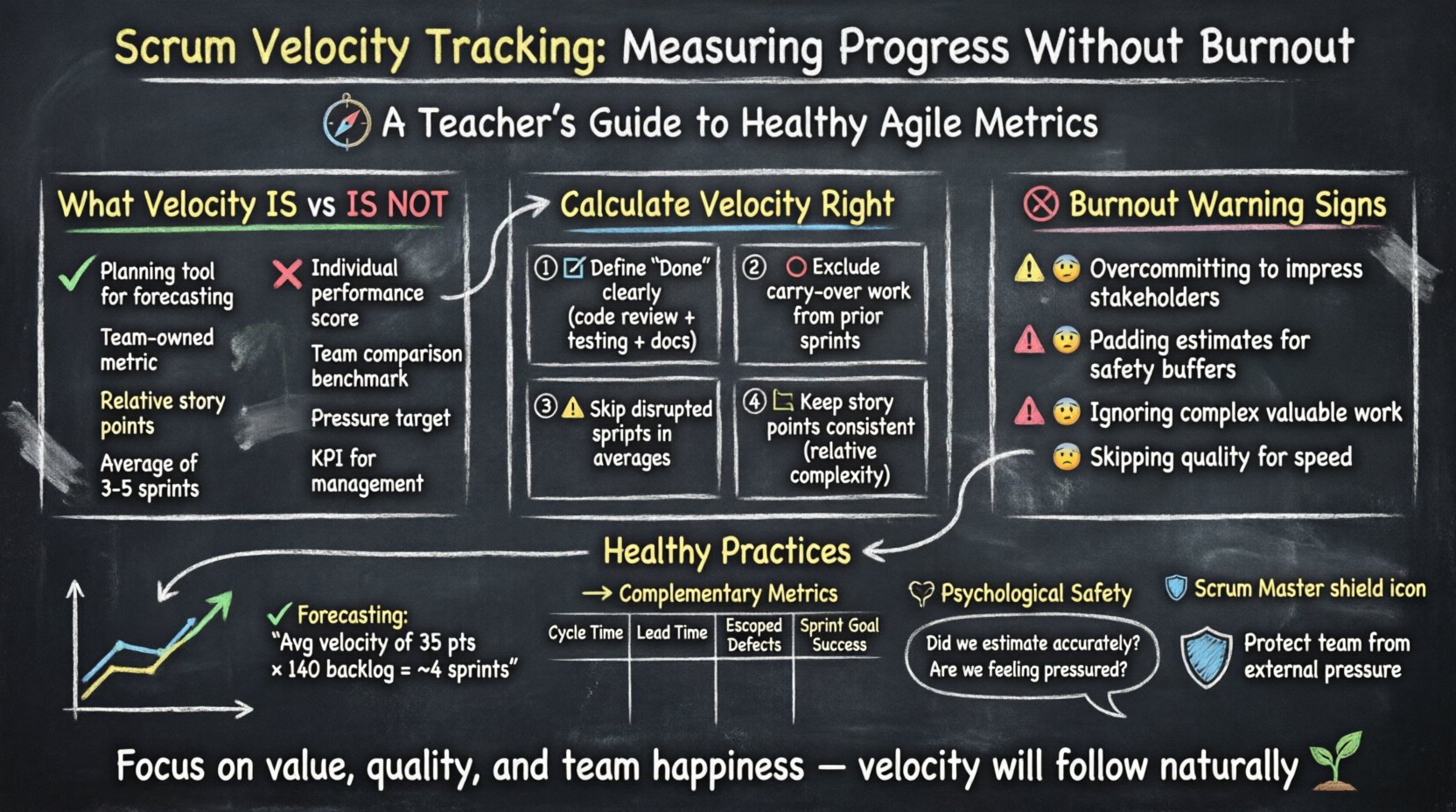
🧠 What is Scrum Velocity Really?
Velocity is a measure of the amount of work a Scrum team can tackle during a single Sprint. It is calculated by summing up the Story Points of all completed User Stories in a Sprint. However, understanding the definition is only half the battle. Understanding the intent is crucial.
Velocity is not a measure of individual performance. It is not a benchmark to compare teams against one another. It is a planning tool designed to help the Development Team forecast how much work they can commit to in future Sprints. 📊
When teams treat velocity as a KPI (Key Performance Indicator), the focus shifts from value delivery to hitting a number. This shift is where burnout begins. To avoid this, the team must reclaim velocity as a private metric, owned solely by the Development Team.
⚖️ The Burnout Connection: Why Velocity Hurts
Many organizations misuse velocity data. Management might look at a team’s velocity and ask, “Why did we only complete 30 points last month? We need 40 this month.” This external pressure creates a toxic environment.
When velocity is used to judge productivity, several negative behaviors emerge:
- Overcommitting: Teams promise more work than they can handle to impress stakeholders.
- Padding Estimates: Developers inflate story points to create a safety buffer, reducing the accuracy of the metric.
- Ignoring Complexity: Easy tasks are prioritized over complex, valuable work to boost the numbers.
- Quality Neglect: Technical debt is ignored because it does not add to the immediate velocity count.
This environment leads to fatigue. Developers stop caring about the quality of the code and focus solely on closing tickets. This is the definition of burnout. To prevent this, velocity must be decoupled from performance reviews.
📉 How to Calculate Velocity Correctly
Accurate calculation requires discipline. It is not enough to simply add up points. The process must be consistent and transparent. Here is the standard methodology for calculating velocity without introducing bias.
1. Define “Done” Clearly
A story is only counted in velocity if it meets the Definition of Done (DoD). If a story is 90% complete, it counts as zero. This prevents teams from reporting inflated numbers based on partial work. The DoD should include code review, testing, and documentation.
2. Exclude Completed Work from Previous Sprints
Work carried over from a previous Sprint does not count toward the current Sprint’s velocity. Only work completed within the current timebox contributes to the score. This ensures the metric reflects current capacity.
3. Handle Disrupted Sprints
What happens if a Sprint is interrupted? If a Sprint is cut short due to unforeseen circumstances, the velocity for that period is invalid. Do not average it in. Instead, note the disruption and use the next full Sprint for calculation.
4. Consistency in Story Points
The team must agree on what a “point” represents. It should be relative, not absolute time. If the team decides a point equals a certain complexity, that standard must remain consistent over time. Changing the scale midway through a project invalidates historical velocity data.
📈 Using Velocity for Forecasting, Not Pressure
The primary use of velocity is forecasting. It helps the team answer: “How many Sprints will it take to finish this backlog?” It does not answer: “Are you working hard enough?”
Forecasting relies on the concept of the average. A single Sprint’s velocity is noisy. It fluctuates due to holidays, sick leave, or technical challenges. To get a reliable forecast, use the average velocity over the last 3 to 5 Sprints.
This smoothing effect reduces the impact of anomalies. It provides a realistic view of capacity. When stakeholders ask for a delivery date, the team can say, “Based on our average velocity of 35 points per Sprint, and a remaining backlog of 140 points, we estimate 4 Sprints.”
This approach is data-driven but not punitive. It relies on the team’s own historical data, not external expectations.
🔄 Alternatives and Complementary Metrics
Velocity is not the only metric that matters. In fact, relying solely on velocity can hide important issues. A high velocity does not guarantee a healthy team or a stable product. Consider using a dashboard of metrics to get a full picture.
| Metric | What it Measures | Why it Matters |
|---|---|---|
| Velocity | Output per Sprint | Forecasting future capacity |
| Cycle Time | Time from start to finish | Identifying bottlenecks in flow |
| Lead Time | Time from request to delivery | Customer responsiveness |
| Escaped Defects | Bugs found in production | Quality and stability |
| Sprint Goal Success | Achievement of objectives | Focus and value delivery |
Cycle time is particularly useful for preventing burnout. If cycle time increases, the team is stuck. This signals that they need help with impediments before adding more work to the queue. Velocity might stay high while cycle time spikes, creating a false sense of health.
🧘 Psychological Safety and Team Health
The most important factor in sustainable velocity is psychological safety. Team members must feel safe to admit when they are struggling without fear of punishment. If a developer hides a problem to protect the velocity number, the metric becomes useless.
Leaders and Scrum Masters play a critical role here. They must reinforce that velocity is a tool for the team, not a tool for management. During Retrospectives, discuss velocity trends openly. Ask questions like:
- Did we estimate accurately?
- Did we encounter unexpected technical debt?
- Did the Definition of Done slow us down?
- Are we feeling pressured to finish early?
If the answer to the last question is yes, the focus must shift to capacity management. It is better to complete fewer stories with high quality than to rush and break things.
🚫 Common Pitfalls to Avoid
There are specific traps that teams often fall into when tracking velocity. Recognizing these early can save a project from failure.
1. Comparing Teams
Comparing the velocity of Team A to Team B is a fundamental error. Every team has different skill levels, different contexts, and different definitions of a story point. Team A might have a high velocity because their points are small. Team B might have a low velocity because they tackle harder problems. Comparison breeds resentment and drives teams to game the system.
2. Chasing Numbers
When a team feels they must hit a specific number, they stop focusing on value. They might break large stories into tiny ones to increase the count. This increases overhead and fragmentation. Focus on value delivered, not points accumulated.
3. Ignoring Capacity
Velocity assumes 100% availability. It does not account for PTO, meetings, or support work. A team with 5 members might have a theoretical capacity of 50 points. If two members are on leave, the actual capacity drops. Always adjust for capacity during Sprint Planning.
4. Using Velocity for Individual Reviews
Linking velocity to individual bonuses or performance reviews is a direct path to burnout. It encourages hoarding information and refusing to help others. Work should be evaluated on the collective output of the team, not individual contributions.
🛠️ Implementing a Healthy Process
Transitioning to a healthy velocity tracking system takes time. It requires a shift in mindset. Here is a step-by-step approach to implementing this responsibly.
Step 1: Educate Stakeholders
Before tracking begins, explain to stakeholders what velocity is and what it is not. They need to understand that it is a forecast, not a promise. It is a team metric, not a management tool. This sets expectations early.
Step 2: Establish a Baseline
Do not expect accuracy in the first Sprint. The first few Sprints are for calibration. Use the data to find the team’s natural rhythm. Do not make changes based on the first Sprint’s numbers alone.
Step 3: Review in Retrospectives
Make velocity a regular topic in Retrospectives. Discuss the variance between planned and actual. If the team planned 40 points and finished 30, analyze why. Was the estimation off? Were there interruptions? This creates a feedback loop for improvement.
Step 4: Adjust Planning
Use the average velocity to plan future Sprints. If the average is 30, do not plan for 40. Plan for 30. If the team consistently completes more, they will naturally increase their capacity in future planning sessions. Let the team drive the increase, not management.
Step 5: Monitor Well-being
Keep an eye on team sentiment. If velocity is high but morale is low, something is wrong. High velocity can be a symptom of overwork. Prioritize well-being over speed. A rested team delivers better code faster in the long run.
📉 Handling Variance in Velocity
Velocity will fluctuate. It is normal. A team might have a high Sprint followed by a low Sprint. This is not a failure; it is reality. Factors influencing variance include:
- Team Composition: New members onboarding reduces velocity temporarily.
- Technical Debt: Paying down debt often slows down new feature velocity.
- External Dependencies: Waiting on third parties halts progress.
- Sprint Length: Changing Sprint length affects the total points available.
When variance occurs, do not panic. Look at the trend over time. A single data point is noise; a trend is a signal. If the trend is downward for three consecutive Sprints, investigate the root cause. Is the work getting harder? Is the team overwhelmed?
💡 The Role of the Scrum Master
The Scrum Master is the guardian of the process. They must protect the team from external pressure to manipulate velocity. If a Product Owner asks for more points next Sprint, the Scrum Master should guide them to look at the average velocity and capacity.
The Scrum Master also ensures that the team is not gaming the metrics. They facilitate honest estimation sessions. They encourage the team to say “no” during Sprint Planning if the workload is too high. This protection is essential for long-term sustainability.
🌱 Building a Sustainable Pace
Agile is about sustainability. The Scrum Guide emphasizes a sustainable pace. This means the team can maintain their velocity indefinitely without exhaustion. If a team burns out to hit a target, the target is wrong.
A sustainable pace allows for continuous improvement. It allows for learning. It allows for life outside of work. When velocity tracking supports this, it becomes a powerful tool. When it undermines this, it becomes a liability.
Focus on the quality of the work. Focus on the happiness of the team. Focus on the value delivered to the customer. Velocity will naturally follow if these three pillars are strong.
🔍 Final Thoughts on Measurement
Tracking Scrum velocity is a necessary part of Agile planning, but it requires care. It is a metric of capacity, not a measure of worth. By treating it as a private tool for the Development Team, organizations can avoid the pitfalls of micromanagement.
Remember that data is only useful if it leads to better decisions. If velocity data leads to stress, it is being used incorrectly. Realign the focus on predictability and flow. Use complementary metrics like cycle time to get a fuller picture of health.
Ultimately, the goal is not to maximize a number. The goal is to deliver value consistently and sustainably. When the team feels safe and supported, velocity becomes a natural reflection of their capability, not a target to be chased. 🎯
Adopt these practices to build a team that is not only productive but also resilient. A resilient team is the best asset an organization can have.