In the fast-paced environment of software development and product delivery, the success of a project often hinges less on the tools used and more on the people building them. Scrum, as an agile framework, places a heavy emphasis on individuals and interactions over processes and tools. However, simply adopting Scrum ceremonies does not guarantee high performance. The underlying engine of a successful Scrum team is its dynamics. This guide explores how to cultivate collaboration among peers, create psychological safety, and establish a self-organizing culture that drives sustainable value.
Understanding Scrum Team Dynamics 🧩
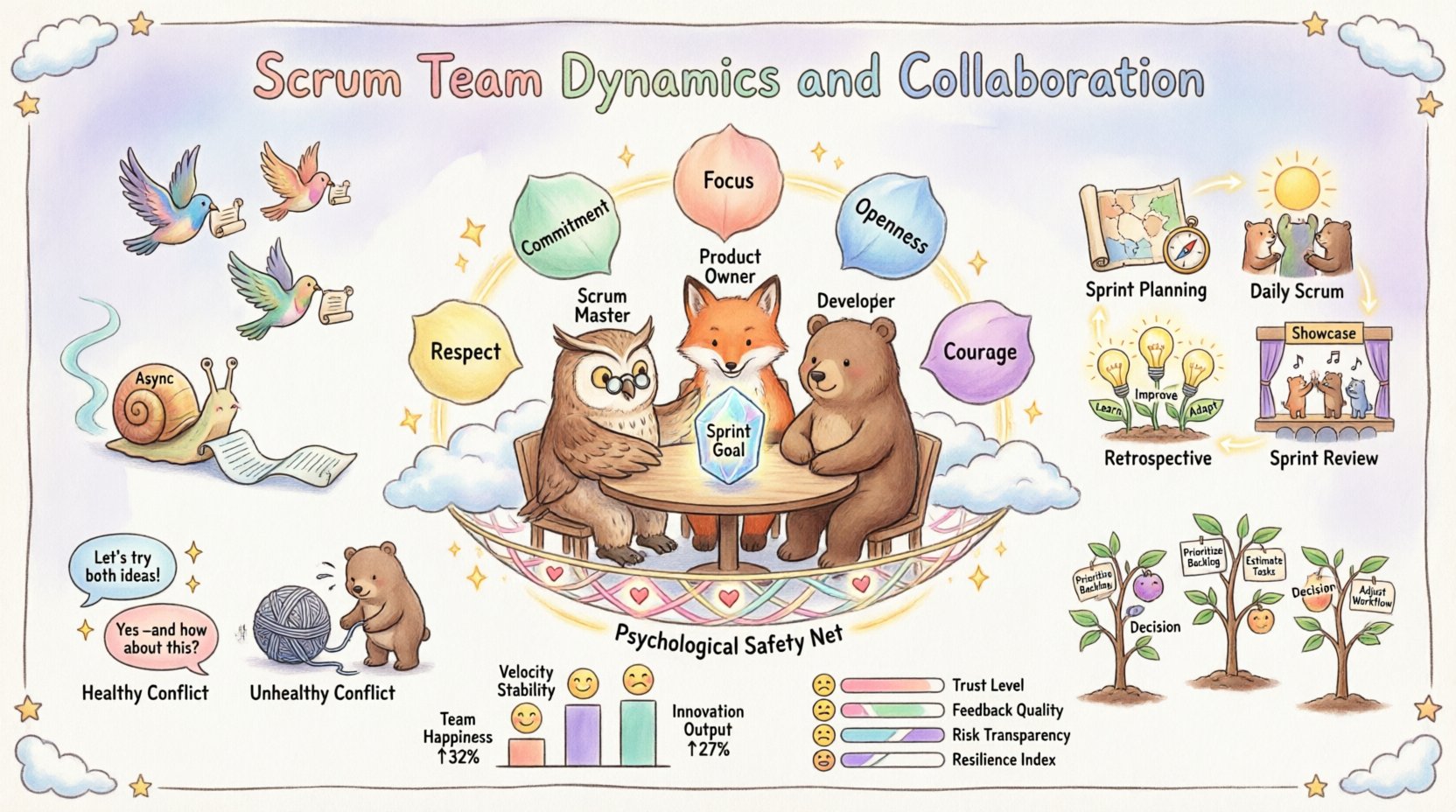
Scrum team dynamics refer to the psychological and behavioral patterns that emerge when a group of individuals work together towards a common goal. In a Scrum context, this involves the interactions between the Developers, the Product Owner, and the Scrum Master. It is not merely about assigning tasks; it is about how energy flows, how decisions are made, and how conflicts are resolved.
High-performing teams exhibit specific characteristics that distinguish them from average groups. These characteristics are not accidental. They are cultivated through intentional practices and a shared commitment to the Scrum values.
Key Components of Team Dynamics
- Trust: The foundation upon which all other interactions are built. Team members must feel safe to admit mistakes and ask for help.
- Communication: Open, transparent, and frequent exchanges of information reduce ambiguity and align expectations.
- Accountability: Individuals hold themselves and each other responsible for outcomes, not just individual tasks.
- Conflict Resolution: Healthy disagreement is encouraged to improve ideas, while destructive conflict is managed constructively.
- Autonomy: The team has the authority to decide how to turn Product Backlog items into increments of value.
The Scrum Values as a Cultural Anchor 🌱
Scrum is built on five values that guide team behavior. When these values are embraced, they naturally foster better collaboration among peers. Ignoring them often leads to friction and inefficiency.
1. Commitment
Team members commit to the work they undertake and to each other. This does not mean overworking or burning out. It means being dedicated to the Sprint Goal and supporting one another to achieve it. When a developer is blocked, the team mobilizes to unblock them rather than waiting for management intervention.
2. Focus
Collaboration requires shared attention. During a Sprint, the team focuses on the Sprint Goal. Distractions are minimized. Meetings are purposeful. This shared focus creates a rhythm where collaboration happens organically around the work, rather than as an add-on activity.
3. Openness
Openness is critical for transparency. This includes sharing progress, challenges, and risks. When information is hidden, collaboration breaks down. Openness allows peers to understand the context of each other’s work, leading to better problem-solving.
4. Respect
Respect means valuing the diverse skills and perspectives within the team. It involves listening actively and acknowledging contributions. Without respect, collaboration becomes a negotiation of egos rather than a partnership of skills.
5. Courage
Courage allows team members to do the right thing even when it is difficult. This includes saying no to scope creep, admitting that a plan is failing, or challenging a product requirement that does not make sense. Courageous collaboration leads to honest feedback and continuous improvement.
Psychological Safety: The Bedrock of Collaboration 🛡️
Research consistently shows that psychological safety is the single most important factor in team effectiveness. In a Scrum context, this means team members feel safe to take risks and be vulnerable in front of each other. If a developer fears being blamed for a bug, they will hide it. If a tester fears being ignored for raising a concern, they will stay silent.
Signs of Psychological Safety
- Team members admit mistakes without fear of retribution.
- Questions are welcomed, even if they seem basic.
- Ideas are debated based on merit, not hierarchy.
- Novel approaches are tried without fear of failure.
Building Psychological Safety
Building this environment requires deliberate effort from the entire team, particularly the Scrum Master.
- Normalize Failure: Treat failures as learning opportunities. Discuss them in Retrospectives without assigning blame.
- Active Listening: Practice listening to understand, not just to reply. Validate feelings and perspectives.
- Encourage Participation: Ensure quiet members are invited to share their thoughts. Avoid dominance by vocal individuals.
- Lead by Example: Leaders and Scrum Masters should admit their own mistakes openly to set the tone.
The Role of Scrum Events in Fostering Collaboration 🗓️
Scrum events are designed to provide regular opportunities for inspection and adaptation. They are also the primary venues for collaboration among peers. When these events are facilitated well, they become powerful engines for alignment.
Sprint Planning
This event is not just about assigning tasks. It is about collaborative planning. The team discusses the Sprint Goal and decides how to achieve it together. This ensures shared ownership of the plan.
- Collaborative Tasking: Instead of a manager assigning work, the Developers discuss who is best suited for specific tasks based on their skills and availability.
- Clarifying Requirements: The Product Owner explains the “what,” while the Developers ask questions to understand the “how.”
Daily Scrum
Often mistaken for a status update to a manager, the Daily Scrum is for the Developers to synchronize activities. It is a 15-minute inspection of progress toward the Sprint Goal.
- Peer Support: Team members identify impediments and ask peers for help immediately.
- Focus on the Goal: The discussion remains centered on the Sprint Goal, not individual task completion.
Sprint Review
This is a collaborative session with stakeholders. The team demonstrates the work and gathers feedback. It fosters collaboration between the team and the external environment.
- Feedback Loop: Immediate feedback helps the team adjust direction.
- Shared Understanding: Stakeholders understand the technical challenges, and the team understands business priorities.
Sprint Retrospective
The most critical event for internal team dynamics. The team inspects itself and creates a plan for improvements. This is where collaboration is deepened.
- Process Improvement: Discussing how the team works together, not just the work itself.
- Experimentation: Trying new ways of collaborating to see if they improve performance.
Conflict Resolution: Healthy vs. Unhealthy 🥊
Conflict is inevitable in any group of diverse individuals. The goal is not to eliminate conflict but to manage it constructively. Unhealthy conflict focuses on personalities and past grievances. Healthy conflict focuses on ideas and solutions.
Types of Conflict
| Aspect | Healthy Conflict (Task-Based) | Unhealthy Conflict (Relationship-Based) |
|---|---|---|
| Focus | Work, processes, and ideas | Personalities and egos |
| Outcome | Better solutions and innovation | Reduced morale and trust |
| Communication | Open, respectful, and direct | Passive-aggressive or hostile |
Strategies for Managing Conflict
- Address it Early: Small issues become big problems if ignored. Address them as soon as they arise.
- Focus on the Issue: Use “I” statements to express how a situation affects the work, rather than accusing others.
- Seek Common Ground: Remind the team of the shared Sprint Goal.
- Involve the Scrum Master: If the team cannot resolve it, the Scrum Master can facilitate a discussion to find a path forward.
Communication Patterns in Scrum Teams 📢
Effective collaboration relies on effective communication. In a Scrum team, communication should be frequent, transparent, and appropriate for the context.
Synchronous vs. Asynchronous
Not all communication needs to happen in real-time. Understanding the difference helps manage energy and focus.
- Synchronous (Real-time): Best for complex problem solving, brainstorming, and resolving conflicts. Examples: Daily Scrum, pair programming, Sprint Planning.
- Asynchronous: Best for information sharing, updates, and documentation. Examples: Status updates, documentation, recorded demos. This allows for deep work without interruption.
Communication Channels
- Visual Management: Use boards or charts to make work visible. This reduces the need for status meetings.
- Documentation: Keep documentation lightweight but accessible. Ensure knowledge is shared, not siloed.
- Direct Messages: Use for quick questions or private matters, but be careful not to create information silos.
Self-Organization and Decision Making 🧠
A core tenet of Scrum is that the team is self-organizing. This means the team decides how to do the work. This requires a shift in mindset from “waiting for instructions” to “taking initiative.”
Benefits of Self-Organization
- Increased Motivation: People are more motivated when they have control over their work.
- Faster Decision Making: Decisions are made by those closest to the information, reducing bottlenecks.
- Better Solutions: The collective intelligence of the team is leveraged.
Challenges to Overcome
- Ambiguity: Without clear direction, teams can wander. Clear goals are essential.
- Accountability: Without a manager assigning tasks, individuals must hold themselves accountable.
- Consensus: Reaching agreement can take time. Teams must learn to make decisions even without 100% agreement.
Measuring Team Health and Dynamics 📊
How do you know if your team dynamics are improving? You need metrics that reflect collaboration and health, not just output.
Qualitative Metrics
- Team Happiness: Regularly survey team members on how they feel about their work environment.
- Conflict Frequency: Track the number of interpersonal conflicts and how quickly they are resolved.
- Feedback Quality: Is feedback in Retrospectives actionable and constructive?
Quantitative Metrics
- Velocity Stability: Consistent velocity suggests stable team dynamics and reliable planning.
- Lead Time: Shorter lead times often indicate efficient collaboration and fewer bottlenecks.
- Defect Rate: High defect rates can indicate a lack of collaboration in code reviews or testing.
Common Pitfalls to Avoid ⚠️
Even well-intentioned teams can fall into traps that hinder collaboration.
- Role Silos: If Developers only talk to Developers, or Testers only talk to Testers, collaboration suffers. Encourage cross-functional interaction.
- Micro-management: When a Scrum Master or Product Owner dictates how work is done, it undermines self-organization.
- Ignoring Retrospectives: Skipping Retrospectives to “save time” is a mistake. It is the primary tool for improving dynamics.
- Over-reliance on Tools: Tools facilitate communication; they do not create it. Do not assume a ticket in a system means the team is collaborating.
Actionable Steps to Improve Collaboration 🚀
To begin improving your team dynamics today, consider implementing the following actions.
- Conduct a Team Health Check: Ask the team to rate their collaboration on a scale of 1 to 10. Discuss the gaps.
- Rotate Facilitation: Allow different team members to facilitate meetings to build shared ownership.
- Establish Working Agreements: Create a document outlining how the team wants to work together (e.g., meeting etiquette, response times).
- Encourage Pairing: Use pair programming or pair testing to increase knowledge sharing and reduce bottlenecks.
- Celebrate Wins: Acknowledge both individual and team successes to build positive momentum.
Conclusion on Continuous Improvement 🔄
Scrum team dynamics are not static. They evolve as the team matures, as the product changes, and as individuals grow. There is no final destination where a team is “perfect.” The goal is continuous improvement. By focusing on psychological safety, embracing Scrum values, and actively managing conflict, teams can build a collaborative environment that delivers high value and provides a satisfying work experience for everyone involved.
Remember, the framework provides the structure, but the people provide the soul. Invest in your team dynamics as much as you invest in your technical architecture. The return on investment is not just in velocity, but in resilience and innovation.