In the world of product development and project management, few methodologies have sparked as much debate as Scrum. While Agile principles have become the backbone of modern delivery, the specific framework of Scrum is frequently misunderstood. Teams often implement Scrum without truly grasping its core tenets, leading to ineffective processes and frustrated stakeholders. This guide aims to dismantle common misconceptions and provide a clear, authoritative look at what Scrum actually is, how it functions, and why the distinction between myth and reality matters for your organization.
Understanding the Foundation 🏗️
Before addressing the misconceptions, it is essential to establish what Scrum is not. Scrum is not a project management methodology in the traditional sense. It is not a set of rules that guarantees success. Instead, Scrum is a lightweight framework designed to help people, teams, and organizations generate value through adaptive solutions for complex problems.
The framework is built upon empiricism and lean thinking. Empiricism asserts that knowledge comes from experience and making decisions based on what is observed. Lean thinking reduces waste and focuses on the essential. Scrum provides a structure within which these principles can be applied.
- Scrum is a Framework: It consists of roles, events, artifacts, and rules.
- Agile is a Mindset: Scrum is one way to implement Agile principles.
- Value is the Goal: The primary objective is to deliver value to the customer, not just to follow a process.
Common Scrum Myths Debunked 🚫
Many organizations adopt Scrum thinking they can improve speed, only to find themselves stuck in a cycle of failed sprints. This often happens because they believe certain myths about how the framework operates. Below, we separate fact from fiction regarding the most persistent misconceptions.
1. Scrum is the Same as Agile ⚡
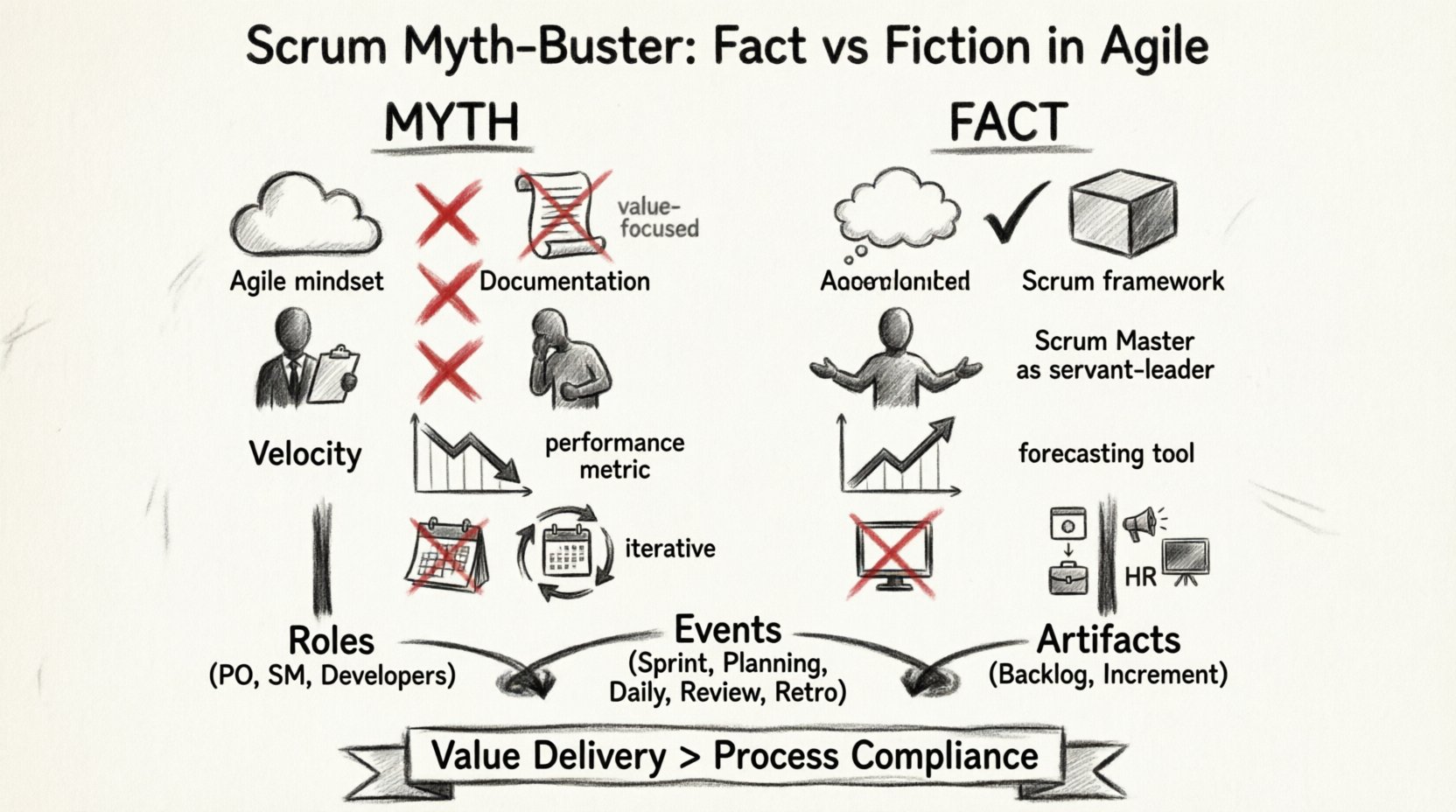
One of the most pervasive misunderstandings is equating Scrum with Agile. While related, they are distinct concepts. Agile is a set of values and principles outlined in the Agile Manifesto. It is a philosophy about how to approach work. Scrum is a specific framework that adheres to Agile values but provides a concrete structure for execution.
You can be Agile without using Scrum. You might use Kanban, Lean, or Extreme Programming. Conversely, you can use Scrum without being truly Agile if you ignore the underlying values and principles.
| Concept | Definition | Scope |
|---|---|---|
| Agile | A mindset and set of values | Philosophical approach |
| Scrum | A specific framework for delivery | Operational methodology |
When teams claim they are doing Scrum but are not Agile, they often miss the point of collaboration, transparency, and inspection. They focus on the mechanics without the mindset.
2. Scrum Means No Documentation 📝
The Agile Manifesto states: “Working software over comprehensive documentation.” Many teams interpret this to mean that documentation is unnecessary. This is a dangerous oversimplification. Scrum does not advocate for the absence of documentation; it advocates for documentation that provides value.
Teams need to document enough to maintain the product, ensure compliance, and allow for knowledge transfer. The key is efficiency. Documentation should be just detailed enough to be useful, not so detailed that it becomes a burden. If a document does not help the team or the customer, it should not exist.
- Product Backlog: This is a living document that must be maintained.
- User Stories: These serve as placeholders for conversations, not replacements for them.
- Definition of Done: This must be documented to ensure quality standards are met.
3. Scrum Master is Just a Project Manager 👔
One of the most significant role confusions in Scrum is the perception of the Scrum Master. In traditional project management, a manager directs the work, assigns tasks, and manages timelines. The Scrum Master is not a manager. They are a servant leader.
Their primary responsibility is to ensure the team understands and follows the Scrum theory and practices. They work to remove impediments that block the team. They coach the organization in Scrum adoption. They do not assign work to the team members; the team self-organizes.
If a Scrum Master is assigning tasks, they are likely undermining the team’s ability to self-organize. This creates a dependency on the leader rather than building a collaborative team.
4. Velocity is a Metric for Performance 📊
Velocity is a measure of the amount of work a team can tackle during a single Sprint. It is calculated by summing the story points of items marked as complete. However, velocity is often misused as a performance metric to compare teams.
Comparing velocity between teams is meaningless. Different teams have different capacities, different definitions of complexity, and different historical data. Using velocity to judge a team’s performance creates pressure to inflate numbers rather than focus on value delivery.
- Internal Use: Velocity is best used for forecasting future capacity.
- External Use: It should not be used by management to evaluate individual performance.
- Consistency: Velocity should be stable over time, but fluctuations are normal.
5. Scrum Requires No Planning 🗓️
Some believe that because Scrum is iterative, long-term planning is unnecessary. This is incorrect. Scrum requires significant planning, but it is done in time-boxed events. Sprint Planning is a formal event where the team decides what can be delivered in the upcoming Sprint.
Additionally, product backlog refinement is an ongoing activity where the team and product owner ensure items are ready for future sprints. While you may not plan every detail six months out, you must have a clear vision and a prioritized backlog.
Without planning, teams risk building the wrong things or running out of capacity. Agile planning is about adapting to change, not ignoring it.
6. Scrum is Only for Software 💻
Scrum originated in software development, but its principles are universal. Any work that is complex, uncertain, and requires creativity can benefit from Scrum. Marketing, human resources, manufacturing, and education have all successfully adopted the framework.
The core of Scrum is managing uncertainty. Whether you are building a product or running a campaign, if the outcome is not fully known at the start, Scrum helps you navigate that uncertainty through iteration and feedback.
The Cost of Misunderstanding Scrum 💸
Implementing Scrum incorrectly carries tangible costs. It is not merely a theoretical exercise; it affects the bottom line and team morale. When teams adopt a “Scrum-but” approach, they often experience:
- Decreased Morale: Employees feel micromanaged or confused about their roles.
- Reduced Quality: Skipping testing or documentation to meet perceived speed targets.
- Lost Time: Meetings that do not produce actionable outcomes.
- Stagnation: The team stops improving because they do not inspect and adapt correctly.
Recognizing these costs helps organizations invest in proper training and coaching. It shifts the focus from “doing Scrum” to “being Scrum.” This distinction is critical for long-term success.
How to Implement Scrum Effectively 🚀
Once the myths are cleared, the path to effective implementation becomes clearer. Here is a structured approach to adopting Scrum within an organization.
1. Define the Roles Clearly
Scrum defines three specific roles. Each has distinct responsibilities.
- Product Owner: Represents the voice of the customer. They manage the backlog and prioritize work based on value.
- Scrum Master: Ensures the process flows smoothly. They protect the team from external interruptions.
- Developers: The people who do the work. They are responsible for creating the increment of value.
Clarity on these roles prevents the overlap that leads to confusion. For example, the Product Owner should not be the Scrum Master. One focuses on the “what,” and the other on the “how” and the process.
2. Establish the Events
Scrum prescribes five events. These provide rhythm and opportunities for inspection.
- Sprint: The heartbeat of Scrum. A fixed-length event of one month or less.
- Sprint Planning: Defines what can be delivered and how work will be achieved.
- Daily Scrum: A 15-minute synchronization for the Developers.
- Sprint Review: Inspects the increment and adapts the backlog if needed.
- Sprint Retrospective: Plans for improvements in the process.
Skipping these events breaks the feedback loop. For instance, skipping the Retrospective means the team never learns from their mistakes.
3. Manage the Artifacts
Artifacts represent work or value. They must be transparent to all stakeholders.
- Product Backlog: An ordered list of everything that is known to be needed in the product.
- Sprint Backlog: The set of Product Backlog items selected for the Sprint.
- Increment: The sum of all Product Backlog items completed during a Sprint.
Transparency is key. If the backlog is not visible, stakeholders cannot make informed decisions. If the increment is not tangible, the team cannot get feedback.
Overcoming Organizational Resistance 🧱
Even with the right knowledge, cultural resistance can derail a Scrum transformation. Traditional hierarchies often clash with the self-organizing nature of Scrum. Middle management may feel threatened by the empowerment of teams. To overcome this:
- Leadership Support: Executives must understand and support the shift.
- Patience: Change takes time. Do not expect immediate results.
- Training: Invest in certified training for Scrum Masters and Product Owners.
- Measure Progress: Focus on value delivered, not just adherence to the process.
Resistance is natural. The goal is to create an environment where the team can thrive without constant oversight. This requires a shift in how leadership views control and authority.
The Future of Scrum and Agile 🔮
The landscape of work is continuously evolving. Remote work, distributed teams, and complex systems are changing how Scrum is applied. However, the core principles remain constant. The need for transparency, inspection, and adaptation is more relevant than ever.
Teams that cling to rigid interpretations of Scrum will struggle. Teams that embrace the underlying values will adapt. The framework is a tool, not a shackle. It serves the team, not the other way around.
Key Takeaways 📝
To summarize the essential points for anyone looking to understand Scrum:
- Scrum is not Agile: It is a framework within the Agile mindset.
- Documentation Matters: Just do it efficiently.
- Scrum Master is a Leader, Not a Manager: Focus on service and coaching.
- Velocity is for Forecasting: Do not use it for performance reviews.
- Planning is Essential: But it is iterative and adaptive.
- Scrum Works Everywhere: It is not limited to software development.
By understanding these distinctions, organizations can avoid the pitfalls of half-hearted adoption. They can build teams that are resilient, responsive, and capable of delivering high-quality value consistently.
Conclusion on Implementation 🏁
Success with Scrum is not about checking boxes. It is about creating a culture of continuous improvement. It requires a willingness to question assumptions and a commitment to transparency. When myths are busted, the path forward becomes clear. Teams can focus on what truly matters: delivering value to their customers and finding joy in their work.
The journey is ongoing. There is no final destination where Scrum is “finished.” There is only the continuous process of learning and adapting. By separating fact from fiction, you lay the groundwork for a sustainable and effective practice.