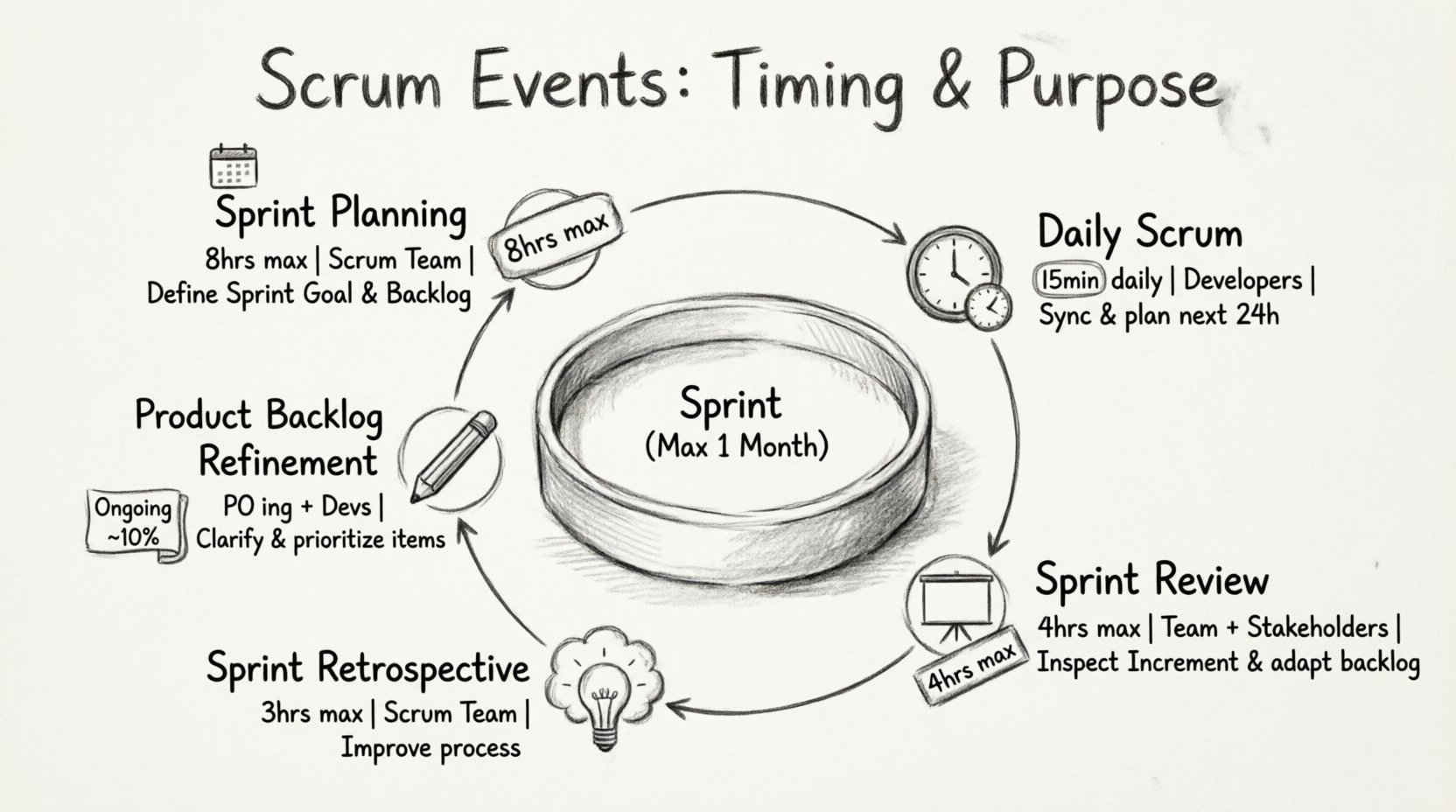
Understanding the rhythm of a Scrum team is essential for delivering value consistently. The framework relies on four distinct events to create transparency and inspection opportunities. These gatherings are not mere administrative hurdles; they are the heartbeat of the agile process. Each event has a specific timebox, a defined purpose, and a set of participants. When executed with discipline, they drive continuous improvement and alignment.
This guide explores the mechanics of every Scrum event. We will examine the timing, the required inputs, and the expected outputs. We will also look at the common pitfalls teams encounter and how to navigate them effectively. The goal is to build a sustainable cadence that supports the team without creating unnecessary overhead.
⏱️ The Sprint: A Container for Work
Before diving into specific events, it is necessary to understand the container they live in. The Sprint is the fundamental unit of development in Scrum. It is a fixed-length iteration of one month or less during which a “Done”, usable, and potentially releasable product increment is created. Sprints happen consecutively. They are the heartbeat of the team.
All Scrum events occur within the Sprint. A new Sprint starts immediately after the conclusion of the previous Sprint. There is no gap between Sprints. This continuity ensures that momentum is maintained and that the team is always moving forward. The duration of the Sprint is set at the beginning and remains constant to establish a predictable rhythm.
- Duration: Maximum of one month.
- Consistency: The length should not change within a Sprint.
- Goal: Every Sprint must have a Sprint Goal.
- Interruption: A Sprint is cancelled only if the Sprint Goal becomes obsolete.
🎯 Sprint Planning: Defining the Work
Sprint Planning is the first event of the Sprint. It sets the stage for the work ahead. This event is collaborative and involves the entire Scrum Team. The Product Owner and the Developers work together to define what can be delivered in the upcoming Sprint and how the work will be achieved.
🕒 Timing and Duration
The timebox for Sprint Planning is eight hours for a one-month Sprint. For shorter Sprints, the event is usually shorter. This ensures the team does not spend too much time planning relative to the time available for execution. The goal is to be efficient and decisive.
🤝 Participants
- Scrum Master: Facilitates the meeting and ensures the timebox is respected.
- Product Owner: Clarifies the order of the Product Backlog items and explains the objectives.
- Developers: Selects the items, forecasts the work, and defines the plan.
📋 Key Questions Answered
During this session, the team answers two critical questions. These questions guide the entire planning process:
- What can be delivered in the Increment? This focuses on value. The Product Owner presents the top items from the Product Backlog. The Developers assess their capacity and select items that align with the Sprint Goal.
- How will the chosen work get done? This focuses on execution. The Developers break down the selected items into tasks. They create a plan for the Sprint Backlog.
📝 Output and Artifacts
The result of Sprint Planning is a Sprint Backlog and a Sprint Goal. The Sprint Goal provides a tangible objective for the Sprint. It gives the Developers flexibility in choosing how to implement the functionality. The Sprint Backlog is a set of Product Backlog items selected for the Sprint, plus a plan for delivering the Increment.
- Transparency: The plan must be visible to everyone.
- Commitment: The team commits to the Sprint Goal, not just a list of tasks.
- Realism: The plan should be based on actual capacity, not ideal scenarios.
🔄 Daily Scrum: Inspecting Progress
The Daily Scrum is a time for the Developers to synchronize activities and create a plan for the next 24 hours. It is not a status update for management. It is a tactical meeting strictly for the Developers. The Scrum Master ensures the Developers have the meeting, but the Developers own the content.
🕒 Timing and Duration
The event takes place every day of the Sprint. It is timeboxed to fifteen minutes. This strict limit forces the team to be concise and focused. If discussions run long, they should be taken offline with specific individuals.
🤝 Participants
- Developers: The only required attendees.
- Product Owner: Optional, but only if invited by the Developers.
- Scrum Master: Optional, unless they are actively working as a Developer.
📋 The Three Questions (Optional but Common)
While the Scrum Guide does not mandate specific questions, many teams use three guiding questions to structure their update:
- What did I do yesterday? This provides context on progress made.
- What will I do today? This sets the immediate focus.
- Do I see any impediments? This identifies blockers that need removal.
📝 Output and Artifacts
The output is not a report. The output is an updated plan for the day. The Developers may adjust the Sprint Backlog based on new learning. They identify dependencies and risks. The meeting fosters self-management and accountability within the team.
- Focus: Keep the conversation on the Sprint Goal.
- Adaptability: Be ready to pivot if the plan changes.
- Collaboration: Offer help to teammates who are struggling.
🎬 Sprint Review: Inspecting the Increment
The Sprint Review is held at the end of the Sprint to inspect the Increment and adapt the Product Backlog if needed. It is a working session, not a formal presentation. The goal is to gather feedback from stakeholders and the Product Owner to ensure the product is moving in the right direction.
🕒 Timing and Duration
The timebox is four hours for a one-month Sprint. Shorter Sprints have shorter reviews. This ensures the team has enough time to demonstrate work and receive feedback without dragging the process out.
🤝 Participants
- Scrum Team: Everyone attends.
- Stakeholders: Customers, users, management, and others invited by the Product Owner.
📋 Key Activities
The Review is collaborative. It is not just a demo. It involves discussion about the market, the customers, and the current state of the product. The Product Owner may also discuss the projected timeline for the Product Backlog to forecast what might be completed in the next Sprints.
- Demonstration: Show the “Done” work.
- Discussion: Talk about what went well and what didn’t.
- Forecasting: Update the Product Backlog based on feedback.
- Adaptation: Adjust the plan for future Sprints.
📝 Output and Artifacts
The outcome is an updated Product Backlog. The Product Owner may add new items, change priorities, or remove items that are no longer relevant. The team gains insight into market needs and customer expectations. This feedback loop is critical for product evolution.
- Transparency: Show real work, not slides.
- Honesty: Acknowledge what is not finished.
- Engagement: Encourage stakeholder input.
🛠️ Sprint Retrospective: Improving the Process
The Sprint Retrospective is the final event of the Sprint. It occurs after the Sprint Review and before the next Sprint Planning. The purpose is to plan ways to increase quality and effectiveness. The team inspects itself and creates a plan for improvements to be enacted during the next Sprint.
🕒 Timing and Duration
The timebox is three hours for a one-month Sprint. This allows enough time for deep reflection without consuming the entire team’s energy. The focus is on the process, not the product.
🤝 Participants
- Scrum Team: Developers, Product Owner, and Scrum Master.
- Stakeholders: Typically not invited to ensure psychological safety.
📋 Key Activities
The Retrospective is a safe space for the team to speak openly. It should not be a blame session. The goal is to identify systemic issues and fix them. The Scrum Master facilitates this environment.
- Review the Sprint: Discuss what went well and what did not.
- Analyze Causes: Look for root causes of problems.
- Identify Improvements: Select actionable items to try next.
- Commit to Change: Agree on one or two improvements to implement.
📝 Output and Artifacts
The output is a plan for improvements. These items are added to the Sprint Backlog for the next Sprint. They are treated as work that needs to be done. This ensures that process improvements are actually implemented rather than just discussed.
- Psychological Safety: Ensure everyone feels safe to speak.
- Actionable Items: Avoid vague goals like “communicate better”.
- Follow-up: Review past improvements in future retrospectives.
🧹 Product Backlog Refinement: Keeping the List Fresh
While not listed as a formal event in the Scrum Guide, Product Backlog Refinement is a critical practice for maintaining flow. It is the act of breaking down and further defining Product Backlog items into smaller, more precise items. This activity is an ongoing process where the Product Owner and Developers collaborate.
Refinement ensures that the top items in the Product Backlog are ready for Sprint Planning. If items are vague, the team cannot estimate them accurately. If items are too large, they cannot be completed in a single Sprint.
📋 Key Activities
- Ordering: Prioritize items based on value and risk.
- Clarifying: Add details, acceptance criteria, and tests.
- Estimating: Provide effort estimates for sizing.
- Sizing: Ensure items fit within a Sprint capacity.
🕒 Timing and Duration
This activity is not timeboxed in the same way as the formal events. It usually consumes about 10% of the Development effort. It happens throughout the Sprint, not just before Sprint Planning.
📝 Output and Artifacts
The output is a refined Product Backlog. Items at the top are clear, actionable, and sized appropriately. This reduces uncertainty during Sprint Planning and allows for smoother execution.
- Clarity: Everyone understands the requirement.
- Readiness: Items are ready to be pulled into a Sprint.
- Flow: Prevents bottlenecks during planning sessions.
📊 Summary of Scrum Events
The following table summarizes the timing, participants, and purpose of each event. This provides a quick reference for teams establishing their rhythm.
| Event | Timebox | Participants | Purpose |
|---|---|---|---|
| Sprint Planning | 8 hours (1 month Sprint) | Scrum Team | Define the Sprint Goal and plan the work. |
| Daily Scrum | 15 minutes | Developers | Inspect progress and plan the next 24 hours. |
| Sprint Review | 4 hours (1 month Sprint) | Scrum Team + Stakeholders | Inspect the Increment and adapt the Product Backlog. |
| Sprint Retrospective | 3 hours (1 month Sprint) | Scrum Team | Inspect the process and create a plan for improvements. |
⚠️ Common Pitfalls to Avoid
Even with a clear framework, teams often struggle with execution. Understanding common mistakes can help prevent them.
🚫 Status Meetings Disguised as Daily Scrums
If the Daily Scrum becomes a status report to management, it loses its value. It should be a conversation among peers. Management should not interrupt this flow. The Developers decide what to share.
🚫 Long-Winded Retrospectives
Spending hours discussing minor issues without taking action leads to frustration. The Retrospective must result in actionable changes. If nothing changes, the team loses faith in the process.
🚫 Overloaded Sprint Planning
Trying to plan every detail of the Sprint can lead to analysis paralysis. Focus on the Sprint Goal. The plan can evolve as the Sprint progresses. Do not over-commit to tasks that may not be relevant.
🚫 Skipping Refinement
Without regular refinement, Sprint Planning becomes a chaotic guessing game. Items are not understood, leading to rework and delays. Consistent refinement keeps the pipeline healthy.
🚫 Ignoring the Sprint Goal
Focusing solely on task completion without regard for the Sprint Goal can lead to a misaligned product. The Sprint Goal provides direction. If the goal changes, the Sprint may need to be cancelled.
🚀 Strategies for Success
To get the most out of Scrum events, teams should adopt specific strategies. These habits foster a culture of continuous improvement and efficiency.
- Respect the Timebox: Start and end on time. This shows respect for everyone’s schedule.
- Prepare in Advance: Do not walk into Sprint Planning unprepared. The Product Owner should have a clear backlog.
- Rotate Facilitation: Allow different team members to facilitate events to build ownership.
- Focus on Outcomes: Measure success by value delivered, not meetings attended.
- Keep it Visual: Use boards and charts to make progress visible during meetings.
- Encourage Silence: Allow pauses. Not everyone speaks immediately. Give space for thought.
- Document Decisions: Write down key decisions from the Review and Retrospective for future reference.
- Protect Focus: Minimize interruptions during the Sprint to allow deep work.
🧠 The Psychology of Scrum Events
Understanding the human element is just as important as understanding the process. Events are social interactions that affect team morale.
When a team feels safe, they perform better. The Retrospective is the primary place for building this safety. If a member is blamed for a mistake, others will hide future issues. The Scrum Master must protect the team from external pressure during these sessions.
Trust is built through consistency. When the team says they will finish a Sprint Goal, they should try to deliver. When they fail, they should own it and learn. This honesty builds a strong foundation for long-term collaboration.
Energy management is also crucial. Sprint Planning can be draining. The Daily Scrum should be energizing. The Review should be rewarding. The Retrospective should be reflective. Balancing these emotional states helps maintain high performance over time.
📈 Measuring Event Effectiveness
How do you know if the events are working? You do not count the number of meetings. You look at the quality of the output.
- Velocity Stability: If velocity fluctuates wildly, planning may be ineffective.
- Stakeholder Satisfaction: Do stakeholders feel heard during the Review?
- Impediment Resolution: Are blockers removed quickly after being raised in the Daily Scrum?
- Process Improvement: Are Retrospective actions actually implemented?
- Team Morale: Does the team feel the events add value or feel like waste?
If the answer to these questions is negative, the team needs to adapt their approach to the events. Flexibility is a core tenet of Scrum. The framework serves the team, not the other way around.
🔗 Integrating Events into the Workflow
Events should not feel like interruptions. They should be integrated into the natural flow of work. For example, the Daily Scrum can happen at the same time and place every day. This habit reduces cognitive load.
Sprint Planning should be treated as a workshop. Preparation materials should be distributed beforehand. This allows the meeting to focus on decision-making rather than information sharing.
The Sprint Review should be a celebration. Even if things did not go perfectly, highlight the progress made. This reinforces positive behavior and motivates the team for the next Sprint.
The Retrospective should be a safe haven. No external judgment. Just honest reflection. If the team feels this is true, they will engage more deeply.
🏁 Final Thoughts on Scrum Events
Mastering the rhythm of Scrum takes time. It is a practice, not a destination. The events are designed to support the team in delivering value. When followed with discipline and intent, they create a predictable and sustainable workflow.
Remember that the goal is not to hold meetings. The goal is to inspect and adapt. If an event stops serving that purpose, it should be changed or removed. The framework is a tool for thinking, not a set of rigid rules. Teams should always strive to improve their own way of working.
By focusing on the purpose and timing of each ceremony, teams can avoid burnout and increase productivity. The structure provides the guardrails, but the team drives the car. With clear communication and shared commitment, the Scrum events become the engine of success.