In the modern technology landscape, the ability to adapt and deliver value rapidly is paramount. Organizations are shifting away from rigid, sequential workflows toward flexible, iterative approaches. This shift places a premium on professionals who understand Agile principles and Scrum frameworks. When preparing for a career in this space, highlighting specific skills becomes a critical differentiator for your professional profile.
This guide explores how developing and articulating Agile competencies can significantly enhance your resume. We will examine the core roles within Scrum, the balance of hard and soft skills required, and strategies for presenting your experience effectively to recruiters and hiring managers.
Why Agile Matters in Today’s Job Market 🌍
The transition from Waterfall to Agile methodologies represents more than just a change in process; it signifies a shift in organizational culture. Companies prioritize speed, customer feedback, and continuous improvement. Consequently, they seek team members who can navigate uncertainty and collaborate across functions.
Recruiters scan resumes looking for keywords that indicate a candidate can function within these adaptive environments. Demonstrating proficiency in this area signals that you are ready to contribute immediately without extensive training on basic methodologies.
- Market Demand: The majority of software and product development teams now operate using Agile or hybrid frameworks.
- Efficiency: Agile skills imply you understand how to reduce waste and focus on high-value tasks.
- Collaboration: These roles require high levels of communication and stakeholder management.
- Problem Solving: Iterative approaches teach you to solve problems incrementally rather than waiting for a final release.
By aligning your resume with these expectations, you position yourself as a candidate who understands the current operational reality of tech companies.
Key Scrum Roles and Their Skill Sets 🎯
Understanding the distinct responsibilities within the Scrum framework allows you to tailor your resume for specific positions. Whether you aim for a facilitation role, a product leadership role, or a development role, the emphasis on skills varies.
Below is a breakdown of the core roles and the competencies associated with them.
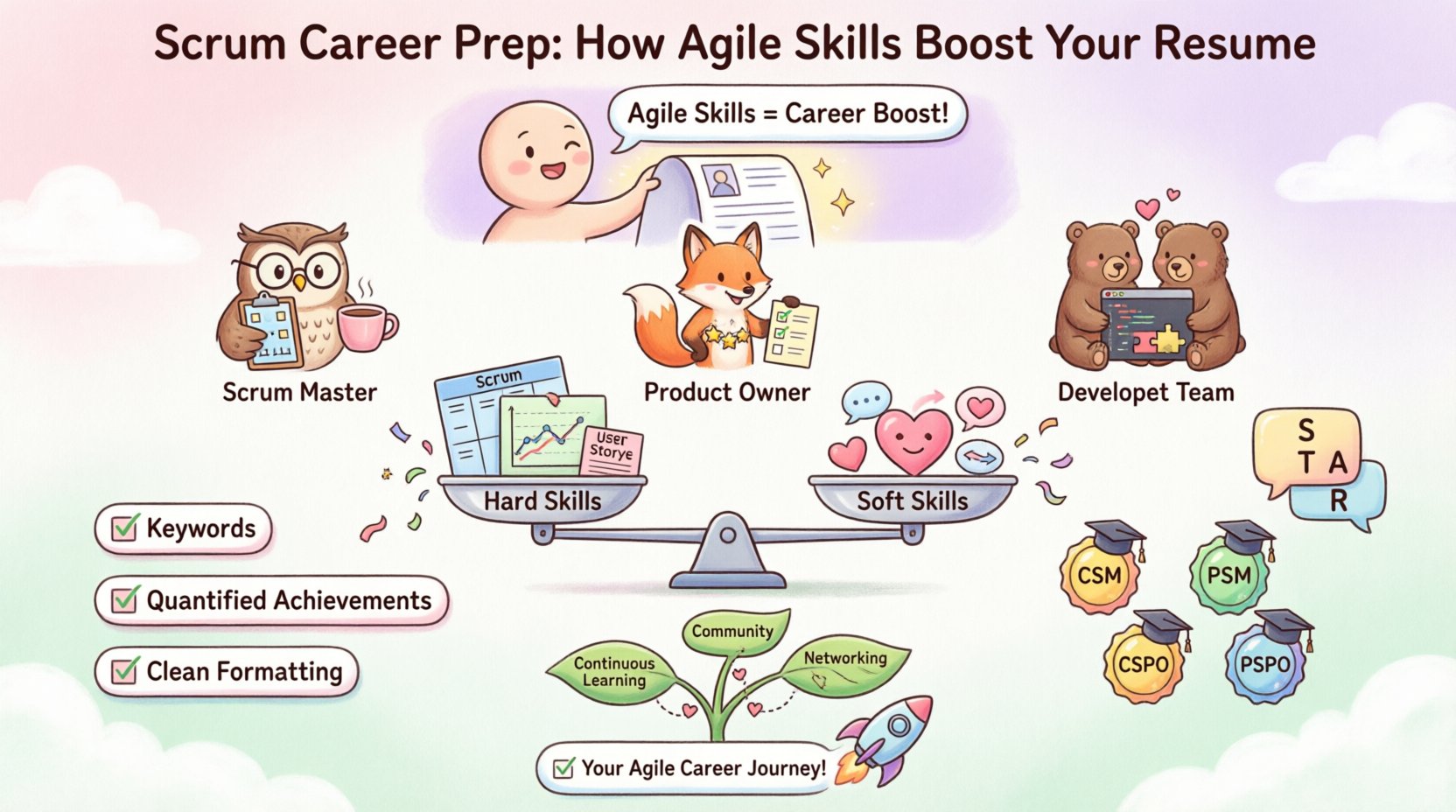
| Role | Primary Focus | Key Competencies |
|---|---|---|
| Scrum Master | Process Facilitation | Coaching, Conflict Resolution, impediment removal |
| Product Owner | Value Maximization | Backlog management, stakeholder communication, prioritization |
| Development Team | Delivery | Technical execution, self-organization, cross-functionality |
The Scrum Master
The Scrum Master acts as a servant leader. The focus is on ensuring the team adheres to Agile practices and removing obstacles that hinder progress. On a resume, you should highlight experience in facilitating ceremonies such as daily stand-ups, sprint planning, reviews, and retrospectives.
- Facilitation: Ability to run meetings that are productive and time-boxed.
- Coaching: Guiding the team toward self-organization and continuous improvement.
- Impediment Removal: Proactively identifying and resolving blockers.
The Product Owner
This role bridges the gap between business needs and technical execution. The Product Owner is responsible for defining the vision and managing the backlog. Your resume should demonstrate an ability to translate business goals into actionable user stories.
- Prioritization: Deciding what is most valuable to build next.
- Stakeholder Management: Communicating progress and expectations to leadership.
- Metrics: Using data to inform decisions about feature scope.
The Development Team
While often technical, the Scrum team member must also embrace Agile values. This includes taking ownership of tasks and collaborating closely with peers.
- Technical Excellence: Writing clean, maintainable code.
- Adaptability: Adjusting to changing requirements without losing momentum.
- Collaboration: Working in pairs or groups to solve complex problems.
Hard Skills vs. Soft Skills Balance ⚖️
A strong resume balances technical capabilities with interpersonal strengths. Agile environments thrive on human interaction as much as they rely on technical execution. Ignoring soft skills can make a candidate appear rigid or difficult to work with.
Hard Skills
These are the tangible, teachable abilities that can be measured. They often include specific knowledge of frameworks or tools.
- Methodology Knowledge: Understanding of Scrum, Kanban, or SAFe frameworks.
- Tools: Proficiency with digital boards or project tracking systems (generic).
- Documentation: Ability to write clear user stories, acceptance criteria, and technical specs.
- Metrics: Familiarity with velocity, burndown charts, and cycle time.
Soft Skills
These are the behavioral traits that determine how well you work with others. They are often harder to quantify but are crucial for long-term success.
- Communication: Clear, concise, and transparent information sharing.
- Empathy: Understanding the perspectives of stakeholders and team members.
- Leadership: Leading by example without relying on formal authority.
- Adaptability: Comfort with change and ambiguity.
Certifications That Carry Weight 🎓
Certifications provide external validation of your knowledge. While experience is paramount, credentials signal your commitment to the profession. They often serve as a filter for Applicant Tracking Systems (ATS) used by large organizations.
Consider the following recognized credentials:
- Certified ScrumMaster (CSM): Focuses on the Scrum Master role and facilitation skills.
- Professional Scrum Master (PSM): A more rigorous assessment of Scrum theory and practice.
- Certified Scrum Product Owner (CSPO): Validates skills in backlog management and product vision.
- Professional Scrum Product Owner (PSPO): Deep dive into product ownership responsibilities.
When listing these on your resume, ensure you include the issuing organization and the date of certification. This provides context and shows currency in your knowledge.
Optimizing Your Resume for ATS and Recruiters 📝
Optimization involves making your content accessible to both machines and humans. Recruiters often spend seconds scanning a document before deciding to read further. You must make your Agile value proposition clear immediately.
Keyword Integration
Incorporate relevant terms naturally throughout your document. This helps your resume appear in search results.
- Agile Methodologies: Scrum, Kanban, Lean, Extreme Programming.
- Process Terms: Sprint, Backlog, Retrospective, Stand-up, User Story.
- Outcome Terms: Velocity, Continuous Delivery, Stakeholder Engagement.
Quantifying Achievements
Numbers provide concrete evidence of your impact. Vague statements like “improved processes” are less effective than specific data points.
- Example 1: “Reduced cycle time by 20% through implementation of Kanban boards.”
- Example 2: “Facilitated 50+ sprint retrospectives resulting in 15+ process improvements.”
- Example 3: “Managed a backlog of 200+ items with a team of 8 developers.”
Formatting for Readability
Use clear headings and bullet points. Avoid dense paragraphs that are difficult to scan. White space is your friend.
- Use Bold Text: Highlight key skills or metrics within bullet points.
- Standard Fonts: Stick to clean, professional typefaces.
- Consistent Layout: Ensure dates and job titles align vertically.
Navigating Agile Interviews 🗣️
Interviewing for Agile roles requires a different approach than traditional technical interviews. You will likely face behavioral questions and scenario-based challenges.
Behavioral Questions
Prepare stories that demonstrate your soft skills in action. Use the STAR method (Situation, Task, Action, Result) to structure your answers.
- Situation: Describe the context of the challenge.
- Task: Explain what needed to be accomplished.
- Action: Detail the specific steps you took.
- Result: Share the outcome and what you learned.
Scenario-Based Challenges
Interviewers may present a hypothetical situation to test your decision-making.
- Example: “The team is missing sprint commitments consistently. What do you do?”
- Response Strategy: Focus on root cause analysis and team collaboration rather than blame.
Asking Questions
Showing interest in their Agile maturity demonstrates your seriousness. Ask about their current processes.
- “How do you currently handle sprint planning?”
- “What challenges does the team face in delivery?”
- “How is success measured for this role?”
Building a Growth Mindset 🌱
Agile is not a destination; it is a continuous journey. The landscape of project management evolves constantly. To remain relevant, you must commit to lifelong learning.
Community Engagement
Connect with other professionals to exchange ideas and stay informed.
- Local Meetups: Attend gatherings focused on Agile and Scrum.
- Online Forums: Participate in discussions on professional networks.
- Conferences: Listen to talks from industry leaders.
Continuous Learning
Stay updated on new trends and adaptations of existing frameworks.
- Read industry blogs and publications.
- Take advanced courses on specific niches like DevOps or Lean Startup.
- Experiment with new tools and techniques in your current role.
Staying Updated on Methodologies 🔄
While Scrum is dominant, it is not the only framework. Understanding the broader ecosystem adds depth to your profile.
- Lean: Focuses on eliminating waste and optimizing flow.
- DevOps: Bridges development and operations for faster deployment.
- SAFe: Scaled Agile Framework for large enterprise implementations.
- Nexus: A framework for scaling Scrum across multiple teams.
Knowledge of these adjacent areas shows you understand how Scrum fits into the larger organizational picture. It allows you to speak the language of different departments, from infrastructure to marketing.
Networking Within the Community 🤝
Your network can be your most valuable asset during a job search. Many opportunities are filled through referrals before they are posted publicly.
- LinkedIn: Connect with peers and hiring managers in your field.
- Referrals: Ask trusted colleagues to recommend you for roles.
- Mentorship: Seek mentors who can guide your career path.
Building relationships takes time. Start engaging with content and people today. Share your own insights and help others in return. A reputation for generosity and expertise precedes you.
Final Thoughts on Career Growth 🚀
Preparing for a career in Scrum and Agile requires intentionality. It involves more than just learning the rules; it requires embodying the values of transparency, inspection, and adaptation. By focusing on the right skills, validating your knowledge, and presenting your experience clearly, you create a strong foundation for professional success.
Remember that your resume is a living document. Update it as you gain new experiences and certifications. Keep refining your narrative to reflect your evolving capabilities. The market values those who can demonstrate tangible value through improved processes and team performance.
Commit to the practice of continuous improvement in your own career. Just as Scrum teams seek to improve their velocity and quality, you should seek to improve your skills and market presence. This alignment ensures you remain competitive and effective in a dynamic environment.
Start by auditing your current resume against the points outlined in this guide. Identify gaps in your skills or presentation. Address them one by one. With consistent effort, you will position yourself as a top-tier candidate ready to lead and contribute in Agile environments.