Implementing Scrum within software engineering environments requires more than just adopting a schedule of meetings. It involves a fundamental shift in how teams approach value delivery, risk management, and continuous improvement. This guide outlines essential practices to ensure your engineering projects run smoothly, adapt to change, and produce high-quality software consistently.
Agile methodologies have become the standard for modern development, yet many organizations struggle with the execution. The difference between a struggling team and a high-performing unit often lies in the adherence to core principles rather than the tools used. By focusing on people, interactions, and working software, teams can navigate complexity with confidence.
🛠 Understanding the Core Framework
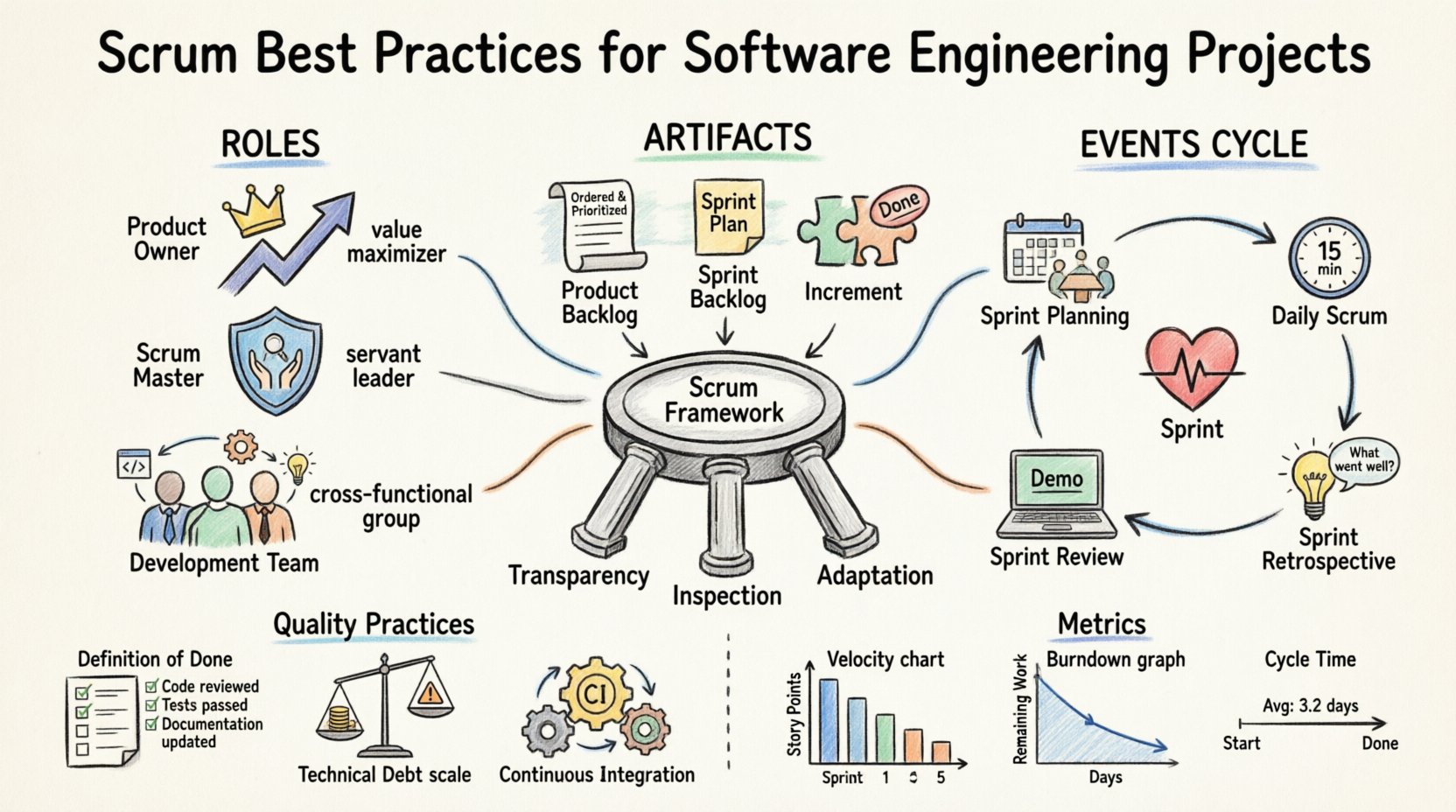
Scrum is not a process or a technique for building products; it is a framework within which you can employ various processes and techniques. It relies on empiricism, meaning knowledge comes from experience and making decisions based on what is observed. There are three pillars that support Scrum:
- Transparency: Significant aspects of the process must be visible to those responsible for the outcome.
- Inspection: Frequent inspection of Scrum artifacts to detect undesirable variances.
- Adaptation: Adjusting the process or material if an aspect of the product is unacceptable.
Software engineering projects benefit from this structure because requirements often evolve. Rigid plans often fail when market conditions shift. Scrum allows for regular reassessment of priorities.
👥 Defining Roles Clearly
Success depends on every member understanding their responsibilities. Ambiguity leads to friction and delays. The framework defines three specific accounts with distinct duties.
The Product Owner
The Product Owner represents the voice of the customer and the business. Their primary duty is maximizing the value of the product resulting from the work of the Development Team. They are responsible for effective Product Backlog management. Key activities include:
- Clearly expressing Product Backlog items.
- Ordering the items in the Product Backlog to best achieve goals and missions.
- Ensuring the Product Backlog is visible, transparent, and clear to all.
- Ensuring the Development Team understands the items in the Product Backlog.
A common pitfall is allowing the Product Owner to micromanage the Development Team. The Product Owner decides what to build, while the Development Team decides how to build it. This separation of concerns empowers technical experts to solve problems creatively.
The Scrum Master
The Scrum Master is responsible for promoting and supporting Scrum as defined in the Scrum Guide. They serve the Development Team, the Product Owner, and the organization. Their role is facilitative rather than directive. They help the team:
- Understand and practice Scrum and other agile frameworks.
- Remove impediments that hinder progress.
- Foster a culture of continuous improvement.
- Coach the organization in its transition to Scrum.
Effective Scrum Masters focus on servant leadership. They do not assign tasks or act as project managers. Instead, they protect the team from external distractions and ensure the process is followed without becoming a bottleneck.
The Development Team
Development Teams consist of professionals who do the actual work of delivering a potentially releasable Increment of product at the end of each Sprint. They are cross-functional, meaning they possess all the skills necessary to create the product. They are self-organizing, meaning they decide internally who does what, when, and how.
- Cross-functional: Includes developers, testers, designers, and other specialists.
- Self-organizing: No external authority dictates how to do the work.
- Size: Typically small, often between three and nine members, to facilitate communication.
📋 Managing Artifacts
Artifacts represent work or value. They are designed to maximize transparency of key information. There are three primary artifacts in Scrum.
Product Backlog
The Product Backlog is an ordered list of everything that is known to be needed in the product. It is the single source of requirements for any changes to be made. It is dynamic and never complete.
- Refinement: Items should be reviewed and updated regularly to ensure clarity.
- Granularity: Items near the top should be detailed enough to be worked on immediately.
- Ordering: Items are ordered by value, risk, priority, and necessity.
Sprint Backlog
The Sprint Backlog is the set of Product Backlog items selected for the Sprint, plus a plan for delivering the Increment. It is created during Sprint Planning. The Development Team works to complete these items.
- Commitment: The team commits to the work they believe they can complete.
- Visibility: The progress is tracked daily.
- Flexibility: As the team learns, they adjust the plan to achieve the Sprint Goal.
Increment
An Increment is a concrete stepping stone toward the Product Goal. It is the sum of all Product Backlog items completed during a Sprint and the value of the increments of all previous Sprints.
- Definition of Done: An Increment is only added to the Product Backlog if it meets the Definition of Done.
- Usability: It must be in a usable condition, regardless of whether the Product Owner accepts it.
🗓 Navigating Events
Events are used in Scrum to create regularity and to minimize the need for meetings not defined in Scrum. They are time-boxed to ensure focus.
Sprint
The Sprint is the heartbeat of Scrum. It is a fixed-length event of one month or less during which a “Done”, useable, and potentially releasable product Increment is created. Sprints contain and consist of the other Scrum Events.
- Consistency: Sprints should occur one after another without a gap.
- Stability: The Sprint Goal is fixed, even if the scope of work is adjusted.
Sprint Planning
Sprint Planning initiates the Sprint by laying out the work to be performed for the Sprint. This results in a plan for the Sprint. The entire Scrum Team is responsible for the output. Two main topics are addressed:
- What can be done? The Product Owner discusses the highest priority items.
- How will the work get done? The Development Team figures out the work necessary to convert the Product Backlog items into an Increment.
Daily Scrum
The Daily Scrum is a 15-minute event for the Development Team to inspect progress toward the Sprint Goal and adapt the Sprint Backlog as necessary. Adjustments should be made that impact or are impacted by the previous day’s work.
- Focus: It is a planning meeting, not a status report for management.
- Participation: Only the Development Team attends, though the Scrum Master and Product Owner may attend if invited.
- Questions: Often structured around what was done, what will be done, and impediments.
Sprint Review
The Sprint Review is held at the end of the Sprint to inspect the Increment and adapt the Product Backlog if needed. The Product Owner explains which items in the Product Backlog have been “Done” and which have not.
- Collaboration: It is an opportunity for stakeholders to provide feedback.
- Transparency: The team demonstrates the work completed.
- Adaptation: The Product Backlog may be adjusted based on feedback.
Sprint Retrospective
The Sprint Retrospective occurs after the Sprint Review and prior to the next Sprint Planning. The purpose is to plan ways to increase quality and effectiveness. The Scrum Team inspects how the last Sprint went regarding individuals, interactions, processes, tools, and their Definition of Done.
- Continuous Improvement: Focus on identifying actionable improvements for the next Sprint.
- Psychological Safety: Team members must feel safe to discuss issues openly.
- Action Items: At least one improvement practice should be implemented.
🔍 Quality and Technical Excellence
Software engineering requires a strong focus on technical quality. Rushing to deliver features often leads to technical debt, which slows down future development. The following practices help maintain code health.
Definition of Done (DoD)
The Definition of Done is a formal description of the state of the Increment when it meets the quality measures required for the product. The moment the Increment meets the Definition of Done, an opportunity for inspection arises.
- Consistency: If an item is “Done,” it meets the same standard as every other item.
- Testing: Includes unit tests, integration tests, and acceptance criteria.
- Documentation: Relevant documentation must be updated.
- Review: Code review processes should be mandatory.
Technical Debt Management
Technical debt is the implied cost of additional rework caused by choosing an easy (limited) solution now instead of using a better approach that would take longer. Teams must manage this debt actively.
- Visibility: Include technical debt items in the Product Backlog.
- Allocation: Dedicate a percentage of capacity each Sprint to debt reduction.
- Prevention: Adopt practices like pair programming and continuous integration.
Continuous Integration
Continuous Integration is a development practice where developers integrate code into a shared repository frequently, preferably several times a day. Each integration is verified by an automated build and automated tests.
- Early Detection: Bugs are found immediately after they are introduced.
- Reduced Risk: Integration issues are minimized.
- Speed: Teams can release faster with confidence.
🚧 Common Pitfalls and Solutions
Even with the best intentions, teams often encounter obstacles. The table below outlines common issues and practical strategies to address them.
| Pitfall | Impact | Solution |
|---|---|---|
| Scope Creep | Delays delivery and reduces quality. | Protect the Sprint Goal; move new items to the Product Backlog. |
| Micromanagement | Reduces team autonomy and morale. | Scrum Master intervenes to enforce boundaries and self-organization. |
| Unclear Requirements | Rework and confusion during development. | Invest in backlog refinement and Definition of Ready. |
| Ignoring Retrospectives | Repeating the same mistakes. | Make retrospectives a priority; ensure action items are tracked. |
| Overcommitment | Burnout and missed deadlines. | Use historical velocity to plan realistic commitments. |
| Partial Completion | Hidden technical debt and waste. | Enforce Definition of Done strictly; no partial work counts. |
📊 Measuring Progress Effectively
Tracking progress helps teams understand their performance and identify areas for improvement. However, choosing the right metrics is critical to avoid perverse incentives.
Velocity
Velocity measures the amount of work a team can tackle during a single Sprint. It is calculated by summing the Story Points (or other units) of the items completed in the Sprint.
- Trend: Look at the average over time rather than a single Sprint.
- Stability: Velocity should stabilize as the team finds its rhythm.
- Usage: Use it for forecasting, not for comparing teams.
Burndown Charts
A Burndown Chart shows the amount of work remaining in the Sprint or Project. It helps the team see if they are on track to complete the Sprint Goal.
- Daily Updates: Update the chart daily to reflect actual progress.
- Patterns: A flat line indicates no progress; a steep drop indicates rapid completion.
- Adjustment: If the line is above the target, discuss scope reduction or support needs.
Lead Time and Cycle Time
Lead time measures the time from when a request is made until it is delivered. Cycle time measures the time from when work actually starts until it is finished.
- Efficiency: Shorter cycle times indicate a more efficient process.
- Flow: Focus on reducing the time items spend in “in progress” status.
- Feedback: Faster cycle times provide faster feedback to stakeholders.
🌱 Fostering a Healthy Culture
Technical practices are only half the equation. The culture surrounding the team determines long-term success. Trust, respect, and open communication are essential.
Psychological Safety
Team members must feel safe to take risks and be vulnerable in front of each other. They should be able to admit mistakes without fear of retribution.
- Open Discussion: Encourage dissenting opinions during planning.
- Mistake Ownership: Treat errors as learning opportunities.
- Support: Ensure the team has the resources to succeed.
Collaboration over Hierarchy
Software engineering is complex work that requires diverse expertise. Hierarchical decision-making slows down innovation.
- Shared Goals: Focus on the Sprint Goal rather than individual tasks.
- Pairing: Encourage knowledge sharing through pairing sessions.
- Collective Ownership: The code belongs to the team, not individuals.
Continuous Learning
The technology landscape changes rapidly. Teams must dedicate time to learning new tools, languages, and methodologies.
- Training: Allocate time for skill development.
- Sharing: Hold internal tech talks or brown bag sessions.
- Experimentation: Allow time for proof of concept work.
🔄 Scaling Considerations
As projects grow, a single team may not be enough to deliver the product. Scaling Scrum requires coordination across multiple teams while maintaining the core values.
- Shared Backlog: Multiple teams often work on a shared Product Backlog.
- Integration: Teams must integrate their work frequently to avoid integration hell.
- Coordination: Identify dependencies early and manage them proactively.
When scaling, do not lose the focus on the customer value. It is easy to get lost in process and lose sight of the product goal.
🔧 Practical Tips for Daily Work
Beyond the formal ceremonies, there are habits that improve daily work life.
- Limit Work in Progress: Focus on finishing items before starting new ones to reduce context switching.
- Visual Management: Use boards to make the status of work visible to everyone.
- Time Boxing: Stick to the time limits for meetings to respect everyone’s time.
- Feedback Loops: Shorten the time between writing code and getting feedback.
- Environment: Ensure the development environment is stable and accessible.
📝 Summary of Key Takeaways
Implementing Scrum effectively requires discipline and commitment. It is not a magic solution, but a framework that provides structure for complex work.
- Roles: Ensure the Product Owner, Scrum Master, and Development Team understand their distinct duties.
- Artifacts: Maintain a clear, ordered Product Backlog and a transparent Sprint Backlog.
- Events: Hold every ceremony with purpose and focus.
- Quality: Enforce a strict Definition of Done to prevent technical debt.
- Metrics: Use data to guide improvement, not to punish performance.
- Culture: Build a foundation of trust and psychological safety.
By adhering to these best practices, software engineering projects can achieve sustainable speed and high quality. The journey involves constant learning and adaptation. Stay focused on delivering value to the customer, and the rest will follow.
Remember that the framework is a tool to help you work better. It is not a constraint. Use the flexibility within Scrum to tailor the process to your specific context and needs. Regularly reflect on what is working and what is not, and adjust accordingly. This continuous improvement mindset is the heart of Scrum.
Start small. Focus on getting one Sprint right. Then build from there. Consistency is more important than perfection. Over time, the habits and processes will become second nature, allowing the team to focus entirely on the work at hand.