Effective Agile execution relies heavily on the quality of work prepared before the development cycle begins. Scrum Backlog Grooming, often referred to formally as Backlog Refinement, is the mechanism that ensures items are ready for selection. This process is not merely administrative; it is a collaborative engineering effort that aligns the team’s understanding with stakeholder expectations. When executed correctly, it transforms a chaotic list of desires into a structured plan of action.
This guide explores the nuances of preparing the Product Backlog for the upcoming Sprint. It covers the essential activities, the roles involved, and the strategies required to maintain a healthy workflow. By focusing on clarity and readiness, teams can reduce friction during Sprint Planning and increase delivery velocity.
What is Backlog Grooming? 🤔
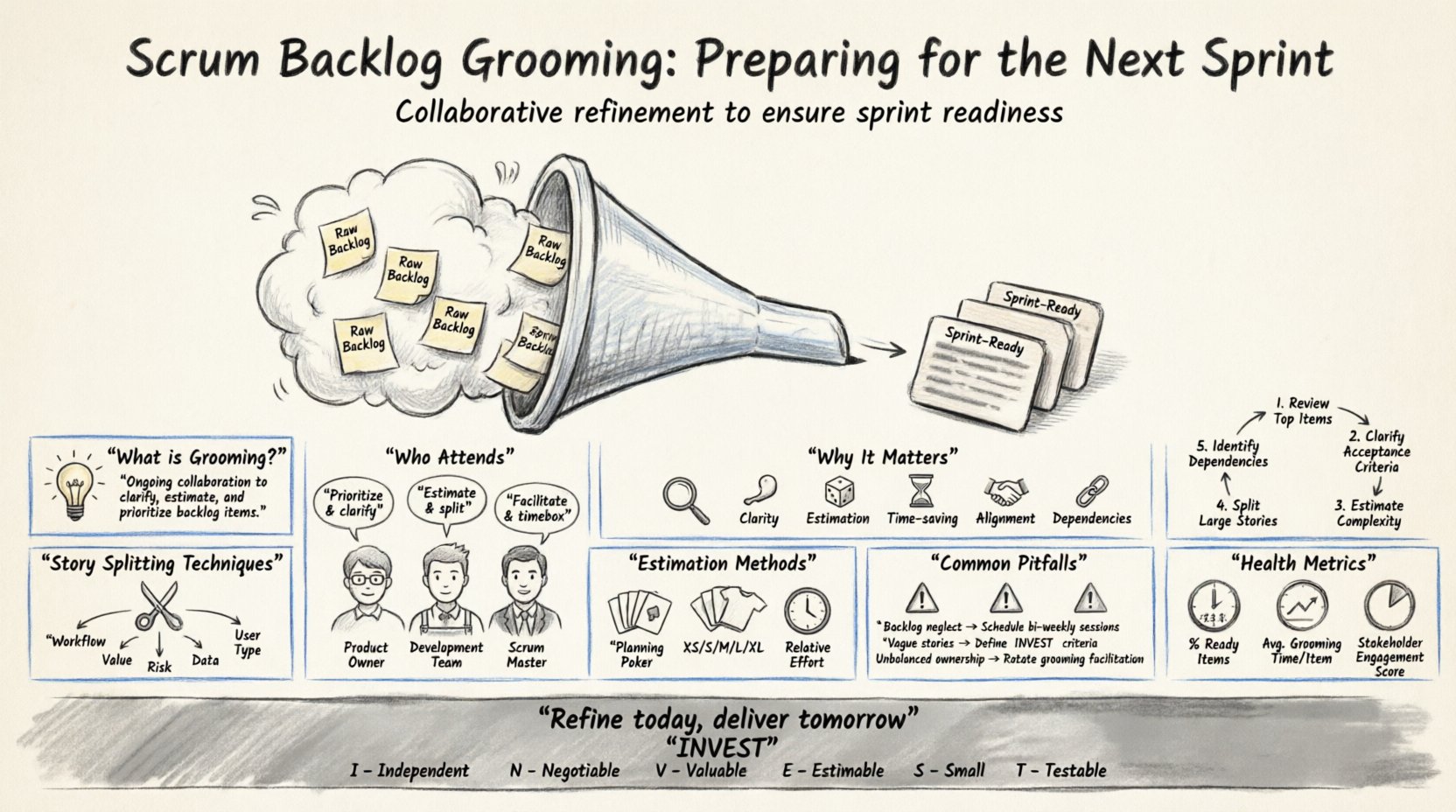
Backlog Grooming is an ongoing process where the Scrum Team reviews items in the Product Backlog to ensure they are well-defined, estimated, and prioritized. While the Product Owner holds the primary responsibility for managing the backlog, the entire Development Team participates in the refinement discussions.
The term “Grooming” has evolved in recent years to “Refinement” in many organizations, reflecting a shift from cleaning up to actively improving the value and clarity of the work. Regardless of the terminology, the core objective remains the same: to prepare the backlog so that it is transparent and actionable.
Why It Matters for Sprint Success 📈
Skipping this phase often leads to significant issues during the Sprint. Without prior refinement, Sprint Planning becomes a guessing game. Teams may commit to work they do not fully understand, resulting in incomplete stories or technical debt accumulation.
Key benefits of consistent grooming include:
- Clarity of Requirements: Ambiguity is reduced before work begins.
- Accurate Estimation: The team can provide more reliable size estimates when they have discussed the details.
- Reduced Planning Time: If stories are ready, Sprint Planning takes less time and focuses on commitment rather than analysis.
- Stakeholder Alignment: Expectations are managed early, preventing surprises at the Sprint Review.
- Dependency Identification: Cross-team or cross-functional blockers are identified and addressed proactively.
Who Should Attend the Session? 👥
While the Product Owner drives the agenda, the value comes from collective intelligence. The following roles are essential for a productive session:
- Product Owner: Clarifies the “Why” and the business value behind the items.
- Development Team: Clarifies the “How” and determines the technical feasibility.
- Scrum Master: Facilitates the discussion, ensures timeboxes are respected, and removes impediments.
In some cases, subject matter experts or users may join to provide specific domain knowledge, though they should not dominate the conversation.
The Step-by-Step Grooming Workflow 🔄
A structured approach ensures that no critical aspect is overlooked. The following workflow outlines the standard activities performed during a grooming session.
1. Reviewing the Top Items
Focus on the highest priority items first. The backlog is ordered by value, so the top items are the most likely to be pulled into the next Sprint. Ensure these items have clear acceptance criteria.
2. Clarifying Acceptance Criteria
Every user story needs a definition of done. The team must agree on what constitutes completion. This prevents the scenario where a story is marked as “Done” but fails to meet quality standards.
3. Estimating Complexity
Use relative estimation techniques to assign size to the items. This helps in forecasting how much work can be taken into the Sprint. Common methods include Planning Poker or Affinity Estimation.
4. Splitting Large Stories
If an item is too large to complete in a single Sprint, it must be broken down. This process is known as slicing. Large items create risk because they cannot be delivered incrementally.
5. Identifying Dependencies
Check if the work relies on external systems, other teams, or specific infrastructure. Dependencies should be mapped out and mitigated before the Sprint begins.
Story Splitting Techniques ✂️
Not all work is created equal. Some items are too broad to be practical. Effective splitting allows for incremental value delivery. Below are common strategies for breaking down large epics into manageable stories.
- By Workflow: Break down by the stages a user goes through (e.g., Login, Browse, Checkout).
- By Business Value: Prioritize the most valuable feature first, even if it is technically simpler.
- By Risk: Address the highest technical risk first to validate assumptions early.
- By Data Volume: Handle small data sets first, then scale up to larger volumes.
- By User Type: Implement features for specific user roles (e.g., Admin vs. Guest) separately.
The goal is to ensure each split story is independent, negotiable, valuable, estimable, small, and testable. This aligns with the INVEST model for user stories.
Estimation Methods 📏
Estimation is not about predicting the future with precision; it is about comparing the relative effort of one task against another. Several techniques exist to facilitate this discussion.
Planning Poker
Each team member selects a card representing their estimate. When everyone reveals simultaneously, it prevents bias from influencing others. Discrepancies in numbers lead to discussion, revealing different understandings of the work.
Timeboxing
Instead of hours, use timeboxes. For example, “I think this will take half a day.” This encourages thinking in terms of available capacity rather than exact minutes.
T-Shirt Sizing
For high-level epics, use sizes like XS, S, M, L, XL. This is useful during early planning phases when details are scarce.
Handling Dependencies 🕸️
Dependencies are the primary cause of delays in complex environments. They occur when one task cannot start until another is finished.
Strategies to manage dependencies include:
- Internal Dependencies: If one team member needs to finish work before another starts, coordinate schedules within the team.
- External Dependencies: If work relies on another team, establish a shared cadence for communication.
- Technical Dependencies: If a feature relies on an API that does not exist, mock the API to allow development to proceed.
During grooming, explicitly flag any dependency that might block progress. If a dependency cannot be resolved before the Sprint, consider removing the item from the Sprint Goal.
Common Mistakes to Avoid ⛔
Even experienced teams fall into traps during refinement. Being aware of these pitfalls helps maintain a healthy process.
| Pitfall | Impact | Mitigation Strategy |
|---|---|---|
| Over-refining | Wastes time on items that may change or never happen. | Only refine items likely to be pulled in the next 2-3 Sprints. |
| Skipping Acceptance Criteria | Developers build the wrong thing. | Make criteria a mandatory field before estimation. |
| Product Owner Absence | Questions about value go unanswered. | Ensure the Product Owner is present or available for questions. |
| Ignoring Technical Debt | Code quality degrades over time. | Include debt items in the backlog and allocate capacity for them. |
| One Person Dominating | Team consensus is lost. | Facilitate round-robin discussions to gather all views. |
Metrics for Refinement Health 📊
To ensure the process is working, track specific metrics. These indicators help the team adjust their approach over time.
- Velocity Stability: If velocity fluctuates wildly, the backlog may not be ready for commitment.
- Sprint Commitment Rate: How many planned items are completed? Low completion rates often signal poor refinement.
- Refinement Duration: Is the grooming session too long or too short? Aim for a consistent cadence, such as 5-10% of total development capacity.
- Number of Unfinished Stories: If many stories are carried over, the size or complexity estimates may be inaccurate.
Adapting for Distributed Teams 🌐
Remote work introduces challenges regarding communication and visibility. Grooming sessions for distributed teams require intentional design.
- Visual Collaboration: Use digital whiteboards to map out stories and dependencies visually.
- Screen Sharing: Always share the backlog view so everyone sees the same details.
- Asynchronous Input: Allow team members to add comments to stories before the meeting to reduce meeting time.
- Time Zone Management: Rotate meeting times if possible, or record sessions for those who cannot attend live.
Technology enables connection, but the human element remains central. Ensure that video is on to capture non-verbal cues that indicate confusion or agreement.
Integrating Technical Debt 🛠️
Technical debt is the cost of additional rework caused by choosing an easy solution now instead of a better approach that would take longer. If ignored, it slows down future development.
During grooming, explicitly discuss debt items. Treat them as first-class citizens in the backlog. Do not hide them under “infrastructure” tickets that never get discussed. Include them in the sprint commitment, perhaps allocating 20% of capacity specifically for maintenance and improvement.
Refining the Definition of Done (DoD) 📝
The Definition of Done is a shared understanding of what it means for work to be complete. It is distinct from the Acceptance Criteria, which applies to specific stories. The DoD applies to all work.
Examples of DoD items include:
- Code has been reviewed by a peer.
- Automated tests are passing.
- Documentation has been updated.
- No new bugs are introduced.
- Performance benchmarks are met.
Review the DoD regularly. As the team matures, the standards may need to rise. Grooming is a good time to discuss if the current DoD is realistic or if it needs adjustment.
Frequently Asked Questions ❓
How often should we groom?
There is no fixed rule, but a common practice is to hold a dedicated session once per Sprint. Some teams do it daily, while others do it ad-hoc. The key is consistency. Ensure there is enough time to cover items likely to enter the next Sprint.
Can we groom during Sprint Planning?
It is not recommended. Sprint Planning should be focused on commitment and alignment on the Sprint Goal. Grooming requires a different mindset focused on analysis and splitting. Mixing them can lead to rushing or incomplete planning.
What if the Product Owner is unavailable?
Without the Product Owner, the team lacks clarity on value. Postpone the session or have the Product Owner review the backlog asynchronously beforehand. Do not proceed with significant estimation without their input.
Should we estimate every item in the backlog?
No. Only estimate items that are near the top of the backlog. Items further down may change or be discarded entirely. Focus effort on the work that is imminent.
Moving Forward 💡
Backlog Grooming is a discipline that improves over time. It requires commitment from the Product Owner to write clear descriptions and from the Development Team to engage actively. When the team feels ownership of the backlog, the quality of the output improves significantly.
Focus on the flow of information. Ensure that the right people are talking to the right people at the right time. By treating the backlog as a living artifact that requires constant care, the team creates a foundation for sustainable delivery. This preparation is the difference between a chaotic sprint and a predictable, successful one.
Implement these practices consistently. Review the outcomes of your Sprints. Adjust the grooming cadence based on feedback. The goal is not perfection, but continuous improvement in how the team prepares for work.