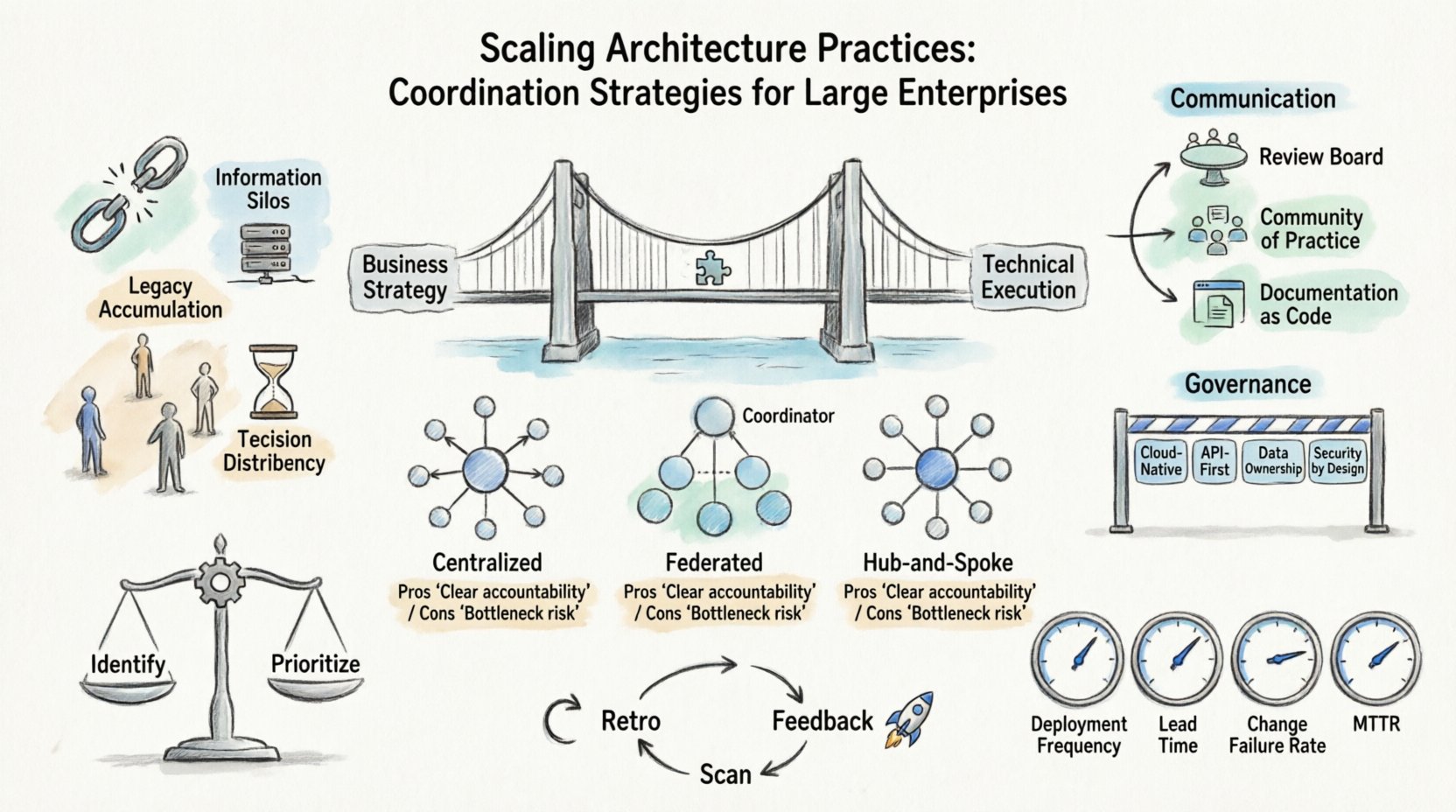
Enterprise architecture is often described as the bridge between business strategy and technical execution. However, as organizations grow from dozens to thousands of employees, and from a handful of applications to complex ecosystems, this bridge must widen significantly. Scaling architecture practices is not merely about adding more people to a team; it is about redefining how coordination happens across vast, distributed networks of developers, stakeholders, and systems. 🧩
When an enterprise reaches a certain size, the centralization of decision-making becomes a bottleneck. Yet, total decentralization leads to chaos, redundancy, and security risks. The challenge lies in finding the equilibrium where agility is preserved without sacrificing stability. This guide explores the structural, procedural, and cultural shifts required to manage architecture at scale. We will examine coordination models, communication protocols, and governance frameworks that enable large organizations to move forward efficiently.
📉 The Complexity of Enterprise Scale
Small teams operate on trust and informal communication. A quick conversation in the hallway can resolve a dependency issue. As an organization scales, these informal channels break down. The sheer volume of interactions required to maintain alignment becomes unmanageable without structure. Understanding the specific friction points is the first step toward resolution.
- Information Silos: Departments often develop solutions in isolation. Marketing technology stacks diverge from engineering, and finance systems may operate on completely different data models.
- Legacy Accumulation: Older systems remain in operation while new ones are built. Integrating modern patterns with legacy constraints requires careful planning and coordination.
- Decision Latency: When too many people need to approve a change, the speed of delivery slows. Bureaucracy can stifle innovation if not managed correctly.
- Talent Distribution: Skilled architects are scarce. Distributing this expertise across multiple business units requires a strategy for knowledge transfer.
Without addressing these issues, technical debt compounds. Systems become fragile, and the cost of change increases exponentially. A coordinated approach ensures that architectural decisions support the business goals rather than hindering them.
🏛️ Organizational Models for Architecture
The structure of the architecture function itself dictates how effectively it can scale. There is no single correct model, but each has distinct trade-offs regarding control, speed, and consistency. Selecting the right model depends on the organization’s maturity and strategic priorities.
1. Centralized Model
In a centralized model, all architectural decisions are made by a single, core team. This ensures high consistency and strict adherence to standards. However, it often creates a bottleneck where the architecture team becomes a gatekeeper.
- Pros: High standardization, clear accountability, reduced duplication.
- Cons: Slow response time, potential disconnect from business unit needs, risk of becoming a bottleneck.
2. Federated Model
A federated model distributes architectural authority to business units while maintaining a central coordinating body. The central team defines principles and standards, but local teams implement them within their specific contexts.
- Pros: Faster local decision-making, better alignment with specific business needs, scalability.
- Cons: Risk of drift from standards, potential for inconsistencies across the enterprise.
3. Hub-and-Spoke Model
This hybrid approach places architects within business units (spokes) who report functionally to a central hub. The hub provides guidance and oversight, while the spokes handle day-to-day execution.
- Pros: Balances local context with global standards, facilitates knowledge sharing.
- Cons: Requires strong communication channels, dual reporting lines can create confusion.
| Model | Control Level | Speed of Delivery | Consistency | Best For |
|---|---|---|---|---|
| Centralized | High | Low | Very High | Highly regulated industries |
| Federated | Medium | High | Medium | Rapidly scaling startups |
| Hub-and-Spoke | Medium-High | Medium | High | Mature enterprises |
🗣️ Communication & Collaboration Protocols
Even the best organizational structure fails if communication is unclear. Large enterprises require formalized channels to ensure that architectural intent is understood by everyone involved. This goes beyond simple status updates; it involves establishing shared languages and forums for discussion.
Architecture Review Boards
Review boards serve as the checkpoint for significant changes. They are not meant to block progress but to ensure alignment. To be effective, these boards must be:
- Transparent: Decisions and rationales should be documented and accessible.
- Representative: Members should reflect diverse views from engineering, security, and business.
- Efficient: Meetings must be time-boxed with clear agendas to prevent meetings from consuming development time.
Community of Practice
Establishing communities of practice allows architects and developers to connect over shared interests. These groups foster peer learning and help disseminate best practices organically.
- Knowledge Sharing: Regular sessions where teams present what they have built and learned.
- Tooling & Standards: Collaborative development of internal libraries and patterns.
- Mentorship: Senior architects guiding junior team members to build capability.
Documentation as Code
Documentation often falls out of sync with reality in large organizations. Treating documentation as code ensures that architectural descriptions evolve alongside the software. This approach allows for version control, review processes, and automated validation.
- Living Documents: Architecture descriptions should be stored in the same repository as the code.
- Automation: Scripts can verify that the deployed system matches the architectural diagrams.
- Accessibility: Ensure documentation is searchable and easy to find for all stakeholders.
🛡️ Governance and Standards
Governance is often viewed as a restriction, but in a large enterprise, it acts as the guardrail that prevents vehicles from driving off the road. Effective governance is lightweight, enabling teams to move fast while staying within safety boundaries.
Defining Architectural Principles
Principles are high-level rules that guide decision-making. They should be few, memorable, and actionable. Examples include:
- Cloud-Native First: Prefer cloud services over on-premise infrastructure.
- API-First: Design interfaces before building implementations.
- Data Ownership: Data must be owned by the domain that creates it.
- Security by Design: Security controls are integrated from the start, not added later.
Compliance vs. Enablement
There is a fine line between enforcing compliance and enabling innovation. Governance teams should focus on outcomes rather than process. If a team can demonstrate that a proposed solution meets security and performance requirements, the approval process should be streamlined.
- Policy as Code: Use automated tools to enforce rules rather than manual checks.
- Exception Handling: Create a clear process for requesting exceptions to standard policies.
- Continuous Feedback: Regularly review policies to ensure they remain relevant.
💾 Technical Debt Management
As systems scale, technical debt accumulates. It is impossible to eliminate debt entirely, but it must be managed to prevent it from becoming unpayable. Ignoring debt leads to systems that are too risky to change, slowing down innovation.
Identifying Debt
Debt is not always obvious. It often manifests as slow build times, frequent production incidents, or difficulty onboarding new developers. Teams must actively scan for these symptoms.
- Code Quality Metrics: Track complexity, duplication, and test coverage.
- Incident Analysis: Review post-mortems to identify recurring architectural failures.
- Dependency Audits: Regularly review third-party libraries for security and maintenance status.
Prioritizing Refactoring
Not all debt is equal. Some requires immediate attention, while others can be deferred. Prioritization frameworks help teams decide what to tackle next.
- Business Impact: Does the debt affect customer experience or revenue?
- Technical Risk: Does the debt increase the likelihood of failure?
- Effort vs. Value: Can the debt be resolved quickly for high value?
Allocating a specific percentage of sprint capacity to debt reduction is a common strategy. This ensures that maintenance work is recognized and scheduled, rather than constantly competing with new feature requests.
📊 Measuring Success
To prove the value of architecture practices, organizations must measure outcomes. Metrics should focus on business value and technical health, rather than just activity levels.
Key Performance Indicators
Tracking the right metrics helps leadership understand the health of the engineering organization.
- Deployment Frequency: How often does the organization release code?
- Lead Time for Changes: How long does it take from commit to production?
- Change Failure Rate: How often does a deployment cause an outage?
- Mean Time to Recovery: How quickly can the team restore service after an incident?
Adoption Rates
Standards and tools are only useful if they are used. Measuring adoption helps identify friction points in the architecture strategy.
- Template Usage: What percentage of new projects use the standard scaffolding?
- Library Adoption: How many teams utilize the shared internal libraries?
- Review Participation: Are review boards meeting regularly and providing value?
🔄 Continuous Improvement
The landscape of technology and business changes constantly. Architecture practices must evolve to remain effective. A static set of rules will eventually become obsolete. Organizations must build mechanisms for continuous improvement.
- Regular Retrospectives: Hold sessions to discuss what is working and what is not within the architecture function.
- Market Scanning: Keep an eye on emerging technologies and industry trends.
- Feedback Loops: Create channels for developers to report issues with architecture processes.
By maintaining a mindset of continuous learning and adaptation, enterprises can scale their architecture practices effectively. The goal is not to control every detail but to create an environment where high-quality decisions happen naturally across the organization. This requires patience, investment in people, and a willingness to iterate on the processes themselves.
🚀 Conclusion
Scaling architecture in a large enterprise is a complex endeavor that requires balancing control with autonomy. By selecting the right organizational model, establishing clear communication channels, and implementing lightweight governance, organizations can achieve alignment without slowing down. Managing technical debt and measuring success ensures long-term sustainability. Ultimately, the success of enterprise architecture lies in its ability to enable the business to move forward with confidence and speed.