Project management is often misunderstood as a purely administrative function. While organizing tasks and tracking timelines are foundational, the role of a senior project manager extends far beyond scheduling meetings. The difference between a standard delivery and a transformative outcome lies in strategic foresight, nuanced stakeholder navigation, and the ability to lead through ambiguity. Senior leaders do not just manage projects; they manage value, risk, and human dynamics simultaneously. This guide outlines the operational shifts that define high-performance leadership in project delivery.
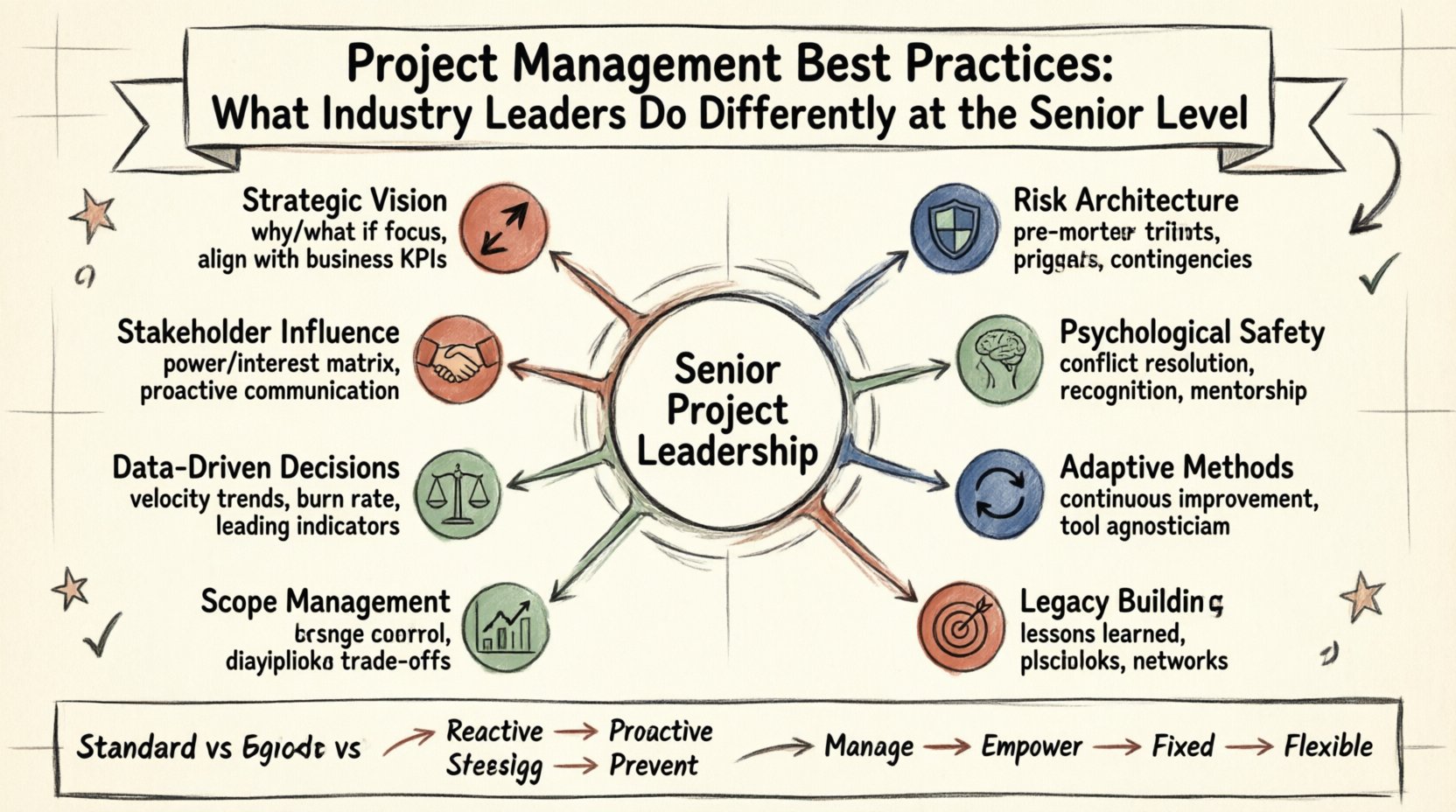
The Shift from Tactical Execution to Strategic Vision 🧭
Junior practitioners often focus heavily on the “how” and “when.” Senior professionals pivot their attention to the “why” and “what if.” This distinction is critical. A project that is delivered on time but fails to meet business objectives is considered a failure, regardless of schedule adherence.
- Tactical Focus: Ensuring tasks are completed within the allocated timeframe.
- Strategic Focus: Ensuring tasks contribute to long-term organizational goals.
Industry leaders align every project phase with the broader corporate strategy. They do not accept project charters that lack clear alignment with business KPIs. Before a single task is assigned, senior leaders validate the project’s value proposition. If the business environment changes, they are willing to pivot the scope to protect the investment.
This requires a deep understanding of the organization’s financial health, market position, and competitive landscape. Senior managers often act as advisors to executive leadership, recommending which initiatives should proceed and which should be paused based on resource availability and potential ROI.
Stakeholder Management: Influence Without Authority 🤝
At the senior level, project managers frequently operate without direct authority over the teams they lead. Success depends on influence, trust, and communication. Managing stakeholders is not about sending status updates; it is about managing expectations and building coalitions.
Identifying Stakeholder Power Dynamics
Not all stakeholders hold equal weight. Leaders map the influence of every individual involved in the project lifecycle. They categorize stakeholders based on their power to impact the project and their interest in the outcome.
- High Power, High Interest: Manage closely. These are your key sponsors.
- High Power, Low Interest: Keep satisfied. Ensure they remain supportive even if they are not deeply involved.
- Low Power, High Interest: Keep informed. They often provide detailed feedback and can become vocal advocates.
- Low Power, Low Interest: Monitor. Do not waste excessive time here.
Proactive Communication Strategies
Senior leaders anticipate questions before they are asked. They do not wait for stakeholders to notice a delay. Instead, they communicate variances early, offering context and potential solutions. This transparency builds credibility.
Effective communication varies by audience. Executives require high-level summaries focusing on risks, budget, and strategic alignment. Team members need detailed task breakdowns and clear directives. A senior project manager switches contexts fluidly, ensuring each group receives the information relevant to their decision-making role.
| Stakeholder Group | Frequency | Format | Key Focus |
|---|---|---|---|
| C-Suite / Sponsors | Monthly | Executive Summary | ROI, Strategic Alignment, Risks |
| Department Heads | Bi-Weekly | Progress Report | Resource Allocation, Dependencies |
| Project Team | Daily / Weekly | Stand-up / Retrospective | Task Completion, Blockers |
| External Partners | As Needed | Contract Review | Deliverables, Compliance |
Risk Architecture: Proactive Mitigation 🛡️
Reactive risk management is a hallmark of inexperienced leadership. Senior professionals build risk architecture into the project plan from day one. They understand that risk is not just a negative event; it is an uncertainty that can affect objectives.
Effective risk management involves more than maintaining a register. It involves active monitoring and contingency planning. Leaders conduct pre-mortem exercises, asking the team to imagine the project has failed and working backward to identify potential causes. This technique surfaces hidden vulnerabilities that standard risk assessments might miss.
Key Risk Management Practices
- Quantitative Analysis: Use data to estimate the probability and impact of risks, rather than relying on gut feeling.
- Trigger Points: Define specific conditions that signal a risk is becoming active, allowing for immediate response.
- Budget Contingencies: Allocate specific reserves for known risks, ensuring funds are available without seeking new approval mid-project.
- Escalation Protocols: Establish clear thresholds for when a risk exceeds the project manager’s authority and requires executive intervention.
Senior leaders also manage “unknown unknowns.” They build flexibility into the schedule and budget to accommodate unforeseen challenges. This agility prevents minor issues from cascading into project failures.
Team Dynamics and Psychological Safety 🧠
High-performing teams are the backbone of successful projects. Senior project managers invest significant time in team culture. They understand that burnout, conflict, and lack of clarity are the primary causes of project delays.
A critical component of this is psychological safety. Team members must feel safe to admit mistakes, ask questions, and propose innovative solutions without fear of retribution. When a team member hides a problem, the project manager learns too late. When a team member voices a concern, the team can pivot before damage occurs.
Fostering a Collaborative Environment
- Conflict Resolution: Address interpersonal friction early. Senior leaders mediate disputes by focusing on shared goals rather than personal grievances.
- Resource Protection: Shield the team from administrative noise and external interruptions. This allows deep work and higher quality output.
- Recognition: Publicly acknowledge individual and team contributions. Recognition reinforces desired behaviors and boosts morale.
- Mentorship: Senior managers actively develop junior staff. They view their role as a multiplier, ensuring the team grows in capability over time.
Data-Driven Decision Making 📊
While intuition plays a role, senior project managers rely on data to validate their decisions. They move beyond vanity metrics like “tasks completed” to meaningful indicators of health and progress.
Leading indicators provide insight into future performance, whereas lagging indicators only report on past performance. A senior leader monitors leading indicators to predict issues before they manifest.
Essential Metrics for Senior Leadership
- Velocity Trends: Tracking the rate of work completion over time to forecast realistic delivery dates.
- Burn Rate: Monitoring the rate at which budget is consumed against the schedule.
- Defect Density: Measuring the number of errors or issues found per unit of work to assess quality.
- Stakeholder Satisfaction: Regular surveys to gauge sentiment and trust levels among those impacted by the project.
Data should not be used to micromanage. Instead, it is used to identify patterns. If velocity drops consistently, the issue is likely systemic, requiring a process change rather than a push for faster individual output.
Adaptive Methodologies and Process Optimization 🔄
There is no single “best” way to manage projects. Industry leaders tailor their approach to the specific context of the initiative. They understand that rigid adherence to a methodology often leads to inefficiency. The goal is to adopt the practices that deliver the highest value for the specific situation.
This might mean applying agile principles to a construction project or using waterfall elements in a software rollout. The key is flexibility. Senior managers are not tied to a specific framework but to the principles of delivering value efficiently.
Process Optimization Principles
- Continuous Improvement: Conduct retrospectives after every major phase. Identify what worked and what did not, then implement changes immediately.
- Standardization vs. Customization: Standardize processes where possible to reduce friction, but customize them where unique requirements demand it.
- Tool Agnosticism: Focus on the workflow rather than the specific software used. Tools should serve the process, not dictate it.
- Documentation Hygiene: Maintain documentation that is accessible and up-to-date. Outdated documents create confusion and rework.
By continuously refining their processes, senior leaders create a flywheel effect. Each project becomes a learning opportunity that makes the next project smoother and faster.
Managing Scope and Expectations 🎯
Scope creep is the silent killer of projects. Senior leaders treat scope as a managed variable, not a fixed constraint. They understand that if time and budget are fixed, scope must be flexible to maintain quality.
The challenge is managing this flexibility without alienating stakeholders. This requires disciplined change control processes. Every request for additional work must be evaluated for its impact on the timeline and budget. If a change is approved, the trade-offs are communicated clearly.
Senior project managers are trained to say “no” or “not yet.” They protect the project’s core objectives by pushing back on low-value additions. This discipline ensures that the project delivers its primary promise without being diluted by constant feature additions.
Building a Legacy of Delivery Success 🏆
The mark of a senior project manager is not just the projects they finish, but the systems they build to ensure future success. They document lessons learned rigorously. They create templates and playbooks that can be reused by other teams. This institutional knowledge prevents the organization from repeating the same mistakes.
Furthermore, they cultivate a network of trusted partners and vendors. Relationships built on mutual respect and clear communication reduce friction during procurement and external collaboration. This network becomes a strategic asset that accelerates project initiation and execution.
Ultimately, senior leadership in project management is about stewardship. It is about managing resources, people, and risks to achieve a defined outcome while leaving the organization better than it was found. The practices outlined above are not a checklist to be completed, but a mindset to be adopted. They require constant vigilance, empathy, and a commitment to excellence.
Summary of Senior Level Differentiators
| Area | Standard Approach | Senior Level Approach |
|---|---|---|
| Focus | Tasks and Timelines | Business Value and Strategy |
| Communication | Reactive Updates | Proactive Influence |
| Risk | React to Issues | Prevent and Mitigate |
| Team | Direct Management | Empower and Coach |
| Metrics | Lagging Indicators | Leading Indicators |
| Scope | Fixed Constraints | Managed Trade-offs |
Adopting these practices requires a commitment to growth and a willingness to challenge the status quo. It is a journey of continuous learning and adaptation. By focusing on strategy, people, and data, senior project managers can navigate complexity and deliver consistent, high-value results.