
In the landscape of business process management, clarity is often the most valuable asset. When stakeholders, auditors, and developers need to understand how work flows through an organization, visual diagrams provide the necessary bridge between abstract strategy and concrete execution. The Business Process Model and Notation (BPMN) standard offers a robust language for this purpose. Among its most critical elements are pools and swimlanes. These structural components allow modelers to define boundaries and assign accountability within a process. This guide explores how to utilize these elements effectively to ensure that every task has an owner and every interaction is clear.
🔍 Understanding the Foundation: What Are Pools?
A pool in BPMN represents a participant in a business process. It defines the boundary of an entity involved in the interaction. This entity could be a company, a department, a customer, or an external system. The primary function of a pool is to separate distinct participants. When you draw a pool, you are essentially saying, “This is where the responsibility of this specific entity ends and another begins.”
There are two main types of pools you will encounter in standard modeling:
- Private Pools: These represent internal processes within a single organization. They often depict the workflow of a specific department or team. The focus here is on internal efficiency, handoffs, and logic.
- Public Pools: These represent external entities. For example, a supplier, a bank, or a regulatory body. Public pools help visualize how data and commands move between different organizations.
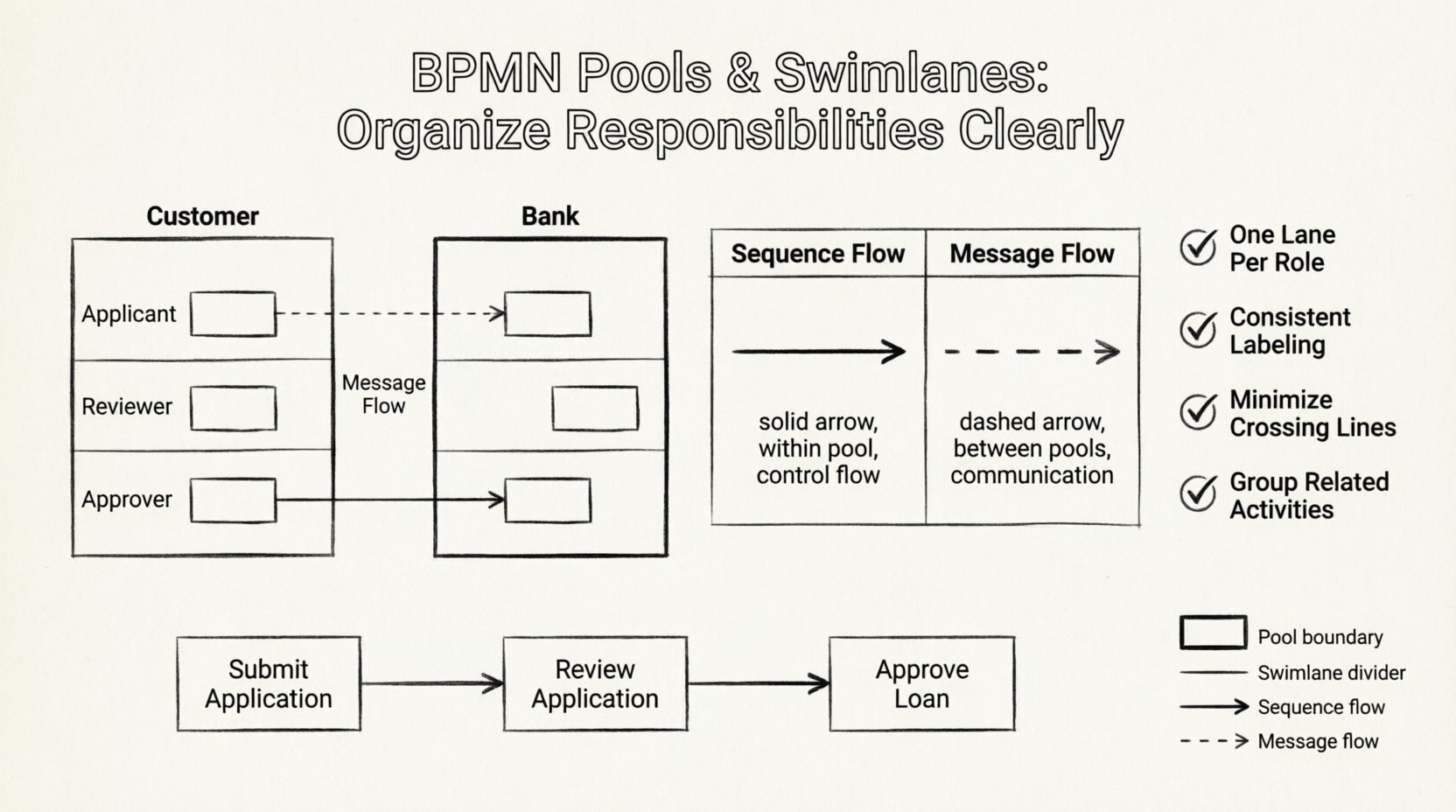
When a process crosses from one pool to another, it signifies a message flow. This is distinct from a sequence flow. A sequence flow happens inside a single pool, indicating the order of tasks. A message flow crosses the boundary between pools, indicating communication. Understanding this distinction is vital for accurate modeling.
🛂 Defining Boundaries and Ownership
One of the primary reasons to implement pools is to establish clear ownership. Without distinct boundaries, it becomes difficult to determine who is responsible for a specific failure or delay. By placing a task within a specific pool, you assign the “who” to the “what.”
Consider a scenario involving a loan application. One pool might represent the “Customer,” while another represents the “Bank.” The Customer pool contains tasks like “Submit Application” and “Provide Documents.” The Bank pool contains “Review Application” and “Approve Loan.” If the process stalls, the diagram immediately reveals which party is holding the task. This visibility is crucial for performance monitoring.
Furthermore, pools help in defining the scope of a process. A process model should not be a monolithic block containing every possible activity. By splitting the model into pools, you create modular views. This modularity allows teams to focus on their specific contributions without being overwhelmed by the entire ecosystem.
🏊 Deep Dive into Swimlanes
Once a pool is established, the internal organization requires further breakdown. This is where swimlanes come into play. A swimlane is a visual subdivision within a pool that represents a specific role, department, or resource type. While a pool defines the participant, a swimlane defines the actor within that participant.
Imagine a single pool representing a “Hospital.” Inside this pool, you might have multiple swimlanes: “Receptionist,” “Doctor,” “Nurse,” and “Billing Department.” This structure allows you to map the patient journey without cluttering the diagram with the hospital’s name repeatedly. It creates a vertical or horizontal grid where tasks are neatly organized.
Types of Swimlane Groupings
Swimlanes can be structured in various ways depending on the complexity of the process. Here are common approaches:
- Role-Based: Tasks are grouped by job title (e.g., Manager, Analyst, Clerk). This is useful for clarifying human responsibility.
- System-Based: Tasks are grouped by the technology used (e.g., CRM System, ERP System, Email). This helps in identifying automation opportunities.
- Department-Based: Tasks are grouped by organizational unit (e.g., Sales, HR, IT). This is effective for cross-functional process analysis.
🔄 Interaction Mechanics: Sequence vs. Message
The interaction between pools and swimlanes dictates the flow of control and information. It is essential to distinguish between the two primary types of flows in BPMN.
| Feature | Sequence Flow | Message Flow |
|---|---|---|
| Location | Within a single pool or swimlane | Between different pools |
| Symbol | Solid line with arrowhead | Dashed line with arrowhead |
| Meaning | Control flow (Next step) | Communication (Data/Signal) |
| Constraint | Cannot cross pool boundary | Must cross pool boundary |
Using the correct flow type prevents logical errors in the process model. A sequence flow crossing a pool boundary is invalid in BPMN standards. This rule enforces the separation of concerns. If a task inside the “Customer” pool triggers an action inside the “Bank” pool, it must be a message flow. This implies that the Customer sends a signal, and the Bank receives it independently.
✅ Best Practices for Organization
Creating a clear diagram requires discipline. There are established guidelines that help maintain readability and accuracy. Adhering to these standards ensures that the model remains useful over time.
- One Lane Per Role: Avoid combining multiple distinct roles into a single swimlane. If a lane contains both “Manager” and “Analyst” tasks, split it. This prevents ambiguity regarding who performs the task.
- Consistent Labeling: Use clear, unambiguous names for pools and lanes. Avoid jargon that might not be understood by all stakeholders. “Finance Dept” is better than “FinOps” unless the audience is technical.
- Minimize Crossing Lines: Try to arrange tasks so that flow lines do not cross swimlanes unnecessarily. This reduces visual noise. If a task in Lane A triggers a task in Lane B, the arrow should be direct and clear.
- Group Related Activities: Keep logically related tasks within the same lane. If a series of approvals always happen within the “Legal” department, keep them in the Legal lane.
- Limit Depth: While nested pools exist, deep nesting can make a diagram difficult to read. Aim for a shallow hierarchy where possible. If a pool contains too many lanes, consider splitting the process into sub-processes.
⚠️ Common Pitfalls to Avoid
Even experienced modelers can make mistakes that degrade the quality of a diagram. Recognizing these common errors helps in maintaining high standards.
- The “Black Hole” Pool: This occurs when a process enters a pool but never exits. It implies the task disappears into a void. Ensure every entry into a pool has a corresponding exit or termination event.
- Overcrowded Swimlanes: A swimlane with twenty tasks is hard to read. It indicates a lack of abstraction. Consider using sub-processes to collapse complex sequences within a single lane.
- Ambiguous Boundaries: If a task can be performed by two different departments, do not leave it floating between lanes. Define the primary owner. If it is a shared task, place it in a shared lane or clarify the handoff protocol.
- Mixing Logic and Communication: Do not use sequence flows to represent external communication. Always use message flows for interactions between pools. Mixing these confuses the reader about the nature of the dependency.
📊 Benefits of Clear Responsibility Mapping
Why invest time in organizing pools and swimlanes? The benefits extend beyond the diagram itself.
1. Enhanced Accountability
When responsibilities are mapped visually, it is easier to identify gaps. If a process step lacks a swimlane, it suggests a missing role. This visibility forces the organization to define who is responsible for that step before implementation begins.
2. Improved Collaboration
Different departments often work in silos. A BPMN diagram that spans multiple pools acts as a translation tool. The “Sales” team can see exactly what information the “Logistics” team needs. This reduces friction and miscommunication during execution.
3. Easier Compliance Auditing
Regulatory bodies often require proof of process control. A diagram with clear swimlanes serves as evidence of segregation of duties. For example, the person who initiates a payment should not be the same person who approves it. Swimlanes make this segregation visually apparent.
4. Targeted Optimization
When analyzing bottlenecks, you can filter by lane. If the “Approval” lane always shows delays, you know the bottleneck is in that specific department. You do not need to analyze the entire process to find the issue.
🛠 Implementation Strategies
Starting a new modeling project requires a systematic approach. Follow these steps to ensure a solid foundation.
- Identify Participants: List all external and internal entities involved. Assign a pool to each.
- Define Roles: Within each pool, list the specific roles or systems that execute tasks. Create swimlanes for these.
- Map the Trigger: Start with the event that initiates the process. Determine which pool owns this event.
- Sequence the Tasks: Draw the flow within each lane. Connect them using sequence flows.
- Connect the Pools: Draw message flows between pools where interaction occurs.
- Review and Validate: Walk through the diagram with stakeholders from each lane to verify ownership and logic.
🔒 Governance and Maintenance
A process model is not a static document. It evolves as the business changes. Governance ensures that the pools and swimlanes remain accurate.
- Version Control: Maintain a history of changes. If a swimlane is renamed or a pool is added, document the reason.
- Access Control: Not everyone needs to edit the model. Designate owners for specific lanes. For instance, the “IT Department” swimlane owner should approve changes to technical tasks.
- Regular Audits: Schedule periodic reviews. Check if new roles have emerged that are not represented in the swimlanes. Remove lanes that are no longer active.
🎯 Advanced Scenarios
Complex processes often require advanced modeling techniques involving pools and swimlanes.
Collaboration Diagrams
A collaboration diagram focuses heavily on the interaction between pools. It minimizes the detail within the pools to highlight the message flow. This is useful for high-level architectural views where the internal logic is less important than the handoffs.
Transaction Boundaries
In some cases, a set of tasks must succeed or fail together. While this is often handled by transaction logic, the visual representation in swimlanes helps indicate where these boundaries lie. If a task in Lane A fails, it may trigger a compensation flow in Lane B. The swimlane structure helps visualize these dependencies.
Event Sub-Processes
Event sub-processes allow you to capture interrupts. If an error occurs in the “Customer” pool, it might trigger an event that pauses the “Bank” pool. This interaction is best visualized when the pools are clearly separated, allowing the error path to be traced without confusion.
📈 Measuring Success
How do you know your organization has successfully adopted this structure? Look for these indicators:
- Reduced Rework: Fewer errors occur due to misunderstood responsibilities.
- Faster Onboarding: New employees understand the process faster because the roles are clearly labeled.
- Clearer Metrics: You can measure time spent in specific lanes more accurately.
- Better Tools: Automation tools can map tasks to specific roles more accurately when the model is structured correctly.
🧩 Summary of Key Concepts
To recap, the effective use of BPMN pools and swimlanes transforms a chaotic list of tasks into a structured map of responsibility.
- Pools define the participant or entity.
- Swimlanes define the internal role or resource.
- Message Flows connect pools (external interaction).
- Sequence Flows connect tasks within a lane (internal logic).
- Clarity is achieved by avoiding ambiguity in boundaries and labels.
By investing in a well-structured model, organizations gain a shared understanding of their operations. This shared understanding is the precursor to efficiency, compliance, and continuous improvement. The diagram becomes a living document that reflects the reality of the business, rather than an abstract theoretical exercise.
🚀 Moving Forward
Start by auditing your current process documentation. Identify areas where responsibility is unclear. Apply the principles of pool and swimlane separation to these areas. You will likely find that the complexity reduces, and the path forward becomes clearer. Remember, the goal is not just to draw a picture, but to facilitate communication and action.