The landscape of software development is shifting beneath our feet. As new generations of engineers enter the workforce, the expectations regarding workflow, autonomy, and value delivery are evolving. Scrum, as a framework for managing complex work, is not exempt from this evolution. It is not merely about sticking to a checklist of ceremonies but adapting to the changing nature of technology and human collaboration. This guide explores the trajectory of Scrum for next-gen developers, focusing on sustainable practices, distributed dynamics, and the integration of modern engineering standards.
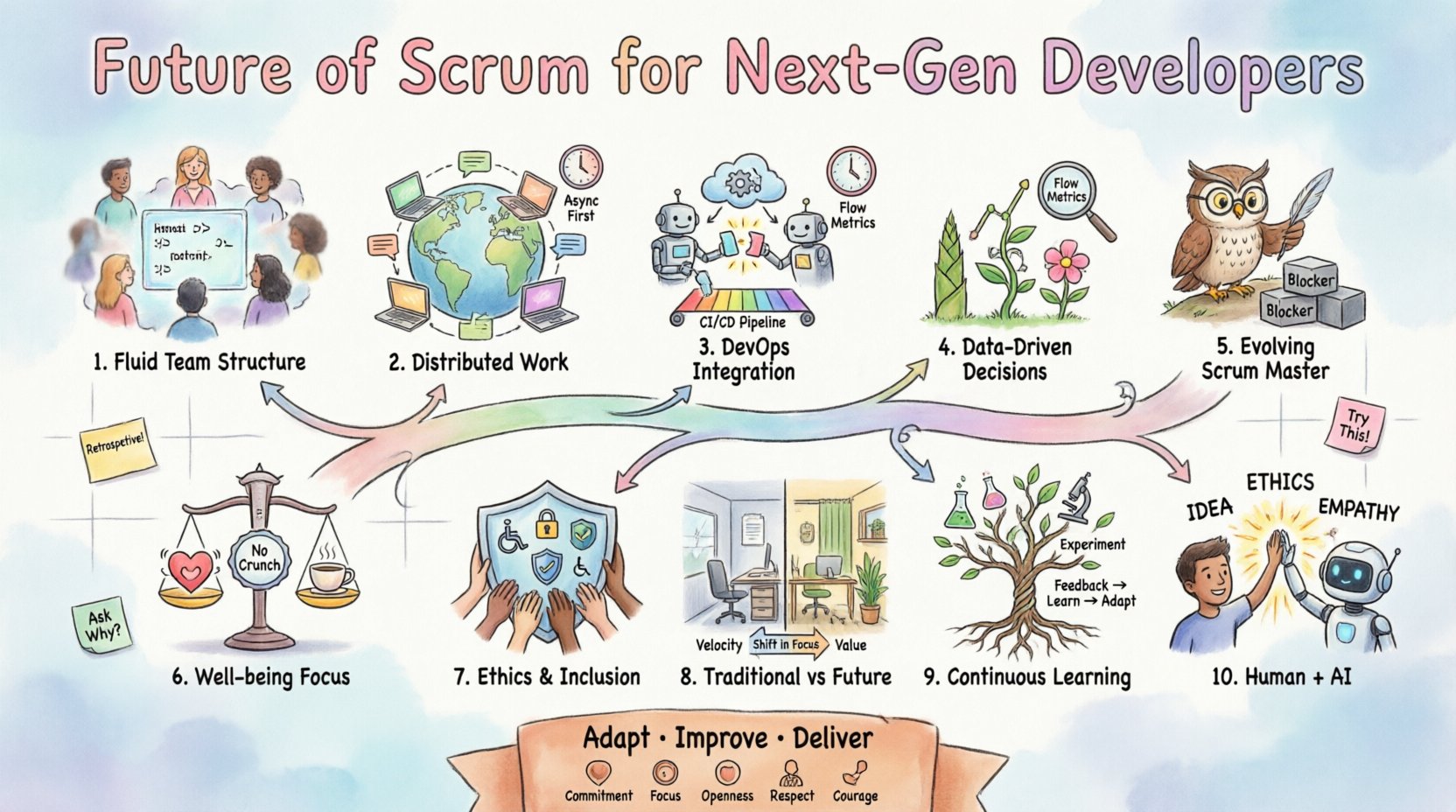
1. The Evolution of the Scrum Team Structure 👥
The traditional definition of a Scrum Team remains a core tenet: a small group of people with all the skills necessary to deliver a product increment. However, the composition and interaction models are shifting. Next-gen developers expect less hierarchy and more autonomy. The team is moving away from siloed roles toward fluid, cross-functional collaboration.
Fluid Roles: While the three accountabilities (Product Owner, Scrum Master, Developers) remain, the rigid boundaries are blurring. Developers may take on product discovery tasks, and Scrum Masters may engage more deeply with technical architecture.
Self-Management: The shift is toward deeper self-organization. Teams are expected to decide not just how to do the work, but what to do when the product goal allows for flexibility.
Psychological Safety: Future teams prioritize an environment where failure is treated as data. This reduces the fear of speaking up during Sprint Reviews or Retrospectives.
For next-gen developers, the team is not just a delivery unit; it is a learning ecosystem. The focus is on continuous improvement not just of the product, but of the team’s way of working.
2. Distributed Work and Async Communication 🌍
The rise of remote work has permanently altered how Scrum functions. The “co-located” ideal is no longer the default for many organizations. Scrum must adapt to asynchronous interactions without losing the essence of collaboration.
Key Adaptations for Remote Scrum:
Documentation First: When face-to-face interaction is limited, documentation becomes the source of truth. Decisions made in meetings must be captured clearly for those in different time zones.
Video-First Ceremonies: While chat tools exist, the nuance of human interaction is best preserved via video calls. However, this must be balanced against meeting fatigue.
Time Zone Agnostic Sprints: Some teams are moving away from strict 2-week windows to ensure overlap is maximized. Others accept that the “Daily Scrum” might be a written update rather than a synchronous stand-up.
Tools used for communication are secondary to the intent of the communication. The goal is to maintain transparency and inspection without forcing synchronous presence.
3. Integration with Modern Engineering Practices 🛠️
Scrum does not exist in a vacuum. It sits atop the technical infrastructure of the organization. For next-gen developers, the gap between “development” and “operations” has largely closed. The integration of DevOps principles into the Scrum framework is becoming standard.
Technical Agility:
CI/CD Pipelines: The ability to release frequently is a core tenet of Scrum. Modern pipelines allow teams to push code multiple times a day, aligning perfectly with the Sprint goal of a potentially shippable increment.
Automated Testing: Quality is no longer a phase at the end of the Sprint. It is embedded. Automated regression tests run in the background, ensuring that every commit maintains stability.
Infrastructure as Code: Managing infrastructure changes within the same workflow as application code ensures consistency and reduces deployment friction.
This integration means the Definition of Done is no longer just “code written.” It includes “code tested, code reviewed, code deployed to staging.” This shifts the focus from completion to delivery.
4. Data-Driven Decision Making 📊
While Scrum has always valued empirical process control, the next generation of teams places a heavier emphasis on quantitative data. However, this is not about vanity metrics. It is about understanding flow and value.
Flow Metrics: Instead of just tracking velocity, teams track cycle time and lead time. These metrics reveal bottlenecks in the process rather than just measuring output.
Value Metrics: The focus shifts from “how many stories did we close?” to “what value did the users receive?” This aligns the Scrum Team more closely with business outcomes.
Feedback Loops: Shorter feedback loops allow teams to pivot quickly. Data informs the Retrospective, ensuring that process changes are based on evidence rather than anecdote.
Next-gen developers understand that data is a tool for improvement, not a weapon for performance management. The distinction is critical for maintaining trust.
5. The Changing Role of the Scrum Master 🧭
The role of the Scrum Master is often misunderstood. In the future, the role will likely evolve from a ceremonial facilitator to a systems thinker and coach. The focus shifts from managing the process to managing the environment in which the process happens.
Core Responsibilities:
Removing Impediments: This remains key, but impediments are now often systemic (e.g., tooling limitations, organizational policies) rather than just technical blockers.
Coaching on Soft Skills: As technical skills become more automated, soft skills like negotiation, conflict resolution, and emotional intelligence become paramount.
Organizational Change: The Scrum Master often acts as a bridge between the team and the wider organization, helping to dismantle barriers that prevent the team from delivering value.
The role is less about ensuring the team follows rules and more about ensuring the team has the context and support to make the best decisions.
6. Sustainability and Well-being 🧘
One of the biggest shifts in the next generation is the prioritization of human well-being. The concept of “crunch time” is increasingly viewed as a failure of planning, not a badge of honor. Sustainable development is a core requirement for long-term success.
Realistic Planning: Teams are expected to say “no” to unrealistic expectations. Sprint commitments are treated as agreements, not targets to be crushed.
Rest and Recovery: The framework acknowledges that rest is productive. Burnout prevention strategies are integrated into team norms.
Work-Life Balance: Next-gen developers value flexibility. The Scrum framework supports this by focusing on output and value rather than hours logged.
When a team is healthy, the quality of their work improves. The Scrum Master plays a vital role in protecting the team from external pressure that threatens this balance.
7. Ethical Considerations and Inclusion 🤝
As software permeates every aspect of life, the ethical implications of development grow. Next-gen developers are more conscious of the societal impact of the products they build. Scrum provides a mechanism to address these concerns through the Product Owner and the team.
Ethical Backlogs: Teams are beginning to include items in the Product Backlog that address accessibility, privacy, and security explicitly.
Diverse Perspectives: Inclusive teams build better products. Scrum encourages diverse voices to be heard during planning and review sessions.
Transparency: Hiding technical debt or ethical risks from stakeholders is becoming unacceptable. Full transparency builds trust and long-term viability.
The future of Scrum involves not just building software, but building responsible software. The framework supports this by allowing ethical considerations to be part of the Definition of Done.
Traditional Scrum vs. Future Scrum ⚖️
To visualize the shift, consider the comparison below.
Aspect | Traditional Scrum | Future Scrum |
|---|---|---|
Team Location | Co-located, Office-Centric | Distributed, Hybrid, Async-First |
Metrics | Velocity, Story Points | Flow Time, Cycle Time, Value Delivered |
Communication | Face-to-Face, Synchronous | Mixed, Document-Driven, Video-First |
Engineering | Dev and Ops Separation | DevOps Integration, Automation |
Well-being | Secondary to Delivery | Central to Sustainability |
Role Focus | Ceremonial Facilitation | Systems Thinking, Coaching |
8. Continuous Improvement as a Core Value 🔄
The heart of Scrum is the Retrospective. In the future, this ceremony must evolve to become a deeper reflection on the team’s health and direction. It is not just about fixing bugs in the process; it is about fixing the culture.
Experimentation: Teams should be encouraged to experiment with their workflow. Try a new planning technique, change the timing of the review, or alter the definition of done.
Feedback Culture: Feedback should be continuous, not just at the end of the Sprint. Peer reviews and regular check-ins replace annual performance reviews.
Learning Time: Dedicated time for learning new technologies or skills should be baked into the Sprint capacity, ensuring the team stays relevant.
This commitment to learning ensures that the team remains agile in a world where technology changes rapidly. If the team stops learning, they stop being agile.
9. Scaling Considerations for Large Organizations 🏢
While Scrum is designed for small teams, large organizations often need to coordinate multiple teams. Frameworks like Scrum of Scrums exist, but the future points toward more organic scaling methods.
Network of Teams: Instead of rigid hierarchy, teams form networks based on the value stream. This allows for better alignment without bureaucratic overhead.
Common Backlogs: Multiple teams may share a Product Backlog for a specific feature set, ensuring a unified vision.
Decentralized Decision Making: Decisions are pushed to the lowest possible level. This reduces bottlenecks and speeds up response times.
Scaling is not about making Scrum bigger; it is about making the organization more responsive. The goal is to maintain the agility of a small team even as the organization grows.
10. The Human Element in Agile 🤖
As automation and AI become more prevalent in the development lifecycle, the human element becomes even more valuable. Scrum provides the structure for humans to focus on creativity, empathy, and complex problem solving.
AI-Assisted Development: AI can handle boilerplate code or testing, freeing developers to focus on architecture and user experience.
Empathy in Design: Understanding user needs requires human insight. AI cannot replace the empathy needed to design for real people.
Collaboration: The friction of collaboration is where innovation happens. Scrum creates the space for this friction to occur productively.
The future of Scrum is not about replacing humans with machines. It is about using technology to amplify human potential. The framework serves as the container for this collaboration.
Final Thoughts on the Path Forward 💡
The journey of Scrum is not static. It is a living framework that must breathe with the needs of the organization and the developers. For next-gen developers, the focus is on value, sustainability, and autonomy. The ceremonies remain, but their purpose shifts from compliance to enablement.
Organizations that cling to rigid interpretations of Scrum risk becoming obsolete. Those that embrace the fluidity and adapt the framework to their specific context will thrive. The core values of Scrum—Commitment, Focus, Openness, Respect, and Courage—remain the guiding light, but the application of these values changes with the times.
By prioritizing human well-being, integrating modern engineering practices, and embracing data-driven insights, Scrum continues to be a robust framework for complex work. The future belongs to those who understand that Scrum is a tool for thinking, not just a set of rules to follow. As the industry evolves, so too must our approach to delivering value.
Next-gen developers are ready for this evolution. They demand transparency, they value autonomy, and they seek meaningful work. Scrum, when adapted correctly, provides the structure to meet these demands. The path forward is clear: adapt, improve, and deliver.