Enterprise Architects often face a distinct challenge. You possess deep technical knowledge, yet the decision-makers who control budgets and strategy operate in a different language. Your diagrams are precise, your models are robust, but if the business leaders do not understand the strategic implication, the work remains invisible. This guide addresses how to bridge that gap effectively. Communication here is not just about speaking clearly; it is about translating technical necessity into business viability.
Understanding the Disconnect 🤔
The friction between technical teams and business leadership is common. Architects frequently focus on attributes like scalability, maintainability, and technical debt. Executives focus on attributes like revenue growth, market share, and risk mitigation. Neither side is wrong, but the translation layer is often missing.
When you present a proposal to modernize a legacy system, you might talk about refactoring code, reducing coupling, or improving API latency. To a CFO, these terms are abstract. To a CEO, they are irrelevant unless tied to a specific outcome. The goal is to move the conversation from what you are building to why the business needs it.
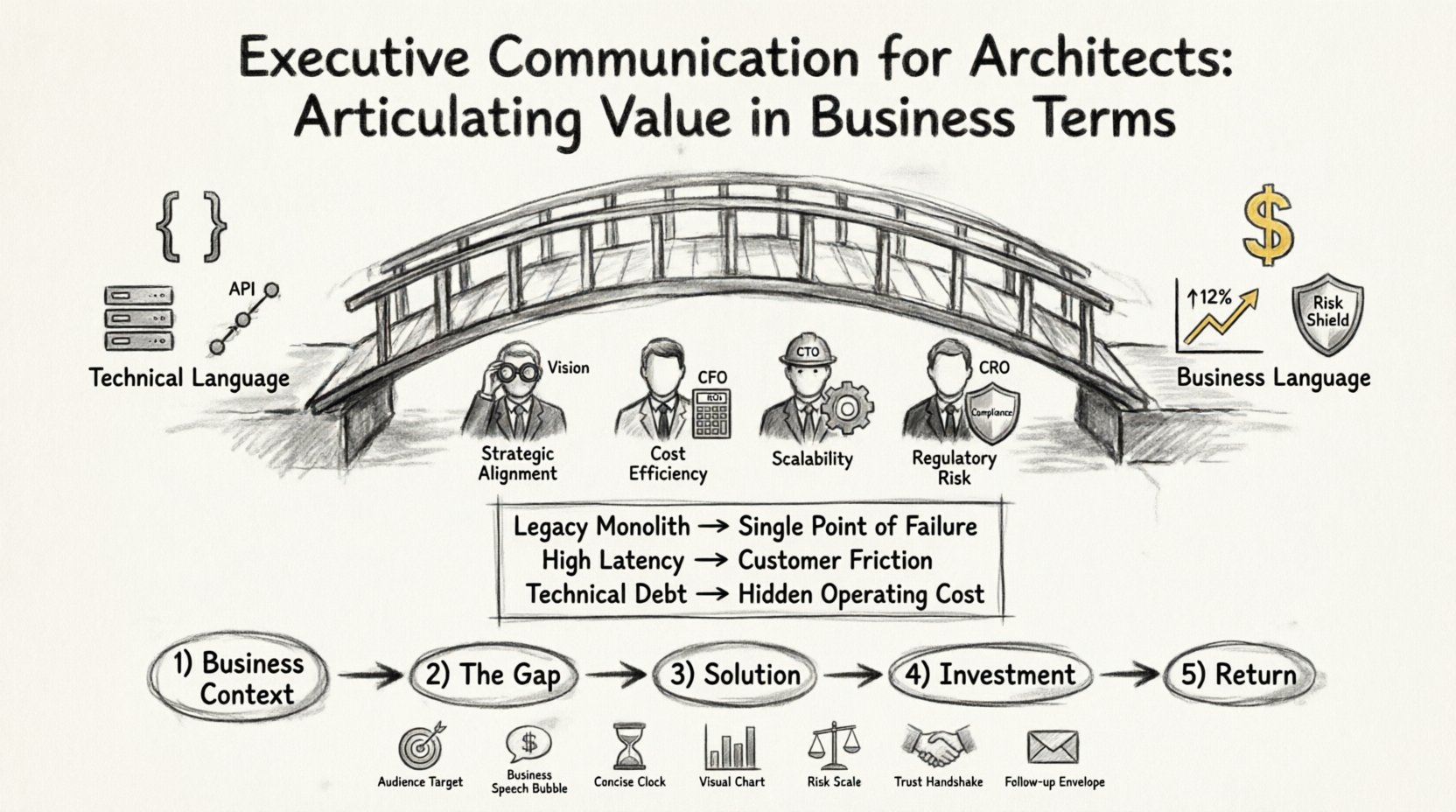
This shift requires a deliberate change in preparation. You must understand the metrics that drive your stakeholders. A Chief Financial Officer cares about Total Cost of Ownership (TCO) and Return on Investment (ROI). A Chief Operating Officer cares about process efficiency and uptime. A Chief Risk Officer cares about compliance and security posture. Your communication must align with these priorities.
Mapping Stakeholder Priorities 🎯
Effective communication begins before you enter the room. You need to know who is sitting at the table and what keeps them awake at night. Different roles require different narratives. Below is a breakdown of key personas and their primary concerns.
- Chief Executive Officer (CEO): Focuses on long-term vision and competitive advantage. They want to know how architecture supports the company’s 3-to-5-year goals.
- Chief Financial Officer (CFO): Focuses on capital allocation and efficiency. They want to know the cost implications and the financial return of your initiatives.
- Chief Technology Officer (CTO): Focuses on technical feasibility and innovation. They want to know how your architecture enables speed and stability.
- Chief Risk Officer (CRO): Focuses on compliance and security. They want to know how your decisions mitigate regulatory and operational risks.
When you prepare a presentation, do not use a one-size-fits-all approach. Tailor the data points to the audience. If you are speaking to the CFO, put the financial impact on the first slide. If you are speaking to the CTO, put the technical architecture on the first slide.
Translating Technical Debt into Business Risk ⚠️
One of the hardest concepts to convey is technical debt. Architects often describe it as “bad code” or “outdated libraries.” Business leaders hear “expensive problems.” To make this tangible, you must frame technical debt as financial liability.
Consider the following comparison:
| Technical Term | Business Equivalent | Why It Matters |
|---|---|---|
| Legacy Monolith | Single Point of Failure | Impacts speed of new product launches |
| High Latency | Customer Friction | Reduces conversion rates and user retention |
| Security Patching | Risk Compliance | Prevents fines and brand damage |
| Technical Debt | Hidden Operating Cost | Increases cost of change over time |
By using these equivalents, you help executives visualize the cost of inaction. When you say that the current system will slow down the next product launch by three months, you are speaking a language they understand. Time is money.
Structuring Your Narrative 📝
A compelling presentation follows a logical flow. It should not start with the solution. It should start with the problem as the business sees it. This ensures you are solving the right issue.
1. The Business Context
Start by acknowledging the current market conditions. Are competitors launching features faster? Is the regulatory landscape changing? This sets the stage for why change is necessary now.
2. The Gap
Describe the current state versus the desired state. Be specific. “We can currently support 1,000 users. The market growth requires 10,000 users. Our current infrastructure cannot scale to 10,000 without significant degradation.”
3. The Solution
Introduce the architectural approach. Keep the technical details high-level unless the audience is technical. Focus on capabilities. “We will implement a cloud-native architecture that allows horizontal scaling.”
4. The Investment
State the cost clearly. Do not hide the budget requirements. Break down the investment into phases if possible. This shows planning and fiscal responsibility.
5. The Return
Close with the benefits. Quantify them where possible. “This investment reduces deployment time by 50%, allowing us to capture market share faster.”
Handling Objections and Pushback 🛡️
Executives will challenge your proposals. This is normal. It is their job to protect the organization’s resources. When you face objections, remain calm and factual. Do not become defensive. Here are common objections and how to address them.
- “This is too expensive.”
Respond by comparing the cost of the project to the cost of inaction. “The current system costs $X per month in maintenance. The new system costs $Y, but it saves $Z in operational overhead and reduces downtime risks.” - “We don’t have time for this.”
Respond by highlighting the risk of delay. “Delaying this initiative means we will spend more money on workarounds next quarter. Investing now reduces the total effort later.” - “Why can’t we just fix it quickly?”
Respond by explaining the underlying complexity. “A quick fix will likely fail under load. We need to build the foundation to support future growth.”
Preparation is key to handling these moments. Anticipate the questions before the meeting. Have the data ready to back up your claims. Confidence comes from knowing the numbers.
The Power of Visuals 📊
Executives often review documents quickly. They do not have time to read walls of text. Use visuals to convey complex information efficiently. However, avoid cluttered diagrams. A complex architecture diagram with five layers of boxes is useless to a non-technical audience.
Use simplified views. Show the flow of data. Show the dependencies between systems. Use color to indicate status (green for healthy, red for at-risk). Keep the labels concise. If a diagram needs a paragraph to explain it, simplify the diagram.
Consider using a roadmap view. This shows the timeline of initiatives. It helps executives understand the sequence of work and when value will be realized. A timeline creates a sense of momentum.
Managing Technical Debt as a Strategic Asset 🛠️
Technical debt is often viewed negatively. In reality, it is a strategic choice. Every organization takes on debt to move faster. The problem arises when the debt is not managed. You must present debt management as part of the investment portfolio.
Allocate a percentage of your budget to debt reduction. Just as you allocate budget to new features, allocate budget to stability. This signals to leadership that you are maintaining the health of the organization. Frame this as “preserving capacity.” If you do not pay down debt, the capacity to build new features diminishes.
Track the ratio of new feature work to maintenance work. If 80% of your time is spent on maintenance, you are burning capacity. Share this metric with leadership. It provides a clear indicator of health.
Building Trust Through Consistency 🤝
Trust is the currency of communication. If you say you will deliver a project by Q3, deliver it by Q3. If you say a risk is high, and it materializes, you have built credibility. If you miss deadlines without warning, you lose credibility.
Be honest about challenges. Do not hide bad news until it becomes a crisis. Early warnings allow leaders to make informed decisions. If a vendor is delayed, tell them immediately. Give them options for mitigation. This shows you are managing the situation, not just reporting on it.
Consistency also applies to your language. Avoid jargon that changes meaning between teams. Define your terms. If you use the term “microservices” in one meeting and “distributed systems” in another, it causes confusion. Stick to consistent terminology.
Post-Communication Follow-Up 📬
The conversation does not end when the meeting closes. Follow-up ensures alignment and accountability. Send a summary of the discussion within 24 hours. Include the key decisions made, the action items assigned, and the timeline agreed upon.
- Recap Decisions: What was approved? What was rejected? What is pending?
- Assign Owners: Who is responsible for the next steps?
- Set Dates: When is the next review?
This document serves as a record. It prevents the “he said, she said” scenario. It keeps the momentum going. It ensures that the business leaders feel heard and that the technical team knows what is expected.
Continuous Learning and Adaptation 🔄
Communication is a skill that improves with practice. After every presentation, reflect on what worked and what did not. Did the audience ask the right questions? Did you get the budget approved? Did you clarify the risks?
Seek feedback from trusted peers. Ask them to review your slides before you present. Ask them to challenge your narrative. This helps you identify blind spots. You might think a point is obvious, but to an executive, it might be confusing.
Stay updated on business trends. Read financial news. Understand the company’s strategic plan. The more you understand the business context, the better you can align your architecture to it. This makes you a strategic partner, not just a technical resource.
Key Takeaways for Architects 🚀
To summarize the essential practices for effective executive communication:
- Know your audience: Tailor the message to the stakeholder’s priorities.
- Speak business language: Translate technical terms into financial and operational impacts.
- Be concise: Respect their time with clear, focused presentations.
- Use visuals wisely: Simplify complex diagrams to highlight key relationships.
- Manage risk: Frame technical debt as financial liability.
- Build trust: Be consistent, honest, and reliable in your delivery.
- Follow up: Document decisions and action items to ensure alignment.
Enterprise Architecture is not just about designing systems. It is about designing value. When you communicate effectively, you ensure that the architecture delivers that value. You move from being a gatekeeper of technology to a driver of business strategy. This shift is critical for the long-term success of the organization.
Start applying these principles today. Review your next presentation. Change the opening slide to focus on business impact. Replace jargon with clear business terms. Measure the response. You will find that your influence grows as your clarity improves. The goal is not to be the smartest person in the room. The goal is to be the most helpful.