In the modern enterprise, business processes are the backbone of operations. However, without a unified approach to documenting and analyzing these workflows, organizations face fragmentation, inconsistency, and operational risk. Establishing process governance standards for enterprise-wide modeling ensures that every diagram, every stakeholder, and every department speaks the same language. This guide outlines the structural, cultural, and technical steps required to build a robust framework for Business Process Model and Notation (BPMN) governance.
Understanding the Need for Governance 🧐
Process modeling is not merely about drawing boxes and arrows. It is about capturing logic, decision points, and handoffs that drive value. When different teams create models without a shared standard, the result is a collection of diagrams that may be technically correct but semantically incompatible. This leads to confusion during audits, system implementations, and process improvements.
Governance in this context refers to the framework of policies, procedures, and standards that guide how processes are modeled, reviewed, and maintained across the organization. It is about consistency and clarity.
- Consistency: Ensures that a “decision gateway” looks the same in the HR department as it does in Finance.
- Clarity: Ensures that any stakeholder can read a model and understand the flow without needing a legend.
- Compliance: Supports regulatory requirements by maintaining clear, auditable process records.
- Efficiency: Reduces the time needed to understand or modify existing processes.
Core Components of a Governance Framework 🧱
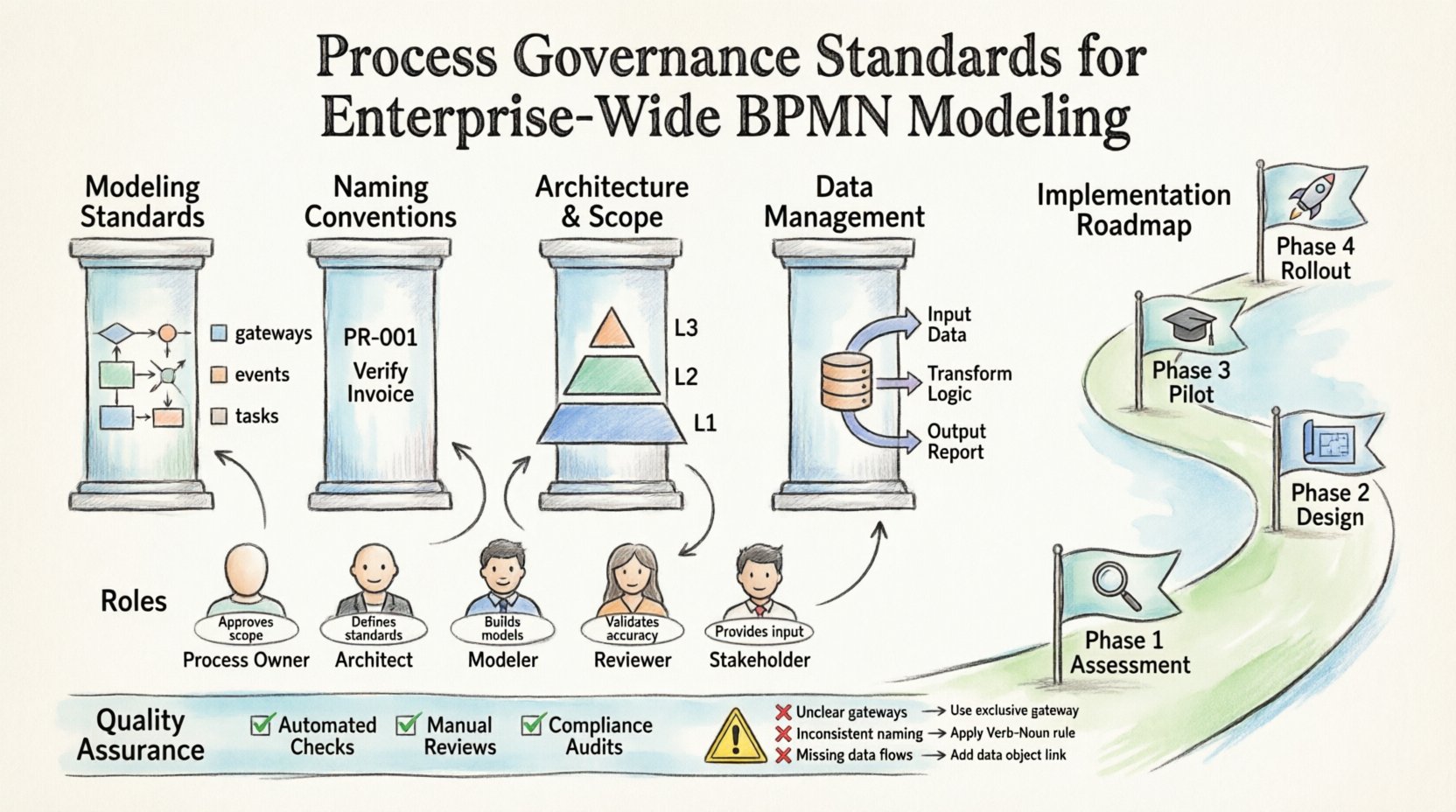
A successful governance framework rests on four pillars. Each pillar requires specific attention to detail to ensure long-term viability.
1. Modeling Standards 📏
These are the technical rules that define how diagrams are constructed. They cover syntax, notation, and layout.
- Notation Adherence: Strict compliance with the BPMN 2.0 specification to ensure interchangeability.
- Color Coding: Define specific meanings for colors (e.g., red for errors, green for successful completion).
- Diagram Types: Specify when to use a high-level overview versus a detailed execution model.
2. Naming Conventions 🏷️
Consistent naming prevents ambiguity. A process named “Order Processing” should not be confused with “Order Fulfillment” unless they are distinct.
- Process IDs: Use a unique identifier system (e.g., PR-001, PR-002).
- Activity Names: Follow a Verb-Noun structure (e.g., “Verify Invoice” instead of “Invoice Verification”).
- Swimlane Labels: Use official organizational unit names rather than department nicknames.
3. Architecture & Scope 🗺️
Not every process needs the same level of detail. Governance defines the hierarchy.
- L1 Maps: High-level value chains showing major business areas.
- L2 Maps: Cross-functional processes spanning multiple departments.
- L3 Maps: Detailed task-level execution flows.
- Integration Points: Standards for how systems interact within the model.
4. Data Management 🗄️
Models must accurately reflect data objects and information flows.
- Object Naming: Standardize how data entities are named across diagrams.
- Information Flows: Define rules for when data objects are created, modified, or consumed.
Establishing Detailed Modeling Standards 📝
To move from theory to practice, specific rules must be codified. These rules act as the constitution for your modeling community.
Visual Consistency
Visual confusion creates cognitive load. When a reader sees a diamond shape, they should immediately know it represents a gateway, regardless of who drew it.
- Gateways: Exclusive gateways must be diamonds. Parallel gateways must be diamonds with a plus sign.
- Events: Start events should always be a single circle. End events should always be a thick circle.
- Tasks: Use rounded rectangles for general tasks. Use cylinders for manual tasks if the tool supports it.
- Connectors: Use solid lines for sequence flows. Use dashed lines for message flows between pools.
Complexity Management
Overcomplicating a diagram renders it useless. Governance must dictate when to sub-process and when to expand.
- Sub-Processes: Use collapsed sub-processes to hide complexity. Expand them only when the detail is required for the specific audience.
- Depth Limit: Limit the number of nested sub-processes to three levels to maintain readability.
- Thread Counts: Limit the number of outgoing flows from a single gateway to prevent tangled logic.
Annotation and Documentation 📄
Diagrams are visual, but they often require text to explain context.
- Text Annotations: Use text annotations for business rules or exceptions that cannot be modeled as flow.
- Model Descriptions: Every diagram must have a metadata section describing the owner, version, and last update date.
- Legend Usage: Avoid legends. Use standard symbols that are self-explanatory.
Roles and Responsibilities 👥
Governance fails without clear ownership. The following roles define who is responsible for what within the modeling ecosystem.
| Role | Responsibility | Authority Level |
|---|---|---|
| Process Owner | Accountable for the end-to-end performance of the process. | High |
| Process Architect | Designs the framework and enforces modeling standards. | Medium |
| Modeler | Creates and maintains the diagrams according to standards. | Low |
| Reviewer | Validates technical accuracy and compliance before publication. | Medium |
| Stakeholder | Provides input on process logic and requirements. | Low |
The Process Architect
This role is critical. The Process Architect is the guardian of the standards. They do not necessarily draw every diagram, but they define the rules. They ensure that the modeling tool is configured correctly and that templates are available.
The Reviewer
Before a process goes live or is used for system configuration, it must pass review. The reviewer checks for:
- Logical dead ends (no exit path).
- Unreachable tasks.
- Incorrect use of gateways.
- Adherence to naming conventions.
Implementation Roadmap 🗺️
Rolling out governance is a change management exercise. It requires planning, communication, and patience.
Phase 1: Assessment and Baseline 📊
Before setting new rules, understand the current state.
- Audit Existing Models: Review current diagrams to identify common errors and inconsistencies.
- Identify Pain Points: Ask stakeholders what frustrates them about current documentation.
- Define Maturity Level: Determine where the organization stands (Ad-hoc, Managed, Defined, Optimized).
Phase 2: Design and Definition 🛠️
Create the documentation that will guide the organization.
- Write the Standard: Document the rules clearly. Avoid jargon where possible.
- Create Templates: Build starter files for common scenarios (e.g., Onboarding, Invoice Processing).
- Define Tool Configuration: Set up the modeling software to enforce rules (e.g., blocking invalid connections).
Phase 3: Pilot and Training 🎓
Do not roll out to everyone at once. Start small.
- Select Pilot Group: Choose one department willing to adopt the new standards.
- Conduct Workshops: Train modelers on the new rules and the rationale behind them.
- Gather Feedback: Ask the pilot group if the standards are practical or too restrictive.
Phase 4: Enterprise Rollout 🚀
Expand the standards across the organization.
- Communication Campaign: Announce the new standards via email, town halls, and intranet.
- Enforcement: Require review sign-off for all new models.
- Support: Establish a help channel for questions regarding the standards.
Quality Assurance and Compliance ✅
Standards are useless if they are ignored. Quality assurance ensures adherence over time.
Automated Checks
Modern modeling tools allow for automated validation. Configure the tool to:
- Prevent saving diagrams with syntax errors.
- Highlight missing metadata fields.
- Warn against deprecated symbols.
Manual Reviews
Automation cannot catch logic errors. Human review is essential.
- Peer Review: Require two modelers to review each other’s work.
- Architect Review: The Process Architect reviews high-value or complex processes.
- Business Review: Subject matter experts verify the logic matches reality.
Compliance Audits
Periodically check the repository for compliance.
- Random Sampling: Select 10% of models at random for a deep dive.
- Issue Tracking: Log non-compliance and track remediation.
- Reporting: Report compliance rates to leadership to maintain accountability.
Handling Exceptions and Variations 🔄
Not every process fits the standard mold. Governance must allow for flexibility where necessary.
When to Deviate
Define specific scenarios where exceptions are permitted.
- Legacy Systems: Older systems may not support modern integration patterns.
- Unique Business Needs: Specialized industries may have unique regulatory requirements.
- Prototyping: Temporary models for exploration do not need full governance.
Managing Variations
If a variation is necessary, it must be documented.
- Tagging: Tag exceptional models with a “Variation” label.
- Justification: Include a comment explaining why the standard was not followed.
- Review: These models require higher-level approval.
Common Modeling Violations ⚠️
Understanding common mistakes helps prevent them. The table below outlines frequent violations and their corrections.
| Violation | Impact | Correction |
|---|---|---|
| Unreachable Tasks | Process cannot complete; logic is broken. | Ensure every task has an incoming flow. |
| Deadlocks | Process hangs indefinitely. | Ensure parallel gateways are balanced. |
| Missing Start Events | Undefined process trigger. | Every process must begin with a start event. |
| Inconsistent Naming | Confusion and misinterpretation. | Enforce Verb-Noun naming convention. |
| Overlapping Swimlanes | Unclear ownership. | Ensure swimlanes are distinct and labeled clearly. |
Continuous Improvement 📈
Governance is not a one-time project. It is a living system that evolves with the business.
Gathering Feedback
Create channels for modelers to suggest improvements to the standards.
- Suggestion Box: Allow anonymous submissions of standard improvements.
- Quarterly Reviews: Meet with the governance committee to review feedback.
- Tool Updates: Adjust standards based on new tool capabilities.
Versioning Standards
Just like software, standards need version control.
- Version Numbers: Label standards (e.g., v1.0, v1.1).
- Change Logs: Document what changed and why in each version.
- Migration: Plan how to migrate existing models to new standards.
Metrics for Success
Track progress to demonstrate value.
- Compliance Rate: Percentage of models that pass the automated check.
- Review Time: Time taken to review and approve a model.
- Rework Rate: Number of models rejected due to errors.
- Usage Rate: Number of processes actively used versus archived.
Conclusion on Governance 🏁
Establishing process governance standards is a foundational step toward operational excellence. It transforms modeling from an ad-hoc activity into a strategic asset. By defining clear rules, assigning responsibilities, and enforcing quality, organizations ensure that their process documentation remains accurate, useful, and aligned with business goals.
Success requires commitment from leadership and participation from all modelers. The effort invested in governance pays dividends in reduced errors, faster implementations, and clearer communication. Start with a strong framework, iterate based on experience, and maintain discipline over time.