Regulatory compliance is often viewed as a static checklist of legal obligations. However, in modern business operations, it is a dynamic state of alignment between organizational behavior and external mandates. Achieving this alignment requires more than policy documents; it demands a clear, executable understanding of how work actually flows through an enterprise. This is where transparent process modeling becomes critical. By visualizing workflows using standard notation, organizations can map regulatory requirements directly to operational steps, ensuring accountability and auditability at every stage.
The complexity of modern regulations—ranging from financial reporting standards to data privacy laws—requires a methodology that bridges the gap between high-level governance and granular execution. A standardized approach to modeling processes provides a shared language for auditors, regulators, and business stakeholders. It transforms abstract rules into concrete actions that can be monitored, measured, and improved.
🔍 The Intersection of Law and Logic
Compliance failures often stem from ambiguity. When a regulation states that a specific action must be taken, but the internal process does not clearly define who performs it, when, and under what conditions, risk increases. Process modeling addresses this ambiguity by creating a visual representation of the workflow. This representation serves as a single source of truth regarding how the business operates.
Consider the following core benefits of integrating regulatory requirements into process models:
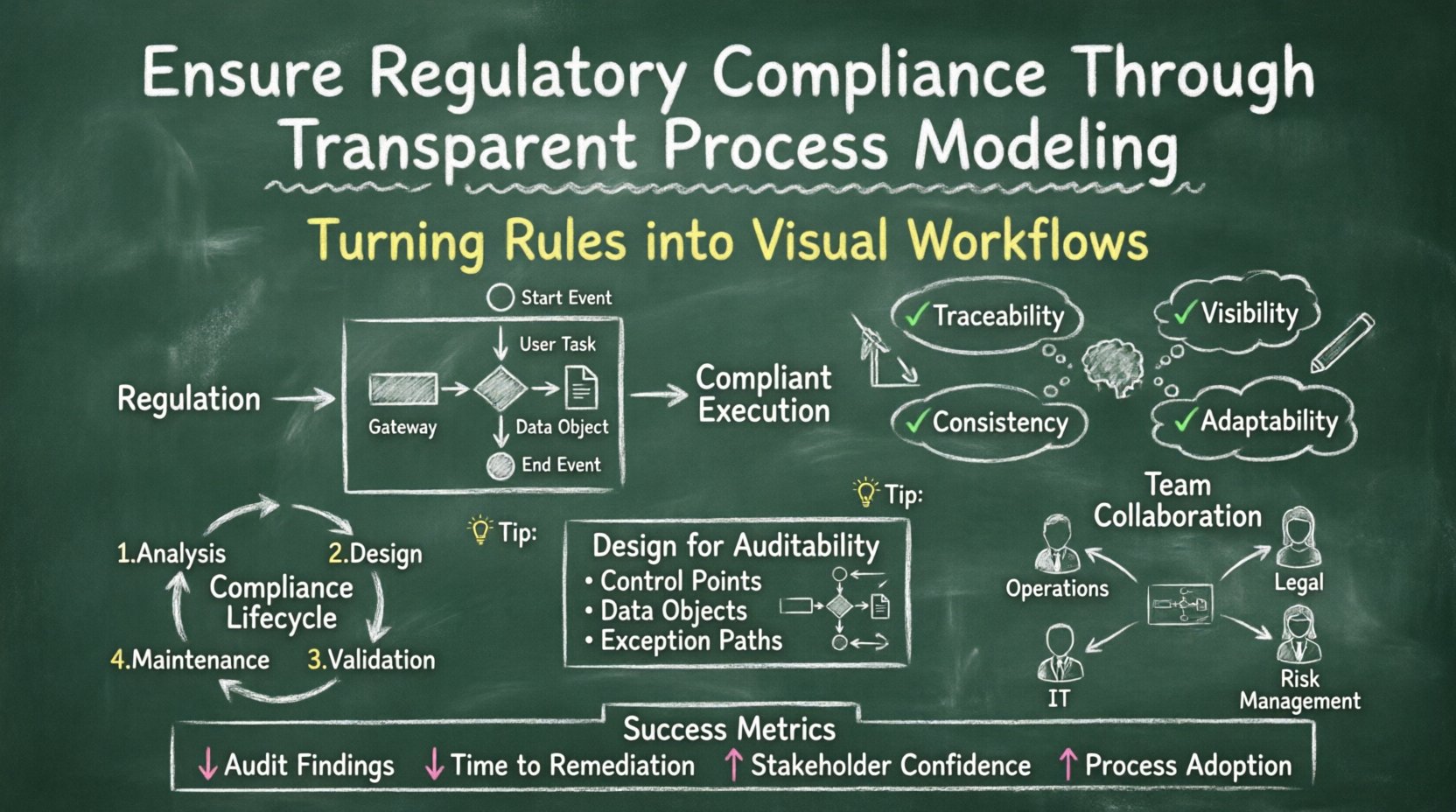
- Traceability: Every control point can be linked back to a specific regulatory clause.
- Visibility: Stakeholders can see where bottlenecks or risks occur within a workflow.
- Consistency: Standardized modeling ensures that all departments interpret rules the same way.
- Adaptability: When regulations change, the model can be updated to reflect new requirements before implementation.
Without this structured approach, compliance often becomes a retrospective activity—fixing problems after an audit. Transparent modeling shifts the focus to prevention, embedding controls into the design of the work itself.
📐 Why BPMN for Compliance?
Business Process Model and Notation (BPMN) has become the industry standard for process visualization. Its value in a compliance context lies in its precision and universality. Unlike proprietary diagrams that only specific teams understand, BPMN is an ISO standard recognized globally by auditors and technical teams alike.
Using a standardized notation allows for the following advantages:
- Clarity: Specific symbols represent specific types of activities, eliminating guesswork.
- Interoperability: Models can be shared across different departments without losing meaning.
- Detail Level: The notation supports varying levels of abstraction, allowing executives to see the big picture while auditors drill down into specific tasks.
When building models for compliance, the focus is not just on efficiency, but on control. Every decision point, data handoff, and exception handling mechanism must be explicit. This level of detail is what distinguishes a compliant process from a theoretical one.
🏗️ Designing for Auditability
Auditability is the ability to reconstruct a sequence of events to verify compliance. In process modeling, this means ensuring that every step in a workflow leaves a digital or documented trail. When designing a model with auditability in mind, specific elements must be utilized correctly.
1. Identifying Control Points
Not every task in a process requires the same level of scrutiny. Control points are specific moments where a regulatory requirement must be met. In a process diagram, these are often represented by decision gateways or specific task types that require approval.
- Manual Tasks: These should be assigned to specific roles, ensuring accountability.
- Automated Tasks: These must be configured to log actions and generate data records.
- Gateways: Decision points act as checks. If a condition is not met, the process should not proceed.
2. Data Object Integration
Regulations often mandate the retention of specific data. A process model must show where data is created, modified, and stored. Using data objects within the model helps visualize the flow of information alongside the flow of work.
For example, in a financial transaction process, the model should explicitly show:
- Where the transaction record is created.
- Who approves the transaction.
- When the record is archived.
- How long the record is retained.
3. Exception Handling
Compliance is often tested during exceptions. What happens when a transaction is rejected? What happens when a deadline is missed? A compliant process model must include paths for exceptions. These paths should not be hidden; they should be visible on the diagram, showing exactly how non-compliant scenarios are managed.
📊 Mapping BPMN Elements to Compliance Controls
To effectively use process modeling for compliance, it is helpful to understand how specific modeling elements translate into control mechanisms. The following table outlines this mapping.
| BPMN Element | Compliance Function | Example Application |
|---|---|---|
| Start Event | Trigger Definition | Defines when a compliance check begins (e.g., upon receipt of a contract). |
| User Task | Human Accountability | Assigns responsibility to a specific role for approval or verification. |
| Exclusive Gateway | Decision Logic | Ensures a condition (e.g., budget limit) is met before proceeding. |
| Data Object | Record Keeping | Indicates where evidence is generated or stored for audit purposes. |
| End Event | Completion Verification | Confirms the process has concluded without unaddressed violations. |
🔄 The Compliance Lifecycle
Compliance is not a one-time project; it is a continuous lifecycle. Process modeling supports this lifecycle through distinct phases: Analysis, Design, Validation, and Maintenance.
Phase 1: Analysis
The first step involves gathering regulatory requirements. This requires collaboration between legal teams and process owners. The goal is to extract actionable constraints from legal text. For instance, a law might state, “All data must be encrypted.” In process terms, this becomes a task requirement: “Encrypt data before transmission.”
During this phase, document the current state of processes to identify gaps between existing operations and regulatory needs.
Phase 2: Design
Once requirements are identified, the future state process is modeled. This design phase incorporates the necessary controls. It is crucial to avoid over-complicating the model. The goal is clarity, not complexity. If a control makes the process too cumbersome, it may be bypassed in practice, rendering the compliance ineffective.
- Ensure all roles are clearly defined.
- Verify that all decision points have clear criteria.
- Confirm that data retention requirements are modeled.
Phase 3: Validation
Before deployment, the model must be validated. This involves reviewing the diagram against the regulatory requirements. Auditors can use the model to understand the process without needing to interview every employee. This reduces the friction during external audits.
Validation also includes testing. If the process is automated, run simulations to ensure that the control logic functions as intended. If the process is manual, conduct walkthroughs to ensure the steps are understood.
Phase 4: Maintenance
Regulations change. Business operations change. A static model quickly becomes obsolete. Maintenance involves a governance structure for updating the process models. When a regulation is amended, the corresponding process model must be revised, and stakeholders must be notified.
🚧 Common Pitfalls in Process Modeling for Compliance
Even with the best intentions, organizations often stumble when implementing process modeling for compliance. Recognizing these pitfalls early can save significant resources.
1. Over-Reliance on Assumptions
A common mistake is assuming that the written process matches the actual process. If the model is based on assumptions rather than observation, it will not reflect reality. Always verify the model against actual execution data or direct observation of work.
2. Excessive Abstraction
While high-level models are useful for executives, they often lack the detail needed for compliance. A model that is too abstract may hide critical control points. Ensure that the level of detail is sufficient for an auditor to understand how a specific control is enforced.
3. Ignoring the Human Element
Processes are executed by people. A model that assumes perfect execution will fail. Human error, fatigue, and lack of training are real risks. The model should account for these factors, perhaps by including training tasks or double-check mechanisms.
4. Siloed Development
Compliance processes often span multiple departments. If the marketing team models their process without consulting the legal team, critical constraints may be missed. Cross-functional collaboration is essential to ensure the model covers the entire scope of the regulation.
🛠️ Implementation Strategy
Implementing a transparent process modeling initiative requires a structured approach. The following steps outline a practical path forward.
- Establish a Governance Committee: Create a group responsible for overseeing process standards and compliance alignment. This group should include representatives from operations, legal, and IT.
- Define Modeling Standards: Agree on a specific set of rules for how diagrams should be created. This includes naming conventions, symbol usage, and version control.
- Train Process Owners: Ensure that those responsible for the processes understand how to model them correctly. Training should focus on both the notation and the compliance implications.
- Integrate with Audit Plans: Use the models to plan audits. Auditors should be able to reference the model to understand what to look for during their review.
- Monitor and Update: Set a schedule for reviewing models. Quarterly reviews are often sufficient to catch drift from compliance requirements.
📈 Measuring Success
How do you know if your transparent process modeling is working? Success in this area is measured by the reduction of risk and the efficiency of the audit process.
Consider the following metrics:
- Audit Findings: A reduction in non-compliance findings during external audits.
- Time to Remediation: Faster identification and fixing of process gaps when issues arise.
- Stakeholder Confidence: Increased trust from regulators and internal governance bodies.
- Process Adoption: Higher adherence to the modeled process by employees.
🌐 The Broader Impact on Governance
Transparent process modeling contributes to the broader governance framework of an organization. It moves compliance from a reactive burden to a proactive strategic asset. When processes are clear, decision-making becomes faster. When controls are visible, risk is managed better.
This approach also fosters a culture of accountability. When employees can see how their work fits into the regulatory framework, they are more likely to understand the importance of their actions. It transforms compliance from a set of rules into a shared value.
🔒 Security and Data Privacy Considerations
When modeling processes, sensitive information is often involved. Data privacy regulations require that personal data is handled securely. The process model itself should not contain actual sensitive data, but it must indicate where such data is handled.
Best practices include:
- Masking Data: Do not include real names or account numbers in diagrams.
- Access Control: Ensure that the repository containing the models is secure and accessible only to authorized personnel.
- Data Classification: Clearly mark which parts of the process handle sensitive data, so security controls can be applied appropriately.
🤝 Collaboration Between Teams
Successful compliance modeling relies on collaboration. The following teams must work together:
- Operations: They know how the work gets done.
- Legal: They know what the rules are.
- IT: They know what systems can enforce the rules.
- Risk Management: They know where the vulnerabilities lie.
Regular workshops involving these groups help ensure that the models are accurate, compliant, and technically feasible. This collaboration prevents the common issue where legal requirements are impossible to implement due to technical limitations.
📉 Handling Process Changes
Business is dynamic. New products, new markets, and new technologies require process changes. Every change introduces a potential compliance risk. A robust modeling framework includes a change management process.
When a change is proposed, it must be evaluated for compliance impact. Does the change affect any control points? Does it alter data flow? Does it introduce new risks? If the answer is yes, the model must be updated, and the change must be approved by the governance committee before implementation.
🎯 Final Thoughts on Process Integrity
Ensuring regulatory compliance through transparent process modeling is about integrity. It is about aligning what an organization says it does with what it actually does. By using standard notation, organizations create a language that bridges the gap between strategy and execution.
This approach does not eliminate the need for vigilance, but it provides the tools to maintain it. Through careful design, validation, and maintenance, process models become living documents that drive compliance and operational excellence. The investment in this discipline pays dividends in reduced risk, smoother audits, and a stronger organizational reputation.
Organizations that embrace this level of transparency are better positioned to navigate the complex landscape of modern regulation. They turn compliance from a constraint into a competitive advantage, demonstrating to stakeholders that their operations are robust, reliable, and responsible.