
In the landscape of enterprise operations, the ability to adapt processes to growing demands is critical. Scalable Process Architectures ensure that business logic remains robust as volume increases, complexity rises, and organizational structures evolve. Business Process Model and Notation (BPMN) provides a standardized language for defining these workflows. However, using BPMN effectively requires more than just drawing shapes; it demands a strategic approach to structure, abstraction, and governance.
When architects design processes without foresight, they often encounter bottlenecks where a model becomes too tangled to maintain or too rigid to deploy. This guide outlines the technical principles required to build resilient, scalable systems using standard BPMN notation. By focusing on modularity, clear event handling, and disciplined modeling patterns, organizations can create workflows that endure.
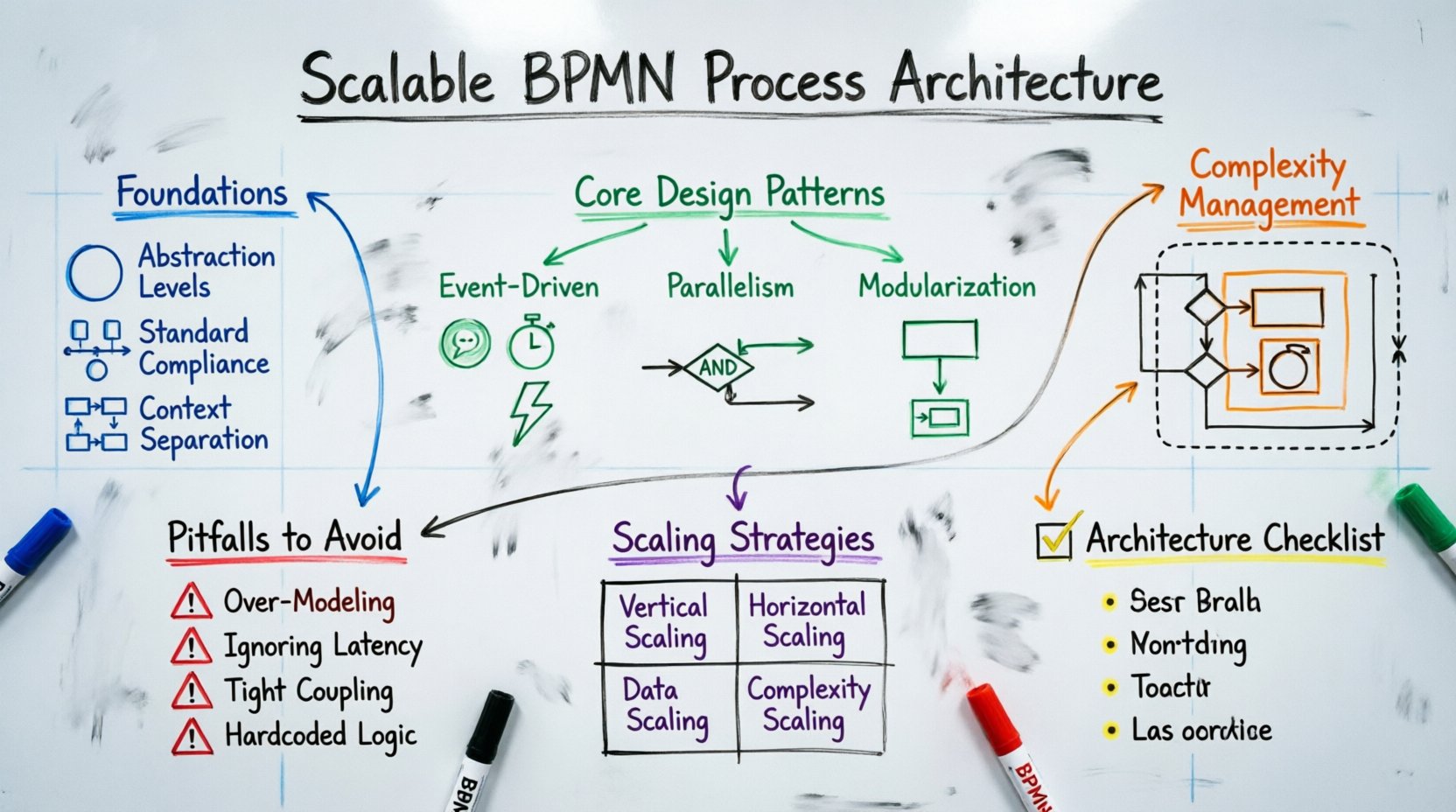
🧱 Foundations of BPMN for Scalability
Scalability in process architecture begins with the fundamental understanding of the notation itself. BPMN 2.0 is not merely a diagramming tool; it is an execution engine specification. To design for scale, one must distinguish between models intended for human consumption and those intended for system execution.
- Abstraction Levels: High-level diagrams provide strategic visibility, while detailed diagrams support implementation. Mixing these levels without boundaries creates confusion and technical debt.
- Standard Compliance: Adhering strictly to the standard ensures that processes can be exchanged, analyzed, and executed across different platforms without custom scripting.
- Context Separation: Scalability relies on separating concerns. A single diagram should not attempt to manage global state, user interfaces, and backend logic simultaneously.
When starting a new architecture, define the scope clearly. A scalable architecture anticipates growth. This means designing interfaces between processes that are loose enough to allow independent updates but strict enough to guarantee data integrity.
🔄 Core Design Patterns for Growth
Certain structural patterns naturally lend themselves to scalability better than others. These patterns help distribute load and isolate failures.
1. Event-Driven Architectures
Traditional linear flows often fail under high load because they require synchronous waiting. Event-driven designs allow processes to react to external stimuli asynchronously.
- Message Events: Use intermediate message events to wait for incoming data rather than polling.
- Timer Events: Implement scheduled tasks to handle batch processing without blocking user interactions.
- Error Events: Define boundary error events to handle failures locally, preventing the entire process instance from crashing.
2. Parallelism and Concurrency
Modern infrastructure supports parallel execution. BPMN supports this through Parallel Gateways.
- AND Gateways: Use these to split a flow into multiple concurrent branches. This reduces overall cycle time.
- Joining Logic: Ensure all parallel branches are accounted for before merging. Missing paths can cause process instances to hang indefinitely.
- Resource Management: Be aware that high concurrency increases memory and CPU usage. Design subprocesses to be lightweight.
3. Modularization via Call Activities
Reusability is the cornerstone of scalability. Instead of duplicating logic across multiple diagrams, encapsulate it.
- Subprocesses: Use embedded subprocesses for logic specific to a single flow.
- Call Activities: Use these to reference external processes. This allows multiple different workflows to invoke the same standardized logic.
- Global Tasks: Where possible, keep logic in global tasks to minimize the surface area of the model.
📦 Managing Complexity with Subprocesses
As processes grow, a single diagram becomes unreadable. Managing complexity is a prerequisite for scalability.
Event Subprocesses
Event subprocesses are powerful tools for handling exceptions and interruptions without cluttering the main flow.
- Boundary Events: Attach these to tasks to catch errors immediately. This keeps the happy path clean.
- Start Events: Use global start events to trigger reactions to external changes, such as a status update from a database.
- Transaction Scope: Understand that event subprocesses do not always rollback the main process. Define transaction boundaries clearly.
Transaction Boundaries
In a scalable system, consistency is key. BPMN defines specific transaction attributes for subprocesses.
- Completable: The subprocess can be rolled back if an error occurs.
- Compensable: The subprocess has a defined compensation activity to undo its effects.
- Replacable: The subprocess can be replaced by another implementation without changing the calling process.
🌐 Horizontal vs. Vertical Scaling in Processes
Process architecture must align with infrastructure scaling strategies.
| Scaling Type | Process Design Implication | BPMN Consideration |
|---|---|---|
| Vertical Scaling | Single instance handles more load. | Optimize task execution time; reduce synchronous waits. |
| Horizontal Scaling | Multiple instances handle load distribution. | Ensure statelessness where possible; use message queues for coordination. |
| Data Scaling | Large volumes of data are processed. | Avoid loading full datasets into memory; use pagination or streaming. |
| Complexity Scaling | More business rules are added. | Use decision tables or external rules engines; keep BPMN focused on flow. |
🛡️ Governance, Versioning, and Stability
A process model is only as good as its governance. Without controls, a scalable architecture quickly degrades into a chaotic mess.
Versioning Strategies
Processes evolve. New requirements arise, and logic changes. How these changes are managed impacts stability.
- Version Numbers: Every change to a process definition should increment a version number. This allows old instances to finish while new instances use the new logic.
- Backward Compatibility: Ensure that new versions do not break existing data structures. Input parameters should remain compatible.
- Deprecation: Clearly mark old processes as deprecated rather than deleting them immediately. This preserves audit trails.
Change Management
Changes should not happen in isolation. A formal review process ensures that impacts are understood.
- Impact Analysis: Before deploying a change, analyze how it affects dependent processes.
- Testing: Validate process logic in a sandbox environment before production deployment.
- Documentation: Keep the model documentation synchronized with the actual code or configuration.
🚫 Common Pitfalls in Process Modeling
Even experienced architects make mistakes. Recognizing these pitfalls helps avoid them.
- Over-Modeling: Trying to model every possible exception leads to spaghetti diagrams. Focus on the primary flow and handle exceptions via boundary events.
- Ignoring Latency: Synchronous waits (user tasks) block throughput. Where possible, decouple human interaction from system logic.
- Tight Coupling: Connecting processes too tightly via shared variables makes independent scaling difficult. Use message flows for loose coupling.
- Hardcoded Logic: Embedding specific business rules inside gateways makes the model brittle. Externalize complex logic.
✅ Checklist for Architecture Readiness
Before deploying a process architecture to production, verify the following elements.
- Are all pools and lanes clearly defined with their respective responsibilities?
- Is there a clear start event for every process instance?
- Are there end events for every possible path?
- Are gateways balanced (one incoming, one outgoing for AND/OR)?
- Are message flows used for communication between pools?
- Are subprocesses nested appropriately to avoid deep hierarchies?
- Is there a defined strategy for error handling on every task?
- Are version numbers applied to all process definitions?
- Is the diagram readable at a 1:1 zoom level without scrolling?
- Are data objects linked to the tasks that use them?
📊 Comparison of Modeling Approaches
Different approaches serve different architectural goals. Choosing the right one depends on the specific needs of the organization.
| Approach | Best For | Scalability Impact |
|---|---|---|
| Monolithic Process | Simple, linear workflows | Low. Hard to maintain as complexity grows. |
| Micro-Processes | Highly distributed systems | High. Allows independent scaling of components. |
| Orchestration | Centralized control flow | Medium. Central point can become a bottleneck. |
| Choreography | Peer-to-peer interaction | High. No single point of failure in the flow. |
🔍 Deep Dive into Gateway Logic
Gateways are the decision points of a process. Their configuration directly influences performance.
- XOR Gateways: Exclusive choices. Only one path is taken. These are fast but require distinct conditions.
- OR Gateways: Multiple paths can be taken. Use sparingly as they increase complexity in tracking state.
- AND Gateways: Parallel paths. Good for performance but requires careful join logic.
- Complex Gateways: Custom expressions. These can impact performance if the expressions are heavy. Keep logic simple.
When designing for scale, avoid complex expressions inside gateways if possible. Move the logic to a service task or a decision table. This keeps the process definition lightweight and easier to parse.
🔗 Integration Patterns
Processes rarely exist in a vacuum. They interact with external systems. These interactions must be managed to prevent bottlenecks.
- Asynchronous Messaging: Use message events to send and receive data without waiting for a response.
- Request-Reply: Use these when a result is needed immediately. Be aware of timeout risks.
- Event Subscription: Subscribe to system events to trigger process instances automatically.
🛠️ Data Management
Data flow is as important as control flow. Poor data management leads to memory leaks and slow execution.
- Variable Scope: Limit variable scope to the minimum necessary. Global variables increase coupling.
- Data Mapping: Map data explicitly between tasks. Do not rely on implicit passing.
- Storage Strategy: For large datasets, do not store everything in process variables. Link to external storage.
🏁 Final Recommendations
Building a scalable process architecture is an iterative discipline. It requires constant review and adjustment as the business environment changes. By adhering to standard BPMN notation, leveraging modular design patterns, and maintaining strict governance, organizations can ensure their processes remain agile and efficient.
Focus on the core principles: simplicity, modularity, and clear boundaries. Avoid the temptation to over-engineer every detail. Instead, build a foundation that allows for future expansion. Regularly audit your process models against the checklist provided. This ensures that the architecture remains aligned with technical and business goals.
Remember that a process model is a living document. It reflects the current state of operations and guides future improvements. Treat it with the care it deserves, and it will serve as a reliable backbone for enterprise growth.