Stepping into an intermediate leadership role within project management marks a significant shift. You are no longer just tracking tasks; you are orchestrating outcomes. The transition involves moving from tactical execution to strategic oversight. While foundational knowledge covers the basics, true proficiency lies in understanding the interconnected components that drive success. This guide explores the essential pillars of project management, designed to help you build resilience and clarity in your work.
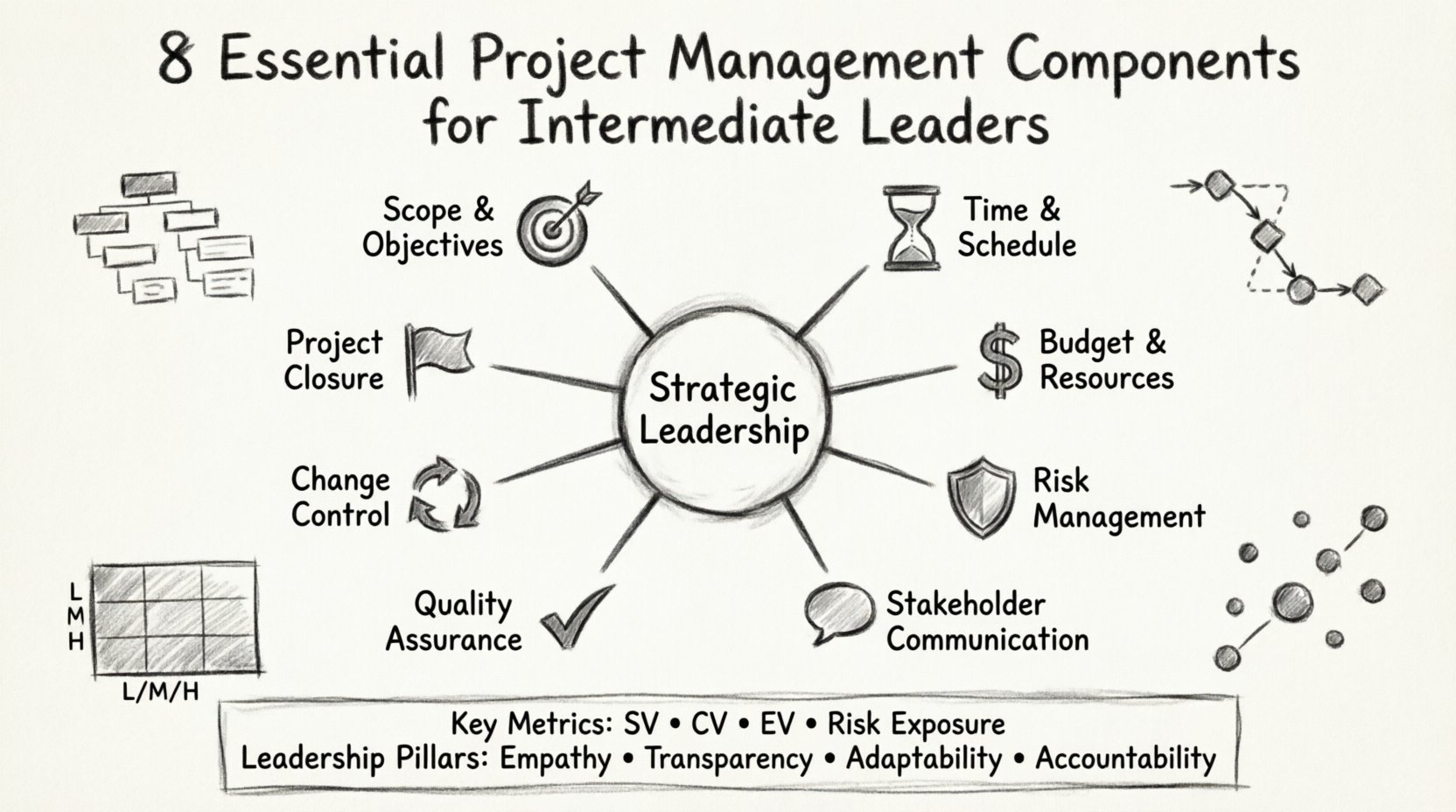
1. Defining Scope and Objectives 🎯
The foundation of any successful initiative is a clearly defined scope. Ambiguity here leads to scope creep, budget overruns, and team burnout. As a leader, your role is to establish boundaries that protect the team while ensuring the deliverables meet business needs.
- Scope Statement: Document what is included and, crucially, what is excluded from the project.
- Deliverables: Define tangible outputs with measurable acceptance criteria.
- Constraints: Identify limitations regarding time, budget, or technology early on.
Without a solid scope definition, stakeholders may assume the project covers more ground than intended. Regularly revisiting this document ensures alignment throughout the lifecycle.
2. Time and Schedule Management ⏳
Time is a finite resource that cannot be recovered. Effective schedule management goes beyond setting deadlines; it involves understanding dependencies and critical paths.
Key Strategies for Schedule Control
- Work Breakdown Structure (WBS): Decompose large goals into smaller, manageable work packages.
- Critical Path Method: Identify the sequence of stages determining the minimum time needed for an operation.
- Milestones: Set significant checkpoints to measure progress without micromanaging daily tasks.
- Buffers: Allocate contingency time for unforeseen delays.
When delays occur, intermediate leaders must assess the impact on downstream tasks immediately. Communication regarding timeline shifts should be proactive, not reactive.
3. Budget and Resource Allocation 💰
Financial health is often the primary metric for project viability. Managing costs requires vigilance and accurate forecasting. Resource allocation is equally critical; you must ensure the right people have the right skills at the right time.
- Cost Estimation: Use historical data and expert judgment to forecast expenses accurately.
- Budget Tracking: Monitor actual spend against the baseline regularly.
- Resource Loading: Avoid over-allocating team members, which leads to fatigue and errors.
- Vendor Management: If external partners are involved, ensure their costs align with the project budget.
Resource Utilization Table
| Resource Type | Key Consideration | Common Pitfall |
|---|---|---|
| Human Capital | Skills and availability | Overbooking team members |
| Financial Capital | Cash flow and approval limits | Ignoring contingency funds |
| Physical Assets | Access and maintenance | Underestimating setup time |
| Technology | Licensing and compatibility | Security gaps |
4. Risk Management Protocols 🛡️
Risks are inevitable. The difference between a struggling project and a successful one often lies in how well risks are anticipated and mitigated. Intermediate leaders must cultivate a proactive mindset regarding uncertainty.
- Identification: Brainstorm potential issues with the team during planning phases.
- Analysis: Assess the probability and impact of each risk.
- Response Planning: Define actions for mitigation, transfer, avoidance, or acceptance.
- Monitoring: Review risk registers regularly as the project evolves.
Reactive vs. Proactive Risk Management
| Aspect | Reactive Approach | Proactive Approach |
|---|---|---|
| Timing | After the issue occurs | Before the issue occurs |
| Cost | High (fixing damage) | Lower (prevention) |
| Team Morale | Low (crisis mode) | High (preparedness) |
| Outcome | Unpredictable | Controlled |
5. Stakeholder Communication & Engagement 🗣️
Projects fail when stakeholders feel out of the loop. Communication is not just about sending updates; it is about managing expectations and building trust. Different groups require different levels of detail and frequency.
- Identify Stakeholders: Map out who influences the project and who is impacted.
- Communication Plan: Define who needs what information, when, and how.
- Feedback Loops: Create channels for stakeholders to voice concerns early.
- Tailored Messaging: Executives need high-level summaries; technical teams need detailed specs.
Regular status meetings should focus on decisions and blockers rather than just status reporting. This keeps the conversation productive and forward-looking.
6. Quality Assurance Standards ✅
Delivering on time and on budget means little if the output is defective. Quality assurance ensures that the project meets the defined requirements and standards. It is an integral part of the execution process, not an afterthought.
- Quality Metrics: Establish measurable standards for deliverables.
- Reviews and Audits: Conduct regular checks to ensure adherence to processes.
- Testing: Validate functionality against user needs before final handover.
- Continuous Improvement: Document lessons learned to improve future quality.
7. Change Control Processes 🔄
Change is constant in project environments. However, uncontrolled changes can derail the project. A formal change control process provides a structured way to evaluate and approve modifications.
- Change Request: Any modification must be documented formally.
- Impact Analysis: Determine how the change affects scope, time, and cost.
- Approval Workflow: Ensure the right authority approves the change.
- Documentation: Update all project documents to reflect approved changes.
This process prevents “gold plating” or unnecessary additions that do not add value to the core objective.
8. Project Closure and Knowledge Transfer 🏁
Ending a project is as critical as starting one. Proper closure ensures that all work is completed, resources are released, and knowledge is retained for future initiatives.
- Formal Acceptance: Obtain sign-off from the client or sponsor.
- Administrative Closure: Close contracts, accounts, and vendor agreements.
- Post-Project Review: Analyze what went well and what did not.
- Knowledge Repository: Store documents and lessons learned for organizational use.
Skipping closure often leaves loose ends that cause issues later. A structured wrap-up provides closure for the team and value for the organization.
Key Metrics for Tracking Health 📊
To maintain control, you need to monitor specific indicators. These metrics provide a snapshot of project health at any given time.
- Schedule Variance (SV): Indicates if you are ahead or behind schedule.
- Cost Variance (CV): Shows if you are under or over budget.
- Earned Value (EV): Measures work performed against the baseline.
- Risk Exposure: Quantifies the potential impact of identified risks.
Tracking these numbers allows for data-driven decision-making rather than gut-feeling adjustments.
Building Resilience in Leadership 🛡️
As you navigate these components, your leadership style will evolve. Intermediate leaders must balance firmness with flexibility. Building a resilient project culture means empowering team members to solve problems without waiting for permission.
- Empathy: Understand the pressures your team faces.
- Transparency: Share bad news early; it allows for better problem-solving.
- Adaptability: Be willing to pivot strategies when circumstances change.
- Accountability: Hold everyone responsible for their commitments.
This approach fosters a environment where quality and efficiency thrive without the need for excessive oversight.
Final Thoughts on Project Excellence
Mastering these components takes time and practice. There is no single formula that works for every scenario. However, by grounding your approach in these core principles, you create a framework that supports consistent delivery. Focus on the people, the process, and the plan. When these three align, projects move forward with clarity and purpose.
Remember that every project offers a learning opportunity. Reflect on your experiences, adjust your methods, and continue to refine your leadership capabilities. The goal is not perfection, but continuous improvement and successful outcomes.