
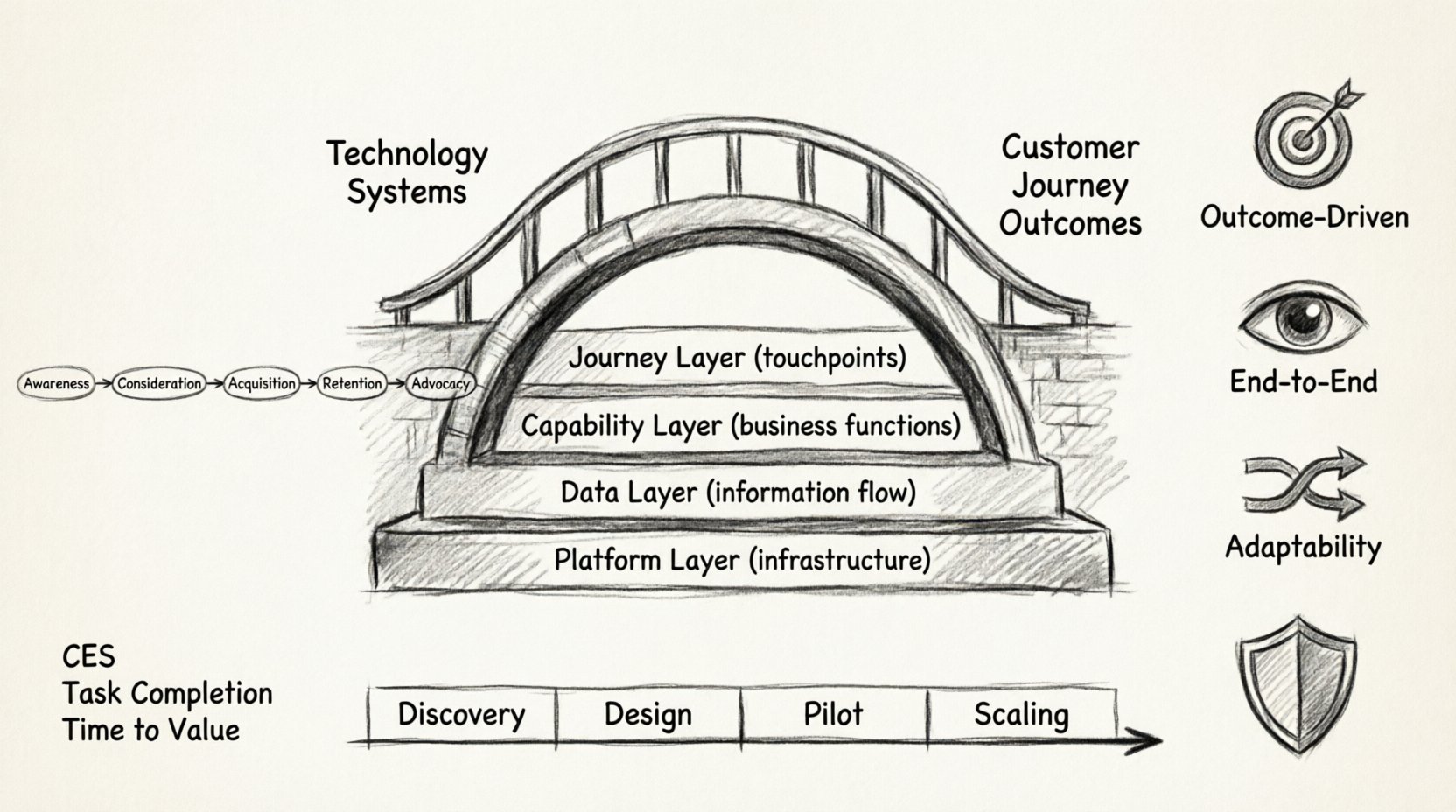
In the modern enterprise landscape, the gap between customer expectations and technological delivery often widens. Organizations invest heavily in digital channels, yet the resulting experience remains fragmented. This disconnect is not merely a marketing issue; it is an architectural one. Customer Experience Architecture (CXA) serves as the bridge, ensuring that enterprise systems support the human needs of the customer at every touchpoint.
This guide explores how to align technology to journey outcomes within the context of Enterprise Architecture. We will examine the principles of CXA, the structural requirements for alignment, and the governance needed to sustain meaningful outcomes. The focus remains on strategic design rather than specific tool implementations.
🤔 Defining Customer Experience Architecture
Customer Experience Architecture is the discipline of designing the technology landscape to enable specific customer journey outcomes. It moves beyond siloed application management to view the entire ecosystem through the lens of the user. In this framework, technology is not the goal; it is the enabler of value delivery.
Traditional Enterprise Architecture often prioritizes stability, cost reduction, and system integration. While these are necessary, they do not guarantee a positive customer experience. CXA introduces a shift in perspective:
- Outcome-Driven: Systems are evaluated based on the value they create for the user, not just their uptime or throughput.
- End-to-End Visibility: The architecture must map the full lifecycle of a customer interaction, from discovery to advocacy.
- Adaptability: The technology stack must evolve as customer behaviors change, requiring a modular and flexible design.
Without this architectural lens, companies risk building powerful engines that drive customers away due to friction. The goal is coherence, where every digital touchpoint feels like a continuation of the previous one.
🎯 The Strategic Alignment of Technology and Journey
Alignment does not happen by accident. It requires deliberate mapping between business capabilities and the technical infrastructure that supports them. The process begins with understanding the customer journey, followed by identifying the specific technological needs to support each stage.
1. Mapping the Journey to Capabilities
The first step is to define the customer journey stages. These typically include awareness, consideration, acquisition, retention, and advocacy. For each stage, we identify the required business capabilities. For example, the “Awareness” stage requires marketing automation and content management, while the “Acquisition” stage requires secure payment processing and identity verification.
Once capabilities are defined, we map them to the technical components. This involves deciding which systems will handle data, which will process transactions, and which will store customer history. This mapping ensures that no critical step in the journey is left unsupported by the underlying technology.
2. Data Flow and Integration
A unified customer view is impossible without seamless data flow. In many organizations, data is trapped in disparate systems. CXA mandates the creation of a coherent data model that travels with the customer across the organization. This involves:
- Master Data Management: Ensuring a single source of truth for customer identities.
- Event-Driven Architecture: Using real-time events to trigger actions across systems, reducing latency in the experience.
- API Strategy: Standardizing how services communicate to allow for rapid composition of new experiences.
When data flows freely, the customer does not need to repeat information. This reduction in friction is a direct result of architectural decisions, not just design aesthetics.
📊 The CXA Framework Components
To maintain clarity, we can categorize the components of a robust Customer Experience Architecture into four layers. This structure helps stakeholders understand where decisions are made and how they impact the final outcome.
| Layer | Focus Area | Key Considerations |
|---|---|---|
| Journey Layer | Customer Touchpoints | Consistency, accessibility, and context across channels. |
| Capability Layer | Business Functions | Order management, customer service, personalization engines. |
| Data Layer | Information Management | Identity resolution, data privacy, real-time access. |
| Platform Layer | Infrastructure | Cloud services, security, scalability, and reliability. |
Each layer interacts with the others. A change in the Platform Layer, such as moving to a new cloud provider, must be evaluated for its impact on the Journey Layer. Does the latency increase? Does the security model change? Architecture decisions must be holistic.
🛤️ Implementation Roadmap
Implementing Customer Experience Architecture is a significant undertaking. It requires a phased approach to minimize risk while demonstrating value early. The following roadmap outlines the typical progression for aligning technology with journey outcomes.
Phase 1: Discovery and Assessment
Before building, we must understand the current state. This phase involves auditing existing systems, identifying data silos, and mapping current customer journeys against the ideal state.
- Inventory Systems: Catalog all applications touching the customer.
- Identify Gaps: Pinpoint where the technology fails to support the journey (e.g., manual handoffs between sales and support).
- Stakeholder Interviews: Gather insights from both IT staff and customer-facing teams.
Phase 2: Design and Blueprinting
With the current state understood, we design the target architecture. This is not a technical blueprint alone; it is a business capability map.
- Define Standards: Establish rules for data sharing and API usage.
- Design Integrations: Plan how systems will communicate to support real-time journeys.
- Security Planning: Embed security and compliance into the design, not as an afterthought.
Phase 3: Pilot and Validation
Roll out the architecture in a controlled environment. Select a specific journey, such as the onboarding process, and apply the new architectural patterns.
- Measure Performance: Track metrics like task completion time and error rates.
- Gather Feedback: Listen to how customers and employees interact with the new flow.
- Iterate: Adjust the architecture based on real-world usage data.
Phase 4: Scaling and Governance
Once the pilot proves successful, expand the architecture across the organization. Governance becomes critical here to prevent the re-emergence of silos.
- Establish Oversight: Create a committee to review new technology proposals.
- Update Documentation: Keep the architecture diagrams current as systems evolve.
- Training: Ensure development teams understand the CXA principles.
📈 Measuring Success and Governance
How do we know if the architecture is working? We cannot rely solely on technical metrics like uptime. We need metrics that reflect the customer journey outcomes.
Key Performance Indicators
- Customer Effort Score (CES): Measures how easy it is for a customer to complete a task.
- Task Completion Rate: The percentage of users who successfully finish a specific journey step.
- Time to Value: How quickly a customer realizes the benefit of the product after signing up.
- System Latency: The speed of response from the backend systems during a transaction.
These metrics provide a feedback loop. If latency increases, the platform layer needs attention. If task completion drops, the journey layer may have introduced friction. This data informs future architectural decisions.
Governance Principles
Architecture drift is a common problem. Over time, teams may introduce shortcuts that violate the original design. Strong governance prevents this.
- Design Reviews: Require architecture sign-off for all new projects.
- Compliance Checks: Ensure all systems meet data privacy and security standards.
- Lifecycle Management: Plan for the retirement of legacy systems to reduce technical debt.
⚠️ Common Challenges and Mitigation
Even with a solid plan, obstacles arise. Recognizing these challenges early allows for better mitigation strategies.
1. Siloed Organizational Structures
Business units often operate independently, leading to duplicated efforts and conflicting systems. Marketing may use one platform, while Sales uses another, resulting in fragmented customer data.
Mitigation: Implement enterprise-wide governance that prioritizes shared services. Encourage cross-functional teams to design solutions together.
2. Legacy System Constraints
Older systems often lack the APIs or flexibility required for modern experiences. They can become bottlenecks that slow down innovation.
Mitigation: Use an API layer to wrap legacy functionality, exposing it in a modern format. Plan for gradual replacement where critical business logic is involved.
3. Misaligned Incentives
IT teams are often measured on stability and cost, while business teams are measured on growth and speed. These conflicting goals can stall CXA initiatives.
Mitigation: Align KPIs across departments. Include customer experience metrics in IT performance reviews and technical stability metrics in business reviews.
🔄 The Feedback Loop of Continuous Improvement
Customer Experience Architecture is not a one-time project. It is a continuous discipline. Customer behaviors change, new technologies emerge, and market conditions shift. The architecture must be resilient enough to adapt.
This requires a culture of continuous improvement. Teams should regularly review the architecture against current journey outcomes. If a new channel becomes popular, the architecture must support it without a complete rebuild. This agility is the hallmark of a mature CXA practice.
Building a Learning Organization
To sustain this cycle, organizations must foster learning.
- Post-Implementation Reviews: Analyze what worked and what did not after every major launch.
- Knowledge Sharing: Document patterns and anti-patterns so other teams can avoid common pitfalls.
- Technology Radar: Maintain a list of emerging technologies to evaluate for future adoption.
By treating architecture as a living system, organizations ensure their technology remains a competitive advantage rather than a constraint.
🔗 The Intersection of People, Process, and Technology
Finally, it is crucial to remember that architecture is not just about code. It is about the people who use the code and the processes that define how work gets done.
- People: Ensure employees have the tools they need to serve customers effectively. If the technology is complex, the experience will suffer.
- Process: Align internal workflows with the external customer journey. A fast checkout is useless if the internal fulfillment process is slow.
- Technology: Provide the infrastructure that connects people and processes seamlessly.
When these three elements are aligned, the organization operates as a cohesive unit. The customer perceives this as a smooth, intuitive experience, unaware of the complex machinery working behind the scenes.
🚀 Summary of Architectural Best Practices
To conclude this overview, here are the core principles to keep in mind when building Customer Experience Architecture.
- Start with the Customer: Always define the journey before selecting the technology.
- Design for Integration: Assume that systems must talk to each other from day one.
- Prioritize Data Integrity: Trustworthy data is the foundation of trust with the customer.
- Embrace Modularity: Build systems that can be changed without breaking the whole.
- Measure Outcomes: Track business and experience metrics, not just technical health.
By adhering to these principles, enterprises can create technology landscapes that truly support their customers. The result is a resilient, adaptable organization capable of delivering value consistently. This alignment is the foundation of long-term success in a digital-first world.