
Building a robust business process model requires more than just drawing boxes and arrows. It demands precision in how decisions are handled within the flow. When you design a workflow, the gateway is the mechanism that determines the path a process takes. Choosing the correct gateway logic ensures that your process executes as intended, avoids bottlenecks, and remains maintainable over time. This guide explores the nuances of BPMN gateways, helping you select the appropriate logic for your specific decision points.
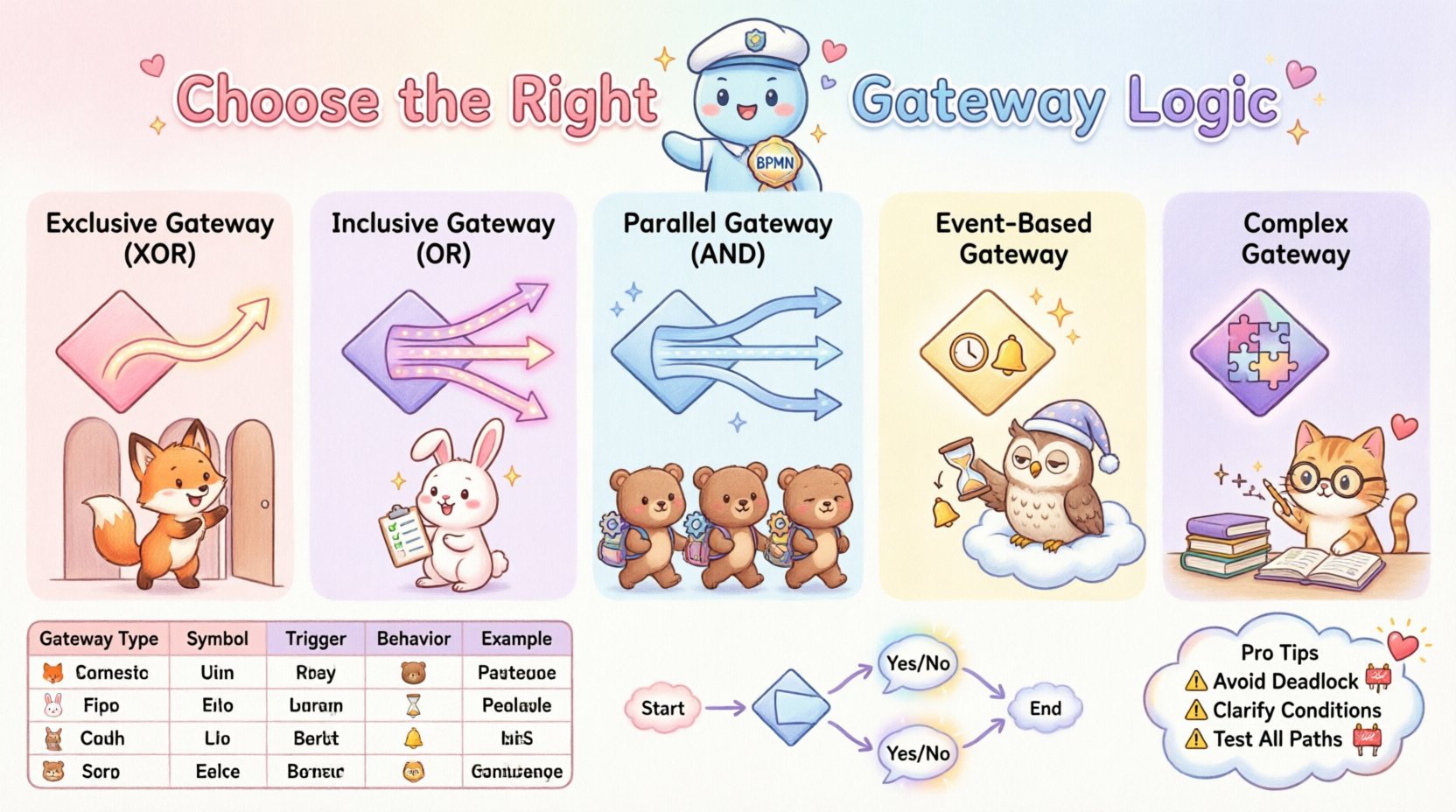
Understanding the Role of Gateways in Process Modeling 🛠️
In Business Process Model and Notation (BPMN), a gateway is a symbol that controls the divergence and convergence of flow. Unlike tasks, which represent work being done, gateways represent logic. They determine whether the process continues along one path, multiple paths, or waits for a specific condition. Getting this logic right is critical because an incorrect gateway choice can lead to deadlocks, unintended parallel execution, or processes that fail to terminate.
Think of a gateway as a traffic controller at a complex intersection. If the signals are confusing, traffic jams occur. Similarly, if your workflow logic is ambiguous, the execution engine may struggle to interpret the next step. There are several types of gateways, each serving a distinct purpose. Understanding the specific behavior of each type is the first step toward accurate modeling.
Exclusive Gateway: The One-Path Decision ⚖️
The exclusive gateway, often denoted as an XOR gateway, is used when only one path out of several possibilities should be taken. This is the most common decision point in workflows. It relies on a condition associated with each outgoing sequence flow. The engine evaluates these conditions sequentially. As soon as one condition evaluates to true, that path is activated, and all others are discarded.
- Use Case: A loan application is either approved, rejected, or requires more information. Only one of these outcomes happens.
- Logic: Condition A OR Condition B OR Condition C (Mutually Exclusive).
- Behavior: Only one token passes through. The others are ignored.
- Requirements: Conditions must be exhaustive to prevent the process from getting stuck.
When using an exclusive gateway, you must ensure that the conditions cover all possible scenarios. If no condition is met, the process may hang. Conversely, if multiple conditions are met simultaneously, the behavior depends on the execution engine, but typically only the first evaluated true condition triggers the path. This makes clear, mutually exclusive conditions essential for stability.
Inclusive Gateway: The Many-Path Option 🔄
While the exclusive gateway forces a single choice, the inclusive gateway allows for multiple paths to be taken simultaneously based on conditions. This is useful when different aspects of a process can occur together. It is often used when a process needs to branch out to handle various optional requirements that are not mutually exclusive.
- Use Case: Sending notifications via email, SMS, and push notification. All three might be triggered if the user has opted in for all channels.
- Logic: Condition A AND/OR Condition B (Independent).
- Behavior: One or more tokens can pass through based on how many conditions are true.
- Requirements: You must define a merge gateway that waits for all active paths to complete.
The inclusive gateway introduces complexity regarding synchronization. If you branch out into three paths using an inclusive gateway, you need a corresponding merge point that waits for all active branches to finish before continuing. If you do not synchronize correctly, the process might end prematurely or wait indefinitely for a path that was never started.
Parallel Gateway: The Synchronization Point ⚡
The parallel gateway is designed to split a process into multiple simultaneous paths without evaluating conditions. Every outgoing path is activated immediately. This is distinct from the inclusive gateway because it does not check conditions; it simply duplicates the flow. Later, a parallel gateway is used to merge these paths back together.
- Use Case: Processing an order involves generating an invoice, updating inventory, and charging a credit card. All three must happen.
- Logic: Split: All paths activate. Merge: Wait for all paths to complete.
- Behavior: Tokens are created for every outgoing flow. Convergence requires all incoming tokens to arrive.
- Requirements: No conditions on sequence flows (usually). Perfect synchronization is mandatory at the merge point.
Parallel gateways are powerful for performance because they allow work to happen concurrently. However, they require strict discipline at the merge point. If one path takes significantly longer than another, the process waits for the slowest path. This is known as synchronization overhead. If a path is removed or fails, the merge point will never receive all tokens, causing the process to deadlock.
Event-Based Gateway: Waiting for a Trigger ⏰
Sometimes, the next step in a process depends on an external event rather than a data condition. An event-based gateway allows the process to wait for a specific event to occur. Once that event is received, the corresponding path is taken, and other waiting paths are aborted.
- Use Case: A customer order expires if not paid within 24 hours. The process waits for either a payment event or a timeout event.
- Logic: Event A OR Event B OR Event C.
- Behavior: The process pauses. Upon event receipt, the matching path activates. Other paths are cancelled.
- Requirements: Events must be configured correctly on the execution engine.
This gateway is essential for handling timeouts and external interactions. It prevents the process from running indefinitely while waiting for a condition that might never change in the data. However, it adds a dependency on external event sources. If the event never arrives, the process remains in a waiting state until a system timeout mechanism intervenes.
Complex Gateway: Advanced Boolean Logic 🧩
For scenarios where standard gateways are insufficient, a complex gateway allows for boolean expressions. You can combine AND, OR, and NOT logic to create sophisticated decision rules. This is useful when the decision depends on a combination of multiple data attributes.
- Use Case: Approving a discount requires the user to be a VIP AND have a total spend over $1,000 OR have a specific promotional code.
- Logic: (VIP AND Spend > 1000) OR (Promo Code).
- Behavior: Evaluates the entire boolean expression. True or False determines the path.
- Requirements: High technical complexity. Requires careful testing of edge cases.
While powerful, complex gateways can reduce readability. If the logic becomes too convoluted, future maintainers may struggle to understand the flow. It is often better to use multiple simple gateways rather than one complex one, unless the boolean logic is truly central to the business rule.
Comparison of Gateway Types 📊
To assist in your selection process, consider the following comparison table. It highlights the key differences in behavior, synchronization needs, and typical use cases.
| Gateway Type | Path Selection | Conditions Required? | Synchronization Needed? | Best For |
|---|---|---|---|---|
| Exclusive (XOR) | One path only | Yes | No | Single decision points |
| Inclusive (OR) | One or more paths | Yes | Yes | Optional parallel tasks |
| Parallel (AND) | All paths | No | Yes | Mandatory parallel work |
| Event-Based | One path (event) | No (Event) | No | Timeouts or external triggers |
| Complex | One path (logic) | Yes (Boolean) | No | Multi-variable conditions |
Common Pitfalls and How to Avoid Them ⚠️
Even with a clear understanding of the types, modeling errors frequently occur. Below are common mistakes and the strategies to prevent them.
1. Deadlocks from Unmatched Gateways
A deadlock happens when the process waits for a condition that can never be met. This often occurs when a parallel split is not followed by a parallel merge. If you split into two paths, you must merge them. If you use an inclusive split, the merge must account for which paths were actually taken.
- Solution: Always ensure every split has a corresponding merge point.
- Solution: Use the same type of gateway for split and merge where possible (e.g., Parallel Split with Parallel Merge).
2. Ambiguous Conditions
When conditions overlap, it becomes unclear which path the engine should choose. For example, if one condition is “Amount > 100” and another is “Amount > 50”, both might be true. In an exclusive gateway, this leads to unpredictable behavior.
- Solution: Make conditions mutually exclusive.
- Solution: Use inclusive gateways if multiple conditions can be true simultaneously.
3. Over-Splitting the Workflow
Creating too many parallel paths can overwhelm the execution engine and make the diagram unreadable. If every task is parallelized unnecessarily, you lose the ability to track dependencies.
- Solution: Only parallelize tasks that are independent and must happen simultaneously.
- Solution: Group related tasks into sub-processes to reduce visual clutter.
4. Ignoring Error Handling
Gateways determine the happy path, but processes often encounter errors. If a path fails, does the process stop, or does it trigger a retry loop? Gateways do not handle errors directly; they only manage flow.
- Solution: Add exception flows or error events outside the gateway logic.
- Solution: Design loops explicitly rather than relying on gateway logic to recover from errors.
Decision Matrix for Selection 🧭
When you are at a decision point in your workflow, ask yourself these questions to identify the correct gateway.
- Can multiple paths happen at once?
- No: Exclusive or Event-Based.
- Yes: Inclusive or Parallel.
- Does the path depend on data conditions?
- Yes: Exclusive, Inclusive, or Complex.
- No: Parallel.
- Does the path depend on an external event?
- Yes: Event-Based.
- No: Data-driven gateways.
- Do you need to wait for all paths to finish?
- Yes: Parallel Merge or Inclusive Merge.
- No: Exclusive Merge.
Best Practices for Maintainability 📝
Once you have selected the logic, focus on how you document and name your elements. A well-structured model is easier to debug and modify.
- Clear Naming Conventions: Name your sequence flows based on the condition (e.g., “Approved”, “Rejected”, “Over Budget”). Do not leave them blank.
- Consistent Symbols: Use standard shapes for gateways. Do not mix styles that might confuse stakeholders.
- Regular Reviews: Have a second person review the model. They might spot a deadlock or an unreachable path that you missed.
- Test with Real Data: Run test cases that cover edge conditions. Ensure that the process terminates correctly in all scenarios.
- Limit Nesting: Avoid nesting gateways too deeply. If a gateway contains another gateway, it often indicates a need to simplify the logic or split the process.
Performance Considerations 🚀
The choice of gateway can impact the performance of your workflow engine. Parallel gateways consume more resources because they create multiple instances of tokens. Inclusive gateways can be expensive if they branch into many paths that all need to be tracked.
- Token Overhead: Every token created by a gateway consumes memory. If a process creates thousands of tokens, it may slow down the system.
- Execution Time: Synchronization at merge points introduces latency. The process waits for the slowest path.
- Optimization: Where possible, keep the number of active branches low. Use event-based gateways to reduce polling or waiting time.
Conclusion on Workflow Logic Design 🏁
Selecting the right gateway logic is a foundational skill in business process modeling. It dictates how your workflow behaves, how efficiently it runs, and how easily it can be understood by others. By distinguishing between exclusive, inclusive, parallel, and event-based gateways, you can build systems that are robust and reliable.
Remember that simplicity often leads to better performance and maintainability. While complex gateways offer flexibility, they also introduce risk. Always test your models thoroughly to ensure that every path leads to a successful completion or a defined error state. With careful planning and adherence to these guidelines, your decision points will function smoothly, supporting your business goals effectively.
As you continue to refine your workflow designs, keep these principles in mind. The goal is not just to automate tasks, but to create a logical flow that adapts to real-world variations without breaking. Your choice of gateway logic is the backbone of that adaptability.