Every project manager knows the sinking feeling of watching a timeline slip. It starts small—a missed deadline here, a budget overrun there—but before you know it, the entire initiative is teetering on the edge of collapse. This is the reality faced by a mid-sized software development firm we will refer to as Vertex Solutions. Facing a critical product launch that was weeks behind schedule and over budget, the leadership team had to make a radical decision.
They did not fire the team. They did not cut scope to the point of unusability. Instead, they completely overhauled their project management strategy. This case study details the step-by-step recovery process, the specific methodologies adopted, and the tangible results achieved. It serves as a blueprint for any organization seeking to understand how to fix a failing project without losing momentum or morale.
📉 The Situation: Project Gamma in Crisis
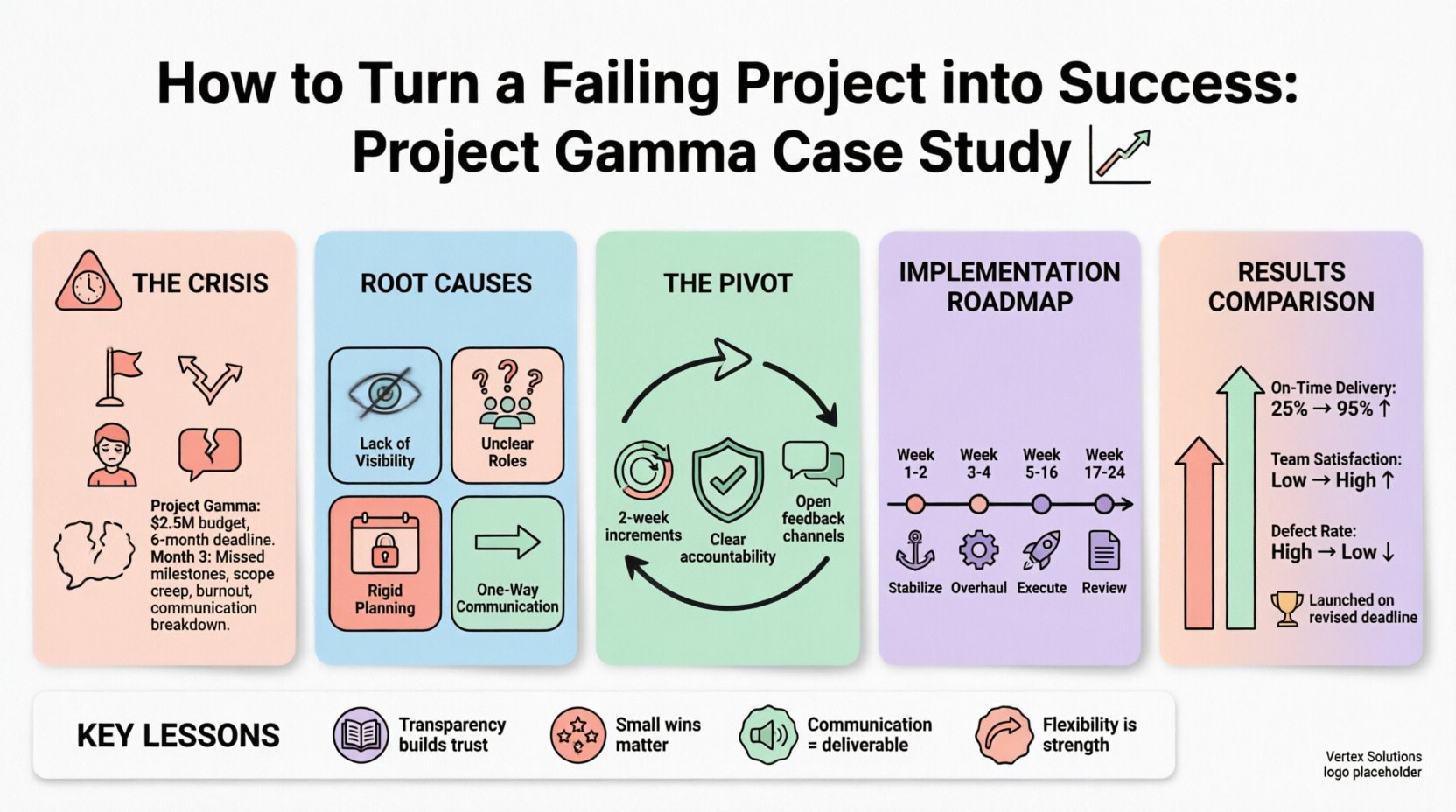
Vertex Solutions was tasked with delivering a major enterprise platform update. The project, internally dubbed “Project Gamma”, had a budget of $2.5 million and a strict deadline of six months. Initially, the team felt confident. However, by month three, the warning signs were impossible to ignore.
- Missed Milestones: Three out of four quarterly checkpoints had been missed.
- Scope Creep: Stakeholders kept requesting additional features without adjusting timelines.
- Team Burnout: Overtime became the norm, leading to a spike in errors and resignations.
- Communication Breakdown: The development team felt disconnected from the business stakeholders.
The original strategy relied heavily on a linear, waterfall approach. Requirements were gathered upfront, and development proceeded in a sequential manner. When issues arose, they were buried until the testing phase, causing massive delays. The leadership realized that the project management strategy itself was the bottleneck, not the team’s capability.
🔍 Diagnosis: Identifying the Root Causes
Before implementing change, the leadership team conducted a comprehensive audit. This was not a blame game; it was a diagnostic exercise to understand where the process broke down. They identified four critical areas of failure that needed immediate attention.
1. Lack of Visibility
Stakeholders were asking for status updates, but the team provided vague reports like “in progress” or “near completion.” There was no granular data on task completion rates or resource allocation. This lack of transparency bred distrust.
2. Unclear Roles and Responsibilities
When a specific module failed to integrate, it was unclear who was responsible for fixing it. The matrix of accountability was blurred, leading to tasks falling through the cracks.
3. Rigid Planning
The initial plan was set in stone. When technical debt surfaced, the team had no mechanism to adjust the timeline without a lengthy approval process. This rigidity prevented adaptive problem-solving.
4. Inefficient Communication Loops
Information flowed top-down only. Feedback from developers regarding feasibility was ignored in favor of feature requests. This disconnect resulted in rework and wasted effort.
🔄 The Strategic Pivot: Core Changes
With the diagnosis complete, Vertex Solutions embarked on a recovery plan. They moved away from the rigid waterfall model toward a more adaptive framework. The goal was not just to finish the project, but to build a sustainable process for the future.
A. Adopting Iterative Development
The team broke the remaining work into smaller, manageable chunks. Instead of waiting for the entire platform to be built before testing, they focused on delivering functional increments every two weeks. This approach allowed for early feedback and reduced the risk of building the wrong features.
B. Clarifying Accountability
They implemented a clear responsibility matrix. Every task now had a single owner and a single reviewer. This eliminated the “he said, she said” dynamic and ensured that every deliverable was accounted for.
C. Establishing Feedback Channels
Communication became a two-way street. Regular sync meetings were held where developers could flag risks without fear of reprisal. Stakeholders were brought into these updates to understand the technical constraints facing the team.
📋 Implementation Roadmap
Transitioning from a failing state to a stable one requires discipline. The team followed a structured four-phase roadmap to ensure the new project management strategy was adopted correctly.
Phase 1: Stabilization (Weeks 1-2)
- Goal: Stop the bleeding and reset expectations.
- Action: Cancelled non-essential features to protect the core launch date.
- Action: Held a town hall meeting to acknowledge the situation and outline the new path forward.
Phase 2: Process Overhaul (Weeks 3-4)
- Goal: Implement the new workflow.
- Action: Introduced daily stand-up meetings to track progress and blockers.
- Action: Defined clear definitions of “done” for each task to prevent partial work from being counted.
Phase 3: Execution & Monitoring (Weeks 5-16)
- Goal: Deliver value consistently.
- Action: Conducted bi-weekly reviews with stakeholders to demonstrate progress.
- Action: Used risk registers to proactively identify potential delays before they impacted the timeline.
Phase 4: Review & Handoff (Weeks 17-24)
- Goal: Finalize and document.
- Action: Performed rigorous testing on all increments.
- Action: Documented lessons learned to prevent recurrence in future projects.
📊 Results: Quantifiable Improvements
The shift in strategy yielded significant results. By focusing on iterative delivery and clear communication, the team regained control of the project. The following table highlights the comparison between the “Before” and “After” states of Project Gamma.
| Metric | Before (Months 1-3) | After (Months 4-6) | Change |
|---|---|---|---|
| On-Time Delivery | 25% | 95% | ↑ 70% |
| Team Satisfaction | Low (High Stress) | High (Sustainable Pace) | ↑ Significant |
| Stakeholder Trust | Low (Frequent Pushback) | High (Proactive Updates) | ↑ Significant |
| Scope Creep | High (Uncontrolled) | Managed (Formal Process) | ↓ Reduced |
| Defect Rate | High (Found at End) | Low (Found Early) | ↓ Reduced |
The project launched on the revised deadline with 95% of the core features operational. While the scope was reduced, the quality of the deliverable ensured a smooth adoption by clients. More importantly, the team morale recovered, and retention rates stabilized.
💡 Key Lessons Learned
This turnaround was not magic; it was the result of applying fundamental principles of effective project turnaround. Several key takeaways emerge from this case study that can be applied to other organizations.
1. Transparency Builds Trust
Hiding bad news only makes it worse. By openly discussing the delays and the plan to fix them, the leadership team earned the respect of the staff. Transparency is not a sign of weakness; it is a foundation for recovery.
2. Small Wins Matter
When a project is failing, the goal of “finishing the whole thing” feels overwhelming. Breaking work into small, achievable chunks allowed the team to experience success frequently. These small wins rebuilt confidence and momentum.
3. Communication is a Deliverable
Many teams treat communication as a side activity. In this case study, communication was treated as a core deliverable. Regular updates, clear documentation, and open channels were prioritized alongside code and design.
4. Flexibility is a Strength
The ability to pivot when circumstances change is crucial. The team learned that a plan is a guide, not a law. Adjusting scope to meet deadlines was a strategic choice, not a failure.
⚠️ Risks to Avoid During Recovery
While the recovery was successful, there were risks that could have derailed the process. Recognizing these pitfalls is essential for anyone attempting a similar turnaround.
- Panic-Driven Decisions: Cutting corners too aggressively can lead to technical debt that hurts future performance. The team had to balance speed with quality.
- Over-Correction: Moving from a waterfall model to a highly agile one too quickly can confuse the team. The transition was gradual to allow for adjustment.
- Ignoring the Human Element: Focusing only on metrics without addressing team burnout can lead to turnover. The team prioritized well-being during the recovery phase.
🛠️ Practical Steps for Your Team
If you are facing a similar situation, here is a checklist to guide your own project management strategy overhaul.
- Conduct a Post-Mortem: Gather the team to discuss what went wrong without assigning blame.
- Re-evaluate the Scope: Identify the minimum viable product (MVP) required to meet the business goal.
- Set Clear Cadences: Define when and how updates will happen. Consistency reduces anxiety.
- Empower the Team: Give decision-making authority to those closest to the work.
- Monitor Health Metrics: Track not just delivery, but team sentiment and workload.
🌟 The Long-Term Impact
The success of Project Gamma did not end with the launch. The processes established during the recovery became the standard for all future initiatives at Vertex Solutions. The culture shifted from a “crunch mode” environment to one of sustainable productivity.
Stakeholders became more collaborative, understanding the value of iterative delivery. The team felt more engaged, knowing their feedback directly influenced the direction of the work. This case study proves that a failing project is not the end of the line; it is often an opportunity to build a stronger, more resilient organization.
By focusing on strategy, communication, and human factors, you can turn the tide on even the most challenging projects. The tools and methodologies are secondary to the mindset of adaptability and clear purpose. With the right approach, success is not just possible—it is inevitable.
🔎 Final Thoughts on Project Recovery
Recovering a project requires courage. It requires admitting that the initial plan was flawed and having the discipline to implement a new one. For Vertex Solutions, this meant letting go of the old ways of working and embracing a more transparent, adaptive model.
The journey from failure to success is rarely linear. It involves setbacks, recalibrations, and hard conversations. However, the end result justifies the effort. By prioritizing the health of the team and the clarity of the process, organizations can navigate even the most turbulent waters.
Remember, a project management strategy is a living system. It must evolve as the project evolves. When you see signs of failure, do not wait for the deadline to pass. Diagnose the issue, pivot the strategy, and communicate clearly. That is the path to a successful turnaround.