In the dynamic landscape of modern enterprise, the disconnect between strategic intent and technical execution often leads to wasted investment and stagnation. Organizations frequently find themselves with ambitious visions but lack the structural blueprint to realize them. This is where capability-driven planning becomes essential. It serves as the critical bridge, ensuring that every line of code, every infrastructure decision, and every architectural pattern directly supports the organization’s core goals. By shifting the focus from assets to capabilities, leaders can build roadmaps that are resilient, adaptable, and strategically aligned.
Enterprise Architecture is no longer just about drawing boxes and lines. It is about defining value. When architects adopt a capability-driven approach, they move beyond describing systems to describing what the business can actually do. This guide explores how to translate high-level business vision into actionable architecture roadmaps using proven planning methodologies.
🎯 Why Capability-Driven Planning Matters
Traditional planning often starts with applications or technology stacks. A common scenario involves a request to “upgrade the database” or “migrate to the cloud.” While these are important technical actions, they do not inherently answer the question of business value. Capability-driven planning flips this perspective. It begins by asking what business functions are required to achieve strategic objectives.
The benefits of this approach are multifaceted:
- Strategic Alignment: Every architectural decision can be traced back to a specific business capability.
- Agility: When capabilities are clearly defined, it is easier to swap out underlying technologies without disrupting business operations.
- Resource Optimization: Investment is directed toward capabilities that drive revenue or efficiency, rather than maintaining legacy support for unused functions.
- Clear Communication: Business stakeholders and technical teams speak the same language, reducing friction and misunderstanding.
Without this alignment, roadmaps become technical wishlists. With it, they become strategic instruments for growth. The shift requires discipline and a willingness to look past the immediate technical debt to see the long-term value proposition.
🧩 Defining Business Capabilities
Before a roadmap can be drawn, the capabilities themselves must be understood and cataloged. A business capability is a stable, enduring ability that an organization has to achieve a purpose. It is distinct from a process or a function. A process describes how work is done; a capability describes what the organization is able to do.
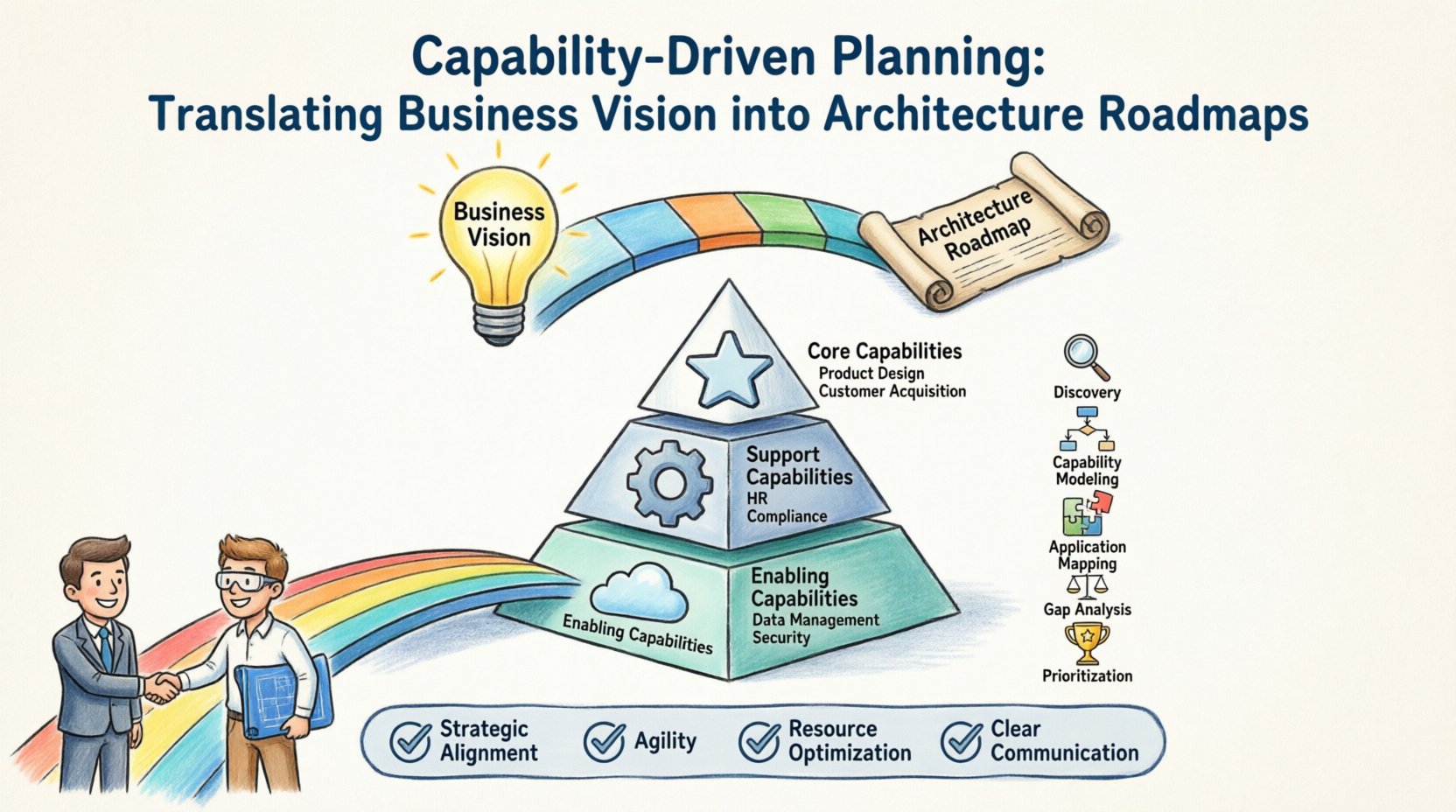
To build an effective map, capabilities are typically categorized into three layers:
- Core Capabilities: These provide the primary competitive advantage. Examples include product design, customer acquisition, or supply chain optimization. These require the highest level of investment and innovation.
- Support Capabilities: These enable the core capabilities to function. Examples include human resources, legal compliance, and facilities management. They are necessary but usually not differentiators.
- Enabling Capabilities: These are often technology-based abilities that support the core and support layers. Examples include data management, security infrastructure, and application hosting.
Defining these layers helps prioritize efforts. When resources are limited, the roadmap should reflect the priority of Core capabilities over Support ones. This hierarchy ensures that the architecture supports the business where it matters most.
🌉 The Bridge Between Strategy and Execution
The gap between strategy and execution is often where roadmaps fail. Strategy documents are written in high-level business language, while architecture documents are written in technical specifications. Bridging this gap requires a translation layer, which is the capability map itself.
This translation process involves several critical steps:
- Identify Strategic Themes: What are the top 3 to 5 goals for the next 3 to 5 years? (e.g., “Expand into new markets,” “Improve customer self-service.”)
- Map Themes to Capabilities: Which capabilities must change or be created to support these themes?
- Assess Current State: How well do current capabilities perform against the requirements?
- Define Target State: What does the capability look like when fully realized?
- Identify Gaps: What is missing between the current and target states?
This structured approach ensures that the roadmap is not just a list of projects, but a coherent plan for capability evolution. It prevents the common pitfall of building systems that no longer align with where the business is going.
🛠️ A Framework for Roadmap Creation
Creating a capability-driven roadmap requires a systematic framework. This framework ensures consistency and repeatability across different departments and initiatives. The following steps outline the process from initial discovery to final validation.
1. Discovery and Inventory
Gather existing documentation, interview stakeholders, and catalog current applications and data assets. The goal is to understand the landscape without bias. Avoid making assumptions about what systems do based solely on their names.
2. Capability Modeling
Construct a hierarchical model of capabilities. Start broad and drill down into specifics. For example, under “Customer Management,” you might find “Customer Onboarding,” “Billing,” and “Support Ticket Resolution.” This granularity allows for precise targeting of architectural changes.
3. Application Mapping
Link each capability to the applications that currently support it. A single capability might be supported by multiple applications, or one application might support multiple capabilities. Identifying these relationships reveals complexity and redundancy.
4. Gap Analysis
Compare the current capability maturity against the strategic requirements. Is the capability weak? Is it non-existent? Is it over-invested in legacy technology? This analysis highlights where the roadmap needs to focus.
5. Prioritization and Sequencing
Not all capabilities can be improved simultaneously. Use a scoring model based on business value, cost of change, and risk. Sequence the roadmap to deliver quick wins while laying the foundation for long-term transformation.
📊 Mapping Capabilities to Architecture
Visualizing the relationship between business capabilities and technical architecture is crucial for clarity. The table below illustrates how a single capability flows down through the architectural layers.
| Business Capability | Target State Requirement | Application Support | Infrastructure Needs | Data Domain |
|---|---|---|---|---|
| Real-Time Fraud Detection | Sub-second latency, 99.99% availability | Stream Processing Engine, ML Model Service | High-performance compute nodes, Low-latency network | Transaction Logs, User Profiles |
| Employee Onboarding | Automated workflow, Self-service portal | HR Management System, Identity Provider | Standard cloud VMs, SSO Infrastructure | Employee Records, Access Rights |
| Inventory Management | Real-time visibility, Multi-location sync | Supply Chain Platform, Warehouse System | Distributed database, IoT Gateways | Stock Levels, Shipment Data |
This mapping makes abstract strategy concrete. It shows that “Real-Time Fraud Detection” is not just a business goal, but a specific set of technical requirements involving stream processing and high-performance compute. This clarity prevents architects from over-provisioning resources for low-priority tasks or under-provisioning for critical ones.
🔄 Step-by-Step Implementation Guide
Implementing capability-driven planning is a journey, not a one-time event. It requires integration into the existing governance and planning cycles of the organization. Follow this guide to begin the transformation.
- Establish a Governance Council: Form a group of business and IT leaders responsible for maintaining the capability model. This ensures that changes to capabilities are approved and tracked.
- Define Metadata Standards: Decide how capabilities will be tagged, versioned, and linked to other entities. Consistency is key for searchability and analysis.
- Integrate with Project Intake: Require new projects to identify which capabilities they support or improve. If a project does not map to a capability, it may lack strategic justification.
- Conduct Regular Audits: Every quarter, review the capability landscape. Are there capabilities that are no longer needed? Are there new capabilities emerging from market changes?
- Train Stakeholders: Ensure that business analysts and project managers understand the difference between a capability and a process. Training reduces resistance and improves data quality.
By embedding these practices into the workflow, the capability model becomes a living artifact rather than a static document. It evolves as the business evolves.
📈 Governance and Continuous Improvement
A roadmap is only useful if it is followed and measured. Governance ensures that the architecture remains aligned with the strategy over time. Without governance, drift occurs, and the roadmap becomes obsolete.
Key governance activities include:
- Change Management: Any significant change to an application or infrastructure must be evaluated for its impact on the supporting capabilities.
- Performance Metrics: Define KPIs for capabilities. For example, “Order Processing Capability” might have a metric for average transaction time. If this degrades, the roadmap may need adjustment.
- Health Checks: Regularly assess the health of the capability landscape. Look for technical debt, security vulnerabilities, or single points of failure within critical capabilities.
- Feedback Loops: Create channels for feedback from end-users and operational teams. They often notice capability gaps before the strategy team does.
This continuous improvement cycle ensures that the architecture remains relevant. It shifts the focus from “delivering projects” to “delivering business outcomes.”
⚠️ Common Obstacles and Solutions
Transitioning to a capability-driven approach is not without challenges. Recognizing these obstacles early allows teams to navigate them effectively.
1. Resistance to Change
Technical teams may feel threatened by a focus on business value, fearing it diminishes the importance of technical excellence. Conversely, business leaders may find the terminology confusing.
- Solution: Emphasize that technical excellence is the foundation for business value. Use plain language when explaining concepts to non-technical stakeholders.
2. Model Complexity
Creating a detailed capability model can become overwhelming if not scoped correctly.
- Solution: Start with high-level capabilities and drill down only where necessary. It is better to have a usable high-level map than a detailed one that no one uses.
3. Data Silos
Capability data often resides in different tools (e.g., project management, architecture repositories, financial systems).
- Solution: Implement a central repository or integration layer that aggregates this data. Ensure data integrity through automated synchronization where possible.
4. Static Roadmaps
Roadmaps created at the beginning of the year are often ignored by the end of the year due to market shifts.
- Solution: Adopt a rolling roadmap approach. Review and adjust the plan quarterly based on new capabilities and strategic shifts.
🏁 Moving Forward with Confidence
The path from business vision to architectural reality is paved with clear definitions and disciplined planning. Capability-driven planning offers a robust framework for this journey. It forces organizations to confront the reality of their current state and plan a deliberate path to the future.
By focusing on what the organization can do, rather than just what systems it owns, leaders can make decisions that drive sustainable growth. The roadmap becomes a dynamic tool for navigation rather than a static document for storage. This approach empowers architects to speak with authority and business leaders to understand the technical implications of their strategy.
Success in this area requires patience and consistency. It is not about finding a silver bullet but about building a culture of alignment. As capabilities are refined and the roadmap evolves, the organization becomes more resilient. It becomes better equipped to handle market disruptions and technological shifts. The investment in capability-driven planning pays dividends through reduced waste, faster delivery, and clearer strategic direction.
Start by mapping your core capabilities today. Identify the gaps. Prioritize the work. And build a roadmap that truly reflects the vision of the business. The future of enterprise architecture depends on this alignment.