
In the modern digital landscape, business processes rarely remain confined within the walls of a single entity. Supply chains, financial settlements, and healthcare coordination require seamless cooperation between distinct legal and operational boundaries. To model these complex relationships effectively, the Business Process Model and Notation (BPMN) standard offers a specific mechanism known as Choreography Tasks. This approach shifts the focus from a single controller orchestrating actions to a decentralized network where participants agree on a sequence of message exchanges.
Defining interaction patterns between organizations using BPMN 2.0 Choreography tasks requires a deep understanding of collaboration, message flows, and the semantic meaning of public versus private processes. This guide explores the structural requirements, common patterns, and governance strategies necessary to build robust inter-organizational models without relying on specific software implementations.
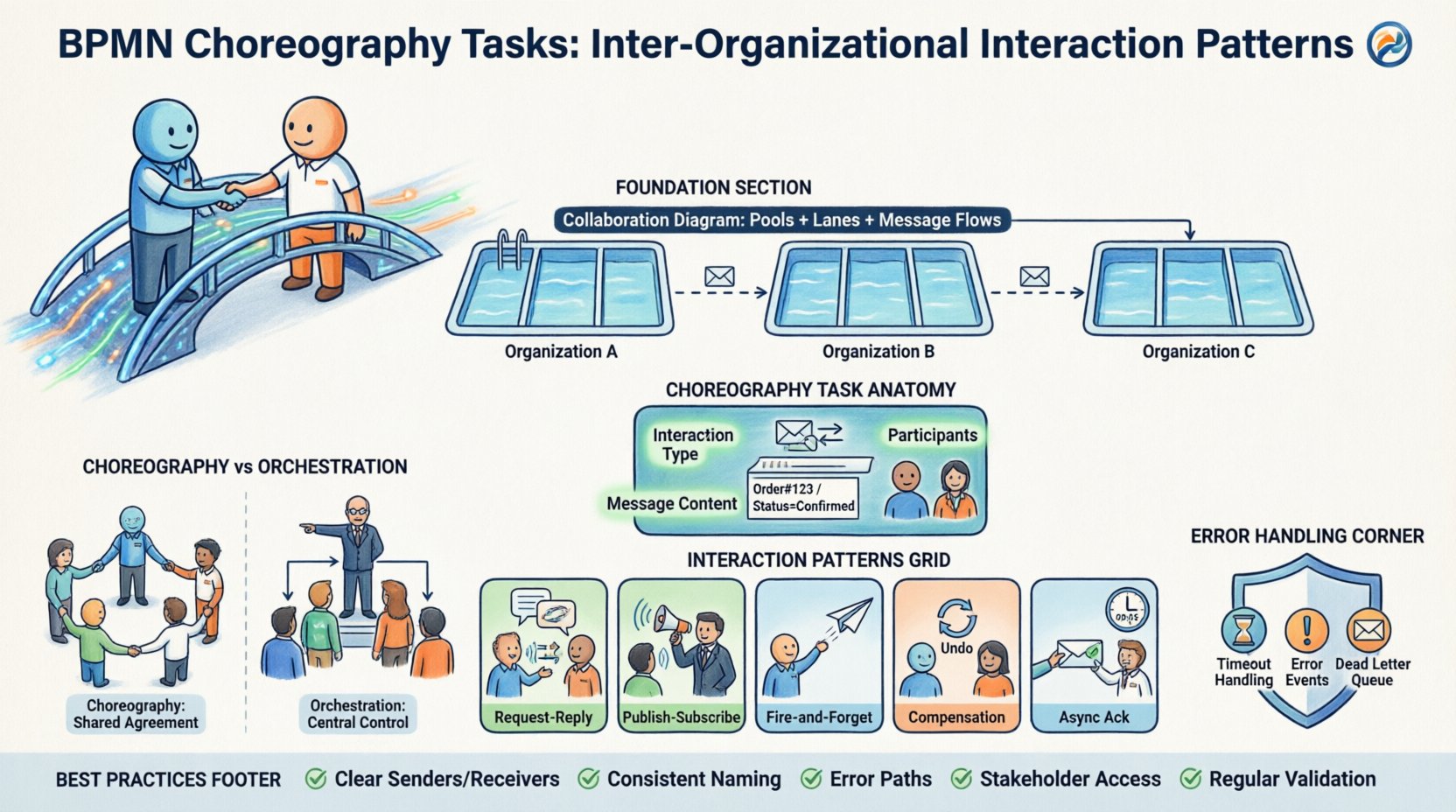
🧩 The Foundation of BPMN Collaboration
Before diving into specific tasks, one must understand the container in which they exist. A standard BPMN process diagram typically represents a private process owned by a single participant. However, when multiple organizations interact, the diagram expands into a Collaboration Diagram.
Pools: These represent the distinct participants or organizations. Each pool is independent, meaning one organization cannot see the internal logic of another.
Lanes: Within a pool, lanes represent roles or departments. In choreography, these help distinguish who is responsible for initiating or receiving a message.
Message Flows: Unlike Sequence Flows which connect activities within a single process, Message Flows connect activities across different pools. They represent the transfer of information.
Choreography tasks are unique because they do not reside inside a single process pool. Instead, they are part of the Choreography Diagram, which sits alongside the private processes. This diagram defines the global view of the interaction, ensuring all parties agree on the sequence of events.
🔑 Anatomy of a Choreography Task
The Choreography Task is the core element for defining interaction patterns. It visually represents a unit of work that involves at least two participants exchanging messages. Understanding its attributes is critical for accurate modeling.
1. Interaction Type
The task defines the nature of the exchange. Common types include:
Message Exchange: A sender transmits a message, and the receiver acknowledges it.
Event-Based: Actions are triggered by specific events occurring in the environment.
Message Flow: The movement of data between the participants.
2. Participants
Every choreography task must specify which participants are involved. This is not merely a label; it defines the boundaries of responsibility. If a task involves “Organization A” and “Organization B”, the model must clearly show who initiates the message and who is the recipient.
3. Message Content
While the diagram does not require the actual data payload, it should imply the type of information being exchanged. For example, an order confirmation task implies the transfer of order details, pricing, and shipping addresses. This semantic clarity helps developers map the process to real-world APIs or messaging queues.
🤝 Common Interaction Patterns
Not all interactions are the same. Different business scenarios require different communication patterns. Below is a structured overview of the most prevalent patterns used in inter-organizational BPMN modeling.
Pattern Name | Directionality | Use Case | Key Characteristic |
|---|---|---|---|
Request-Reply | Bi-directional | Order Placement & Confirmation | Sender waits for a response before proceeding. |
Publish-Subscribe | One-to-Many | Market Price Alerts | One source broadcasts to multiple subscribers. |
Fire-and-Forget | Unidirectional | Log Submission | No response is expected; the sender moves on immediately. |
Compensation | Bi-directional | Order Cancellation | Reverse actions to undo previous commitments. |
Asynchronous Ack | Bi-directional | Document Upload | Sender receives a receipt, but the actual processing happens later. |
Detailed Analysis of Key Patterns
Request-Reply
This is the most common pattern in supply chain management. Organization A sends a request (e.g., a purchase order), and Organization B must reply with a status (e.g., order accepted or rejected). In the choreography diagram, this is modeled as a sequence of message flows connecting the two pools. The critical rule here is that the sender cannot complete its local process until the reply is received.
Compensation
Business processes are not always linear. Sometimes, a previous step must be undone. If Organization A cancels an order after Organization B has already shipped goods, a compensation flow is triggered. This involves a specific choreography task that initiates the return process. This requires precise timing and agreement on who pays for the return logistics.
Fire-and-Forget
In scenarios like reporting or logging, the value lies in the delivery, not the immediate reaction. Organization A sends a daily compliance report to Organization B. Organization B stores it. Organization A does not wait for a confirmation. While efficient, this pattern carries risk. If Organization B never receives the message, Organization A might assume success when it did not. Models using this pattern should include periodic reconciliation tasks.
⚠️ Handling Errors and Exceptions
Inter-organizational processes are high-risk environments. Network failures, data mismatches, or policy violations can occur at any stage. A robust choreography model must account for these failures without breaking the agreement between organizations.
1. Timeout Handling
What happens if a reply never arrives? A choreography task should define a timeout duration. If Organization B does not respond within the agreed timeframe, Organization A must trigger a fallback procedure. This could be a manual intervention, a retry mechanism, or a cancellation event.
2. Error Events
When a message is invalid, an error event is triggered. This event should be visible to both participants. For example, if Organization A sends an invoice with an incorrect tax ID, Organization B receives the message but triggers an error event. This event signals the need for correction rather than a process termination.
3. Dead Letter Queues
In technical implementations, messages that cannot be processed are often moved to a dead letter queue. In the process model, this is represented as a separate path in the choreography diagram. It ensures that failed transactions are not lost but are routed to a human operator or a specialized recovery system.
🛡️ Governance and Compliance
When multiple organizations share a process model, governance becomes a critical concern. The choreography acts as a contract. If one party changes their internal process, they must ensure the external contract remains valid.
Version Control: Every version of the choreography diagram must be versioned. If Organization A updates their process, Organization B needs to know if the message format has changed. Legacy versions should be supported for a transition period.
Access Control: While the choreography diagram is public between the participants, internal details within each pool remain private. The model must clearly delineate what is shared and what is hidden.
Compliance Auditing: Regulatory bodies often require proof of process adherence. The choreography diagram serves as the blueprint for auditing trails. Every message exchange should be logged to prove that the agreed pattern was followed.
🚧 Common Modeling Pitfalls
Even experienced architects make mistakes when defining interaction patterns. Avoiding these common pitfalls ensures the model remains accurate and implementable.
1. Mixing Orchestration and Choreography
A frequent error is trying to model the internal logic of one organization inside the choreography diagram. The choreography diagram should only contain the public interface. Internal decision-making belongs in the private process. Mixing these creates confusion and tight coupling.
2. Ignoring Asynchronicity
Not all messages are processed instantly. Some systems operate in batches. A model that assumes synchronous processing for all tasks will fail when implemented in an asynchronous environment. Use explicit markers for asynchronous message flows.
3. Over-Specifying Data
Do not clutter the diagram with data attributes. The purpose of BPMN is to model the flow, not the schema. Define the data structure in a separate specification document. Keep the visual diagram clean and focused on the sequence of events.
4. Lack of Visibility
If a process is complex, participants may lose track of where they are in the flow. Ensure that key milestones are clearly marked with events. This provides a checkpoint for all parties to verify their state.
🔄 Choreography vs. Orchestration
Understanding the distinction between these two concepts is vital for selecting the right pattern.
Orchestration: Centralized control. One process acts as the manager, telling others what to do. It is best for internal workflows where one entity has full authority over the steps.
Choreography: Decentralized control. Participants interact based on a shared agreement. It is best for inter-organizational workflows where no single party has control over the others.
Choosing the wrong pattern can lead to rigid systems. If you model a multi-party negotiation as an orchestration, you force one party to dictate the terms, which may be rejected by partners. Choreography allows for flexibility, where each organization can react to the message flow based on its own internal rules.
📈 Implementing the Model
Once the interaction patterns are defined, the next step is implementation. This involves translating the diagram into technical specifications.
Define Message Contracts: Specify the XML or JSON schemas for every message exchanged in the choreography tasks.
Establish Protocols: Determine the transport mechanism. Is it HTTP, AMQP, or a file drop? The protocol must match the timing requirements of the choreography.
Set Up Monitoring: Implement logging for every message flow. This allows you to track the health of the interaction and debug issues.
Test with Real Data: Run pilot tests with actual partners. Simulate failures and timeouts to ensure the error handling logic works as expected.
🔮 Future-Proofing the Interaction
Business relationships evolve. Partnerships dissolve, and new ones form. A choreography model should be designed to accommodate these changes.
Modularity: Break down the interaction into smaller, reusable patterns. If you need to add a new payment method, you should be able to plug in a new choreography task without rewriting the entire order process.
Extensibility: Use extension elements to allow for custom data fields that may be required by future partners without breaking the core model.
Standardization: Adhere to industry standards where possible. Using standard message types reduces the integration effort for new partners.
📝 Summary of Best Practices
To ensure success in defining interaction patterns between organizations, adhere to the following guidelines:
Clarity: Ensure every message flow has a clear sender and receiver.
Consistency: Use consistent naming conventions for tasks and messages.
Completeness: Ensure every flow has an error handling path.
Visibility: Keep the choreography diagram accessible to all stakeholders.
Validation: Regularly review the model against actual operational data.
By following these principles, organizations can build resilient, transparent, and efficient inter-organizational processes. The choreography task is not just a diagram element; it is a digital handshake that defines the rules of engagement for modern business collaboration.
Effective modeling reduces friction, lowers costs, and builds trust. It transforms complex legal agreements into executable, visual logic that drives business value across the entire ecosystem.