
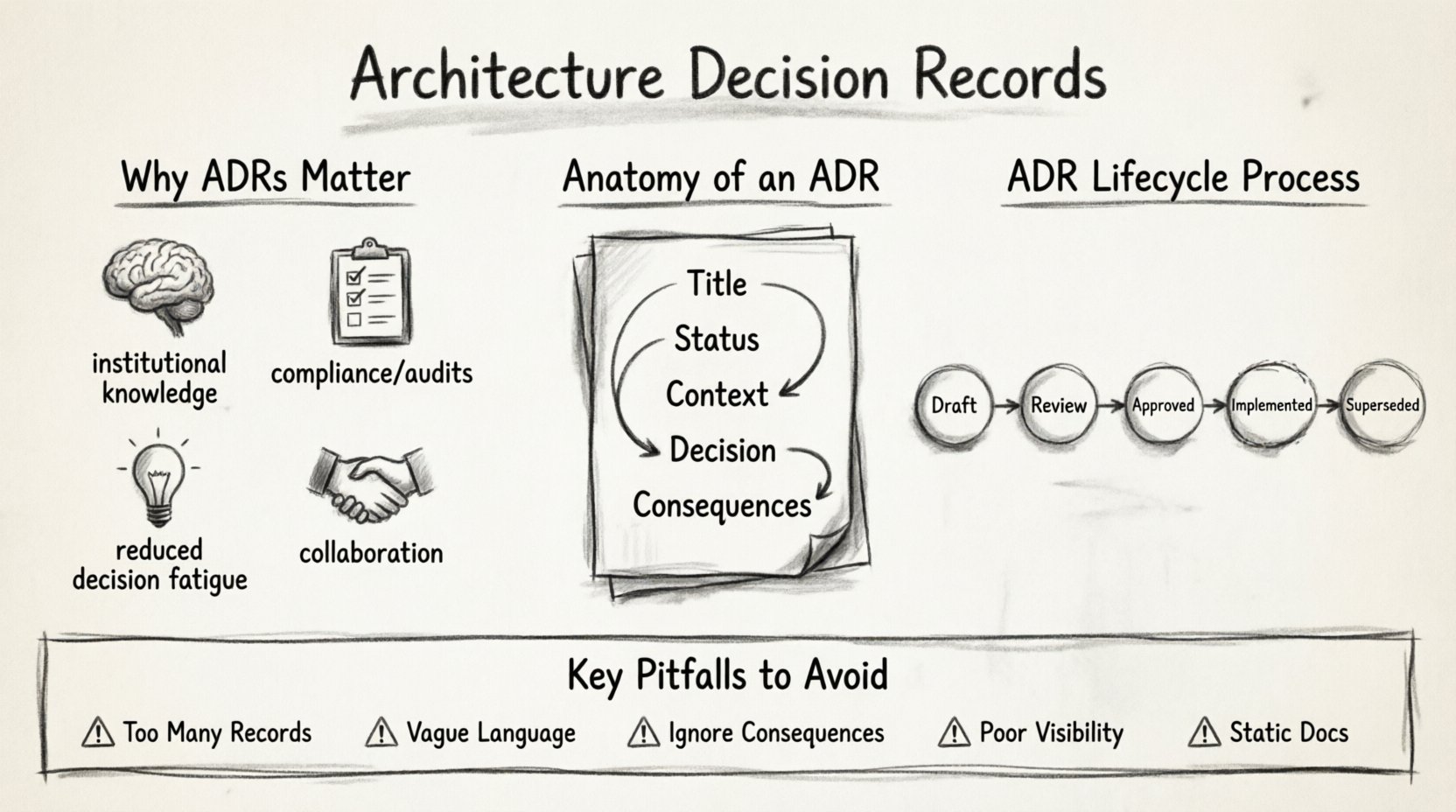
In modern enterprise architecture, the speed of delivery often outpaces the clarity of understanding. Teams move quickly, deploying services and integrating systems with little regard for the long-term implications of their choices. This creates a legacy of technical debt that is not just code-based but knowledge-based. When a key engineer leaves or a critical system requires modification years later, the reasoning behind past choices often disappears. Architecture Decision Records (ADRs) solve this problem by creating a durable, searchable history of why specific technology choices were made. This document serves as a guide to implementing ADRs effectively, ensuring transparency and accountability across the organization.
Why ADRs Matter for Enterprise Architecture 🧠
Enterprise architecture is not merely about drawing boxes and lines on a whiteboard. It is about the strategic alignment of technology with business goals. Every technology choice represents a trade-off between cost, performance, scalability, and risk. Without a formal record of these trade-offs, an organization risks repeating the same mistakes or losing the context that justified a specific path.
- Preserving Institutional Knowledge: Personnel turnover is inevitable. ADRs ensure that when a developer joins the team, they understand the history of the system, not just its current state.
- Facilitating Audits and Compliance: In regulated industries, explaining why data is stored in a specific location or how security is enforced is a legal requirement. ADRs provide the evidence trail needed for compliance audits.
- Reducing Decision Fatigue: When a team faces a similar problem in the future, they can reference existing records rather than re-evaluating the same options from scratch.
- Enabling Better Collaboration: ADRs force a discussion before implementation. This ensures that stakeholders from different domains (security, operations, development) agree on the direction.
The goal is not to create bureaucracy, but to create clarity. A well-maintained ADR process turns implicit assumptions into explicit agreements.
The Anatomy of a High-Quality ADR 📝
An ADR is a short document that captures a significant architectural decision. It should be concise enough to be read quickly but detailed enough to provide context. A standard ADR typically includes specific sections that guide the writer and the reader through the logic of the decision.
Core Components of an ADR
Every record should follow a consistent structure. This consistency allows engineers to find information quickly. The following components are essential for a robust record:
- Title: A short, descriptive name for the decision.
- Status: Indicates whether the decision is proposed, accepted, rejected, or superseded.
- Context: The background information. What problem was being solved? What constraints existed?
- Decision: The actual choice made. This should be clear and unambiguous.
- Consequences: The outcomes of the decision. What are the benefits? What are the trade-offs or negatives?
Example Structure Table
| Section | Purpose | Example Content |
|---|---|---|
| Title | Identify the decision quickly | Use of Container Orchestration for Microservices |
| Status | Current state of the decision | Accepted |
| Context | Why are we deciding this? | Current monolith is scaling poorly. Need isolation for deployment. |
| Decision | What was chosen? | Adopt a cluster-based orchestration platform for all new services. |
| Consequences | What are the impacts? | Increased operational complexity. Reduced manual deployment errors. Higher infrastructure cost. |
Notice how the “Consequences” section is critical. It is not enough to state what was chosen; one must state what was given up. This section often contains the most valuable information for future engineers.
The Process of Creating ADRs 🛠️
Creating an ADR is not a one-time event. It is a workflow that integrates into the development lifecycle. The process ensures that decisions are made deliberately rather than accidentally. This section outlines the steps required to establish a functional ADR workflow.
1. Initiation
When a significant change is identified, an engineer or architect drafts an initial proposal. This is often called a “Draft ADR”. It should describe the problem space and potential options. At this stage, the status is typically “Proposal”. The document is shared with relevant stakeholders for review.
2. Review and Discussion
The draft is not final. It is a conversation starter. Teams should discuss the options listed in the draft. This discussion can happen in meetings, chat channels, or code review systems. The goal is to expose risks and edge cases. If a significant risk is found, the decision may change. This is a normal part of the process.
3. Approval and Status Update
Once the discussion concludes, the status is updated to “Accepted”. This signals that the decision is binding. If the decision is deemed unsuitable, the status becomes “Rejected”. This is important because it prevents teams from trying to implement a rejected option later.
4. Implementation
The technical work begins. The ADR serves as the reference point for the code. Developers refer to the ADR when writing code to ensure alignment with the decision. If the implementation deviates from the ADR, the ADR should be updated, or the implementation should be corrected.
5. Maintenance and Superseding
Technology evolves. A decision made three years ago may no longer be valid. When a decision needs to change, a new ADR is created that references the old one. The old ADR status is updated to “Superseded”. This maintains the history while acknowledging the change.
Governance and Lifecycle Management 🔄
Without governance, ADRs can become obsolete documents sitting in a folder. They must be treated as living artifacts. Governance ensures that the records remain accurate and relevant over time.
Version Control Integration
ADRs should be stored alongside the code they describe. Using a version control system allows for history tracking. Every change to an ADR is a commit. This provides an audit trail of how the thinking evolved. It also allows teams to revert to a previous decision if the new direction proves flawed.
Review Cadence
Not every ADR needs constant attention. However, a periodic review is necessary. A quarterly or semi-annual review ensures that decisions are still valid. During this review, teams can identify ADRs that are “Superseded” but not marked as such. It also helps identify decisions that are causing friction.
Accessibility and Searchability
ADRs are useless if no one can find them. They should be hosted on a central documentation platform. This platform should support full-text search. Teams should be able to search for keywords like “database”, “security”, or “API” and find relevant decisions. Indexing the content is vital for long-term utility.
Common Pitfalls and How to Avoid Them ⚠️
Even with the best intentions, ADR initiatives can fail. Understanding common failure modes helps teams avoid them. The following list highlights frequent issues and their solutions.
- Too Many Records: Writing an ADR for every minor configuration change creates noise. Limit ADRs to significant architectural decisions. Small changes should be documented in commit messages or code comments.
- Vague Language: Ambiguity leads to misinterpretation. Avoid words like “maybe”, “perhaps”, or “best effort”. Use definitive language like “will”, “must”, or “shall”.
- Ignoring Consequences: Focusing only on the benefits creates false optimism. Always document the downsides. This prepares the team for the challenges ahead.
- Lack of Visibility: If the ADRs are stored in a private repository, others cannot learn from them. Ensure the documentation is accessible to the wider engineering organization.
- Static Documentation: If an ADR is never updated, it is a lie. If the system changes, the ADR must change. Treat the document as a contract that can be amended.
Cultural Shifts and Team Dynamics 👥
Implementing ADRs is as much a cultural change as a technical one. It requires a shift from implicit understanding to explicit communication. This can be uncomfortable for teams used to working informally.
Empowering Engineers
ADRs are not just for architects. Any engineer who makes a significant decision should have the authority to write an ADR. This empowers the team to take ownership of their choices. It reduces the bottleneck of waiting for management approval for every decision.
Encouraging Dissent
A healthy ADR process allows for disagreement. If a team member believes a proposed decision is flawed, they should feel safe raising it in the draft phase. The status of “Rejected” is just as valuable as “Accepted” because it saves time later.
Building Trust
Transparency builds trust. When stakeholders can see the reasoning behind a decision, they are more likely to support the implementation. This is particularly important when a decision involves risk or cost. The ADR becomes the evidence that the decision was not made lightly.
Measuring the Impact of ADRs 📊
How do you know if the ADR process is working? Quantitative and qualitative metrics can help assess the effectiveness of the practice.
Key Metrics
- Decision Latency: How long does it take to finalize a decision? If it takes too long, the process may be too bureaucratic.
- Rework Rate: Are teams spending time undoing decisions because the context was lost? A reduction in rework indicates better documentation.
- Onboarding Time: How long does it take a new hire to understand the system? Good ADRs should significantly reduce this time.
- ADR Usage: Are engineers actually referencing the records? This can be measured by search logs or references in code comments.
Integration with Broader Strategy 🗺️
ADRs should not exist in a vacuum. They must align with the broader organizational strategy. This ensures that technical decisions support business goals.
Alignment with Standards
Organizations often have technology standards or patterns. ADRs should reference these standards. If a decision deviates from a standard, the ADR must explain why. This ensures that exceptions are intentional and documented.
Supporting Innovation
ADRs can also support innovation. By documenting experiments and their results, teams can build a knowledge base of what works and what doesn’t. This reduces the risk of trying new technologies, as the team can see the history of previous attempts.
Long-Term Planning
When planning for the next year, leadership can review ADRs to understand the technical debt landscape. This allows for better budgeting and resource allocation. Decisions that require significant maintenance can be identified early.
Final Considerations for Implementation 🚀
Starting an ADR initiative requires a clear plan. It is best to start small. Pick one team or one project and pilot the process. Gather feedback and refine the template before rolling it out across the enterprise. This iterative approach prevents resistance and allows for adjustments.
The value of Architecture Decision Records lies in their ability to capture the “why” behind the “what”. In an industry where technology changes rapidly, the reasoning remains constant. By documenting these reasons, organizations build a foundation of stability amidst change. This stability is crucial for long-term success and resilience.
Remember that the tool is secondary to the practice. Whether using a text editor, a wiki, or a specialized platform, the core requirement is the discipline of documentation. The habit of asking “Why did we choose this?” is the most valuable outcome of this process.
By adopting these best practices, enterprises can ensure that their technology choices are transparent, deliberate, and sustainable. This leads to systems that are easier to maintain, easier to understand, and easier to evolve. The investment in documentation pays dividends in operational efficiency and risk reduction over time.