Traditional project management frameworks were designed for environments with clear objectives, defined deliverables, and stable requirements. Think of building a bridge or launching a standard software version. In these scenarios, the path from point A to point B is visible. However, modern business environments are increasingly defined by ambiguity, volatility, and complexity. When faced with complex, unstructured problems, rigid adherence to predictive models often leads to failure. This guide explores how to adapt core project management principles to navigate uncertainty without losing control.
Applying discipline to chaos requires a shift in mindset. It is not about abandoning structure, but rather adapting the structure to fit the fluidity of the work. We will examine specific strategies for planning, risk management, stakeholder engagement, and governance when the end goal is not fully known at the start.
🧩 Understanding the Nature of Unstructured Problems
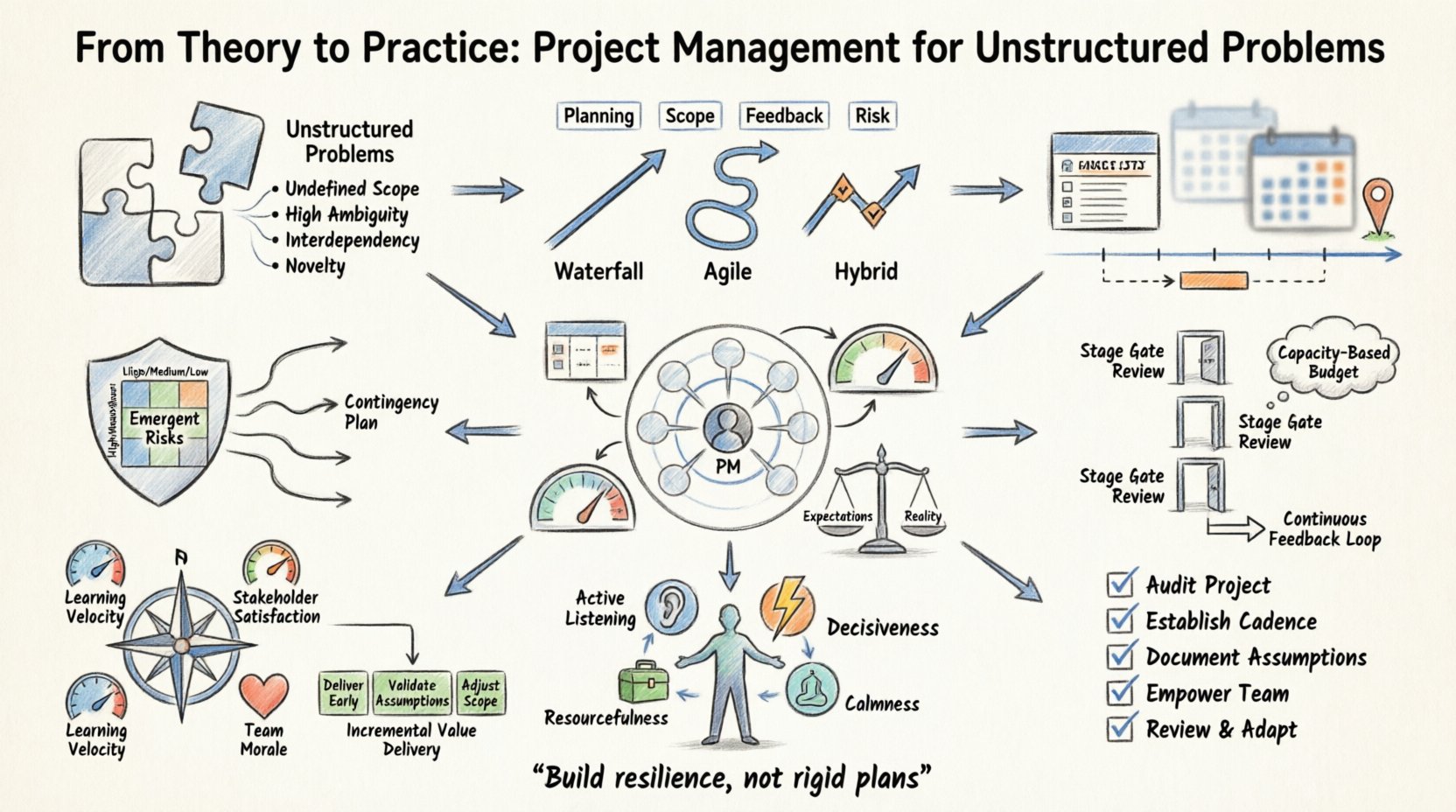
Before applying solutions, one must define the problem space. Unstructured problems differ significantly from structured ones. Structured problems have known inputs and known processes. Unstructured problems lack one or both. These challenges are often characterized by:
- Undefined Scope: The deliverables are not clearly documented at the outset. They evolve as work progresses.
- High Ambiguity: Stakeholders may not know what they want until they see what they do not want.
- Interdependency: Changes in one area create unpredictable ripple effects elsewhere.
- Novelty: The work involves new technologies, markets, or processes that have no historical data.
In these contexts, the “correct” answer is often discovered through experimentation rather than calculation. Project managers must transition from being architects who draw the blueprints to being navigators who adjust the course based on changing winds.
🛠 Adapting Methodologies for Ambiguity
The choice of methodology dictates how work is executed. While many practitioners default to Agile or Waterfall, unstructured problems often require a hybrid approach. Rigidly following a single framework can stifle necessary flexibility.
Consider the following comparison when selecting an approach for unstructured work:
| Characteristic | Predictive (Waterfall) | Adaptive (Agile/Iterative) | Hybrid Approach |
|---|---|---|---|
| Planning | Front-loaded, detailed | Just-in-time, rolling wave | High-level upfront, detailed later |
| Scope | Fixed | Flexible | Fixed constraints, flexible features |
| Feedback | End of phase | Continuous | Regular checkpoints |
| Risk | Identified early | Emergent | Continuous monitoring |
For unstructured problems, the Hybrid Approach often yields the best results. It allows for the governance and reporting required by leadership while permitting the team the flexibility to pivot when new information arises. The key is to maintain a “single source of truth” regarding the current state of the project, even if that state changes frequently.
📋 Strategic Planning in Uncertainty
Planning does not disappear in unstructured environments; it changes form. You cannot create a detailed work breakdown structure (WBS) for the entire project duration if the requirements are not known. Instead, planning becomes iterative.
- Rolling Wave Planning: Plan the immediate work in high detail. Plan the later phases at a high level. As you complete the near-term work, you refine the plan for the subsequent phases. This ensures accuracy where it matters most.
- Milestone-Driven Scheduling: Focus on major deliverables or decision gates rather than specific task dates. This reduces the administrative burden of tracking tasks that may become obsolete.
- Option-Based Planning: Keep multiple paths open. Identify critical decision points where you will choose between different technical or strategic directions. Budget time specifically for these decision-making moments.
- Buffer Management: Add time buffers not just for tasks, but for learning curves and discovery. Complex problems require time to understand the problem before solving it.
When creating a plan for ambiguity, communicate the assumptions explicitly. If a timeline is based on the assumption that a specific technology is viable, state that assumption clearly. If the assumption fails, the plan can be adjusted without losing credibility.
⚠️ Risk Management in Chaos
In structured projects, risks are often identified through historical data and checklists. In unstructured environments, risks are emergent. You cannot predict every potential issue. Therefore, risk management must be proactive and continuous.
1. Identify Emerging Risks
Hold regular risk identification sessions. These should not be formal meetings but integrated into daily or weekly work reviews. Ask questions such as:
- What surprised us this week?
- What information was missing that caused a delay?
- Are we making assumptions that might be wrong?
2. Qualitative over Quantitative
Complex problems often lack the data needed for quantitative risk analysis (e.g., Monte Carlo simulations). Focus on qualitative assessment. Rate risks based on their potential impact on the project’s primary goals (time, quality, budget, morale) and their probability of occurring. Use a simple High/Medium/Low matrix to prioritize attention.
3. Mitigation vs. Contingency
For unstructured work, mitigation is harder because you cannot fully prevent the unknown. Focus more on contingency planning. Define triggers that signal a shift in strategy. If a specific milestone is missed, what is the pre-agreed fallback? Having a “Plan B” ready reduces panic when things go wrong.
🤝 Stakeholder Management in Ambiguity
Stakeholders in unstructured projects often have conflicting expectations. Some want innovation and speed; others want safety and predictability. Managing this tension is a core responsibility of the project lead.
- Transparent Communication: Do not hide the uncertainty. Stakeholders appreciate honesty more than false confidence. Regularly report on what is known, what is unknown, and what is being done to reduce the unknown.
- Visual Management: Use dashboards and visual boards to show progress. In complex work, status reports can be misleading. A visual board showing current work, blockers, and next steps provides a clearer picture of reality.
- Manage Expectations Early: Define what success looks like for each stakeholder group. If the business goal is learning, do not measure success solely by the final product launch. If the goal is speed, accept that scope may be reduced.
- Empower Decision Makers: Ensure the right people have the authority to make decisions when ambiguity arises. If every decision requires a committee, the project will stall. Delegate decision-making authority to the team closest to the work.
📊 Governance and Control Mechanisms
Control does not mean micromanagement. In unstructured projects, control mechanisms must be lightweight but effective. Heavy governance processes can kill innovation and slow down the discovery process.
1. Stage-Gate Reviews
Implement stage-gate reviews to ensure alignment. These are checkpoints where stakeholders review progress and decide whether to proceed, pivot, or stop. This provides control without dictating daily tasks. At each gate, ask:
- Is the problem definition still valid?
- Do we still have the resources to continue?
- Has the value proposition changed?
2. Financial Control
Financial management in unstructured projects requires a different approach. Instead of a fixed budget for specific tasks, use a capacity-based budget. Allocate funds to teams or timeboxes rather than specific deliverables. This allows the team to explore different solutions without worrying about budget variances on minor tasks.
3. Quality Assurance
Quality in ambiguous work is defined by fitness for purpose, not adherence to a spec sheet. Implement continuous testing and feedback loops. If the output is not meeting user needs, it is not high quality, regardless of how well it was built. Involve end-users in the review process early and often.
🎯 Measuring Success without Clear Metrics
How do you measure success when the goalposts move? Traditional metrics like “on time, on budget” are insufficient. You need leading indicators that reflect progress toward value.
- Learning Velocity: Measure how quickly the team reduces uncertainty. Did we learn something new this week? Did we validate a hypothesis?
- Stakeholder Satisfaction: Regularly survey stakeholders on their confidence in the project direction. Even if the product isn’t finished, their confidence should remain high if they trust the process.
- Team Morale: Unstructured work is stressful. Monitor team health. High burnout leads to poor decisions. A healthy team is more resilient to ambiguity.
- Incremental Value Delivery: Focus on the value delivered in each iteration. Can the business use what was produced today? Even if the final product changes, the interim value counts.
🧭 The Role of the Project Manager
In complex environments, the Project Manager acts less as a commander and more as a facilitator. The role shifts from “assigning tasks” to “removing obstacles.” The PM must cultivate an environment where failure is treated as data, not as a reason for punishment. This psychological safety is essential for teams to innovate and solve difficult problems.
Key behaviors for the PM include:
- Active Listening: Understand the underlying needs of stakeholders, not just their stated requests.
- Decisiveness: When information is incomplete, make the best decision possible and be ready to change it later.
- Resourcefulness: Find ways to achieve goals with limited or shifting resources.
- Calmness: Maintain composure. Panic is contagious. If the leader remains steady, the team can function effectively.
🔧 Practical Steps for Immediate Application
To begin applying these principles today, consider the following checklist:
- Audit the Project: Review the current project charter. Identify which requirements are fixed and which are flexible. Adjust the plan to reflect this reality.
- Establish a Cadence: Set a regular rhythm for communication. Whether it is daily stand-ups or weekly reviews, consistency provides stability in an unstable environment.
- Document Assumptions: Create a living document that lists all assumptions made during planning. Review this document regularly to validate them.
- Empower the Team: Give the team ownership of the solution. Let them propose the methods to reach the goal, rather than dictating the methods.
- Review and Adapt: Schedule a retrospective after every major phase. Ask what worked, what did not, and how the process should change for the next phase.
🌟 Final Thoughts on Managing the Unknown
Managing complex, unstructured problems is not about eliminating uncertainty. It is about managing the exposure to that uncertainty. By adapting planning techniques, focusing on emergent risk, and maintaining transparent communication, project leaders can steer even the most ambiguous initiatives toward success. The goal is not to predict the future, but to build an organization capable of responding to it effectively.
Success in this context is defined by resilience and adaptability. It is the ability to pivot when necessary without losing sight of the ultimate objective. As you apply these principles, remember that the framework serves the project, not the other way around. Stay flexible, stay focused, and keep the value delivery at the center of every decision.