

Enterprise Architecture (EA) has long been a cornerstone of organizational strategy, enabling alignment between business objectives and technological capabilities. However, the traditional modeling lifecycle—built on manual, labor-intensive processes—has faced persistent bottlenecks in agility, accessibility, and accuracy. These challenges have now been redefined through the integration of artificial intelligence (AI) into architectural workflows. A new generation of AI-driven tools, such as the Visual Paradigm AI Chatbot and the AI Diagram Generator, marks a paradigm shift: from designing diagrams to generating strategic insights.
From Blank Canvas to Intelligent Modeling: The Evolution of EA
For decades, enterprise architects began their work with a blank canvas—no templates, no guidance, and no automation. The process of translating high-level business goals into detailed, compliant diagrams required deep technical expertise, painstaking attention to detail, and extensive time investment. This cycle was not only inefficient but also introduced significant risks: missed relationships, inconsistent notations, and misaligned stakeholder views.
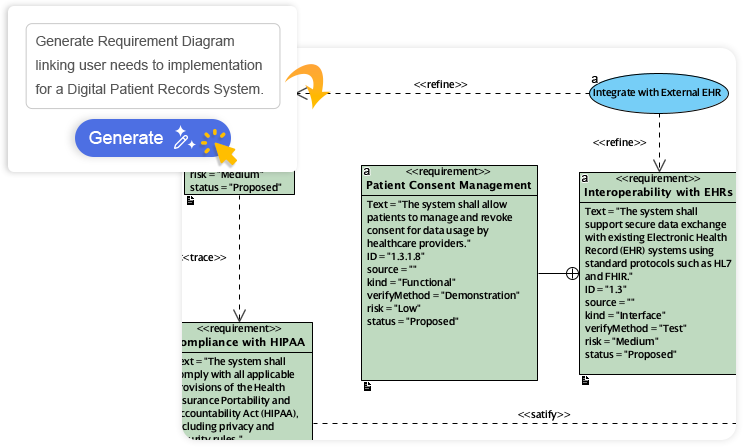
Modern AI automation fundamentally disrupts this model by introducing a conversational, context-aware workflow where architects and stakeholders define architectural goals in natural language. The AI interprets these inputs, applies domain-specific knowledge, and automatically generates fully compliant ArchiMate models—complete with correct notations, layered viewpoints, and semantic integrity—within seconds.
1. Accelerating the Modeling Lifecycle with Contextual Generation
Traditional modeling could take weeks to produce a single, comprehensive view. AI-powered tools eliminate this lag by reducing initial modeling effort by 70% to 90%. For instance, a stakeholder might describe, “We need to model how our customer service operations transition to cloud-based support systems.” The AI parses this statement, identifies key actors, processes, and technologies, and generates a fully structured ArchiMate model with appropriate layers and relationships—without requiring any manual input.
This transformation is not just about speed—it’s about freeing architects from the mechanical aspects of diagramming. Instead of spending hours drawing flow lines or placing components, they can dedicate their time to strategic validation, stakeholder alignment, and scenario planning.
2. Closing the Knowledge Gap with Natural Language Intelligence
One of the most significant barriers in EA is the specialized knowledge required to work with standards like ArchiMate 3.2. Mastering the syntax of viewpoints, the semantics of relationships (such as ‘uses,’ ‘controls,’ or ‘depends on’), and the hierarchical structure of layers demands years of training and experience.
AI bridges this gap through natural language processing (NLP). Users no longer need to memorize technical terminologies or refer to complex specification documents. Instead, they can express business needs in plain English. For example:
- “We want to show how sales data flows into CRM and then into analytics.”
- “Create a capability map for our digital transformation initiative.”
- “Show the technology stack used in the finance department today.”
The AI analyzes the intent, maps it to the appropriate ArchiMate constructs, and applies correct notations—such as using the Business Process layer for workflow, Technology Use for infrastructure, and Capability for functional outcomes—ensuring compliance with the official specification.
3. On-Demand Viewpoint Generation for Diverse Stakeholders
Agile enterprises often need to communicate architecture across diverse audiences—from executives focused on ROI, to engineers concerned with scalability, to compliance officers focused on data governance. Traditional modeling requires creating and maintaining dozens of specialized views, each tailored to a distinct stakeholder group.
With AI automation, viewpoint generation becomes on-demand and dynamic. When a meeting begins with a request like “Show me the executive-level overview of our digital supply chain,” the AI instantly restructures the model into a clear, high-level Capability Map or Business Value View. Later, in a technical design session, the same model can be reconfigured into an Implementation & Migration View to show timelines and system transitions.
This capability ensures that no stakeholder is left out of the conversation. Executives see value alignment; developers see technical dependencies; operations leaders see integration risks—all derived from a single, evolving model.
4. Ensuring Compliance, Consistency, and Semantic Integrity
Manual modeling is inherently error-prone. Inaccurate relationships, mismatched colors, inconsistent layering, or missing constraints can lead to misaligned decisions and costly rework.
AI-driven tools enforce syntactic and semantic compliance with ArchiMate specifications. Every element—from the shape of a component to the type of relationship between them—is validated against the official standard. For example, the AI ensures that:
- Only defined viewpoints are used in specific contexts.
- Relationships are correctly categorized (e.g., ‘uses’ vs. ‘is used by’).
- Color coding follows the standardized palette (e.g., blue for technology, green for business).
Moreover, these models are not static. They evolve through a living architectural picture—a model that changes in real time as new information is introduced. A simple query like “What happens if we retire the legacy payment gateway?” triggers an automated impact analysis, updating related processes, capabilities, and technology nodes.
5. Enabling Real-Time Impact and Gap Analysis
Traditional gap analysis relies on manual comparisons between current and future states—often taking days or weeks to complete. In contrast, AI enables intelligent impact and gap detection through real-time model analysis.
For example:
- What-If Scenarios: A user asks, “What if we migrate our customer portal to a new platform next quarter?” The AI simulates the change, tracing dependencies, identifying impacted processes, and highlighting risks like data migration or user training.
- Gap Detection: The system continuously compares the current state against a defined future state (e.g., digital transformation roadmap). It identifies mismatches—such as outdated systems or missing integration points—and suggests actionable improvements.
This dynamic analysis becomes a core feature of EA governance, enabling proactive change management and reducing the risk of technical debt.
6. Democratizing Enterprise Architecture
Historically, EA has been a domain reserved for certified architects with years of experience. This exclusivity created silos and limited stakeholder engagement, particularly among business analysts, project managers, and executives.
AI automation fundamentally changes this by democratizing access. Non-technical users can now participate in architectural modeling through conversational interfaces. They can describe their vision, ask questions, and receive instant feedback—all without needing to understand ArchiMate syntax.
This shift enables collaborative modeling workshops where business leaders co-create models with AI support, leading to more accurate, stakeholder-aligned architectures. The AI acts as a bridge, converting ambiguous business ideas into structured, validated architectural representations.
Real-World Impact: Case Studies and Use Cases
The benefits of AI-powered EA are already being realized across industries:
| Use Case | Traditional Process (Time) | AI-Powered Process (Time) | Impact |
|---|---|---|---|
| Developing a digital transformation roadmap | 4 weeks (manual drafting, stakeholder alignment) | 3 days (natural language prompts, AI-generated viewports) | Reduces timeline by 75%, improves stakeholder buy-in |
| Performing a gap analysis for cybersecurity compliance | 6 weeks (manual comparison of systems and policies) | 1 week (automated mismatch detection and reporting) | Enables faster compliance assurance and response |
| Designing a service mesh for microservices architecture | 3 weeks (manual diagramming, relationship validation) | 2 days (AI generates full dependency map) | Improves technical clarity and reduces integration risks |
Challenges, Considerations, and the Future of AI in EA
While the benefits are compelling, several considerations remain:
- Accuracy of Natural Language Interpretation: AI must still be trained on domain-specific contexts. Ambiguous or overly broad prompts may lead to suboptimal model generation—requiring human oversight.
- Change Management: Transitioning from manual to AI-driven modeling requires upskilling and cultural change, particularly in organizations where EA is seen as a monolithic, expert-led function.
- Model Ownership and Trust: As AI generates models, teams must establish clear processes for validation, review, and traceability to maintain trust in the output.
- Integration with Existing Tools: AI tools must seamlessly integrate with enterprise modeling platforms and project management systems to support end-to-end workflow.
Looking ahead, the integration of AI with machine learning, natural language reasoning, and predictive analytics will enable even deeper capabilities—such as forecasting architectural risks, recommending optimal migration paths, or even generating automated change requests.
The future of EA is not just about better tools—it’s about transforming architecture into a living, responsive, and inclusive practice that evolves with the organization.
Articles and resources Visual Paradigm AI
-
AI-Powered Visual Modeling and Design Solutions by Visual Paradigm: This portal allows users to explore cutting-edge AI-driven tools for visual modeling, diagramming, and software design to enable faster, smarter development workflows.
-
Visual Paradigm – All-in-One Visual Development Platform: This is a comprehensive platform for visual modeling, software design, and business process modeling that integrates various AI-powered development tools.
-
AI Chatbot Feature – Intelligent Assistance for Visual Paradigm Users: Users can leverage this AI-powered chatbot functionality to get instant guidance, automate tasks, and enhance productivity within the modeling environment.
-
Visual Paradigm Chat – AI-Powered Interactive Design Assistant: This interactive AI chat interface helps users generate diagrams, write code, and solve complex design challenges in real time.
-
AI Textual Analysis – Transform Text into Visual Models Automatically: This tool uses AI to analyze text documents and automatically generate diagrams such as UML, BPMN, and ERD for faster modeling and documentation.
-
AI Brainstorming Features – Visual Paradigm: These features enhance the idea generation process by providing intelligent suggestions and supporting collaborative workflows.
-
AI-Powered Use Case Diagram Refinement Tool – Smart Diagram Enhancement: This tool leverages AI to automatically refine and optimize use case diagrams for improved clarity, consistency, and completeness.
-
AI Fishbone Diagram Generator: This AI-powered tool identifies the root causes of complex problems by automatically generating Fishbone (Ishikawa) diagrams.
-
AI Development Plan Generator – Visual Paradigm: This tool is designed to revolutionize project planning by empowering users to quickly transform ideas into actionable roadmaps and visualized timelines.
-
AI-Powered 3-Aspect Infographic Designer Tool: This AI-driven designer tool enables the instant generation of professional infographics based on user input.