Selecting the appropriate project management framework is one of the most critical decisions a senior leader makes. It dictates how resources are allocated, how risk is mitigated, and how value is delivered to the organization. For decades, the industry has oscillated between two primary methodologies: the linear certainty of Waterfall and the adaptive flexibility of Agile. Understanding the nuances between these approaches is not merely about process preference; it is about strategic alignment.
This guide provides a deep dive into both methodologies. We will examine their structural differences, their impact on team dynamics, and the specific scenarios where each framework excels. Senior project managers must navigate these choices with a clear understanding of organizational constraints and stakeholder expectations.
The Foundation: Understanding Waterfall ⏳
Waterfall is a traditional approach to project management that follows a strict, sequential flow. Each phase must be completed and approved before the next phase begins. This structure was originally designed for manufacturing and construction industries where changes were costly and difficult to implement once production started.
Key Characteristics of Waterfall
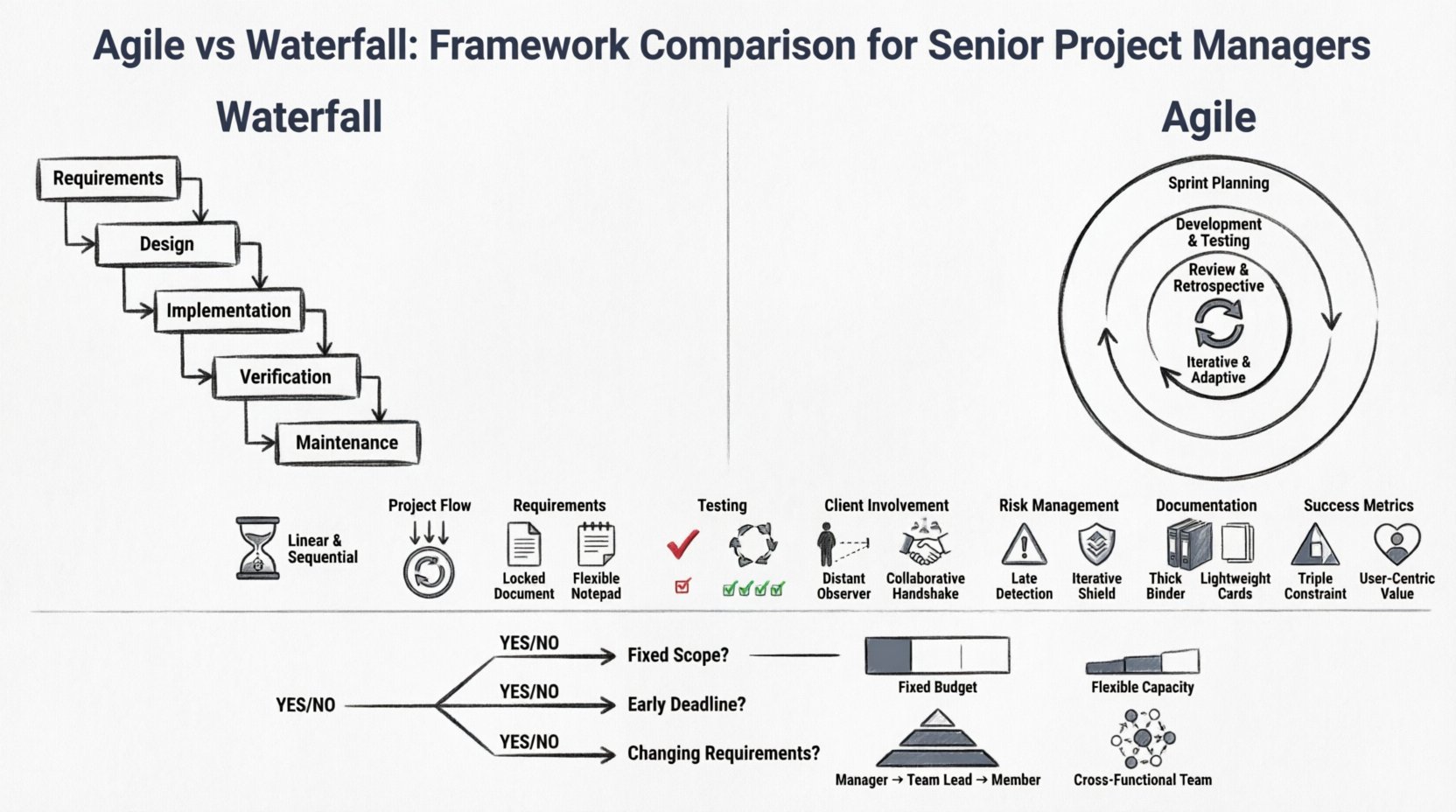
- Sequential Phases: The project moves through distinct stages: Requirements, Design, Implementation, Verification, and Maintenance.
- Documentation Heavy: Extensive documentation is required upfront to define scope and specifications before work begins.
- Fixed Scope: The project scope is typically defined early and remains stable throughout the lifecycle.
- Client Visibility: Stakeholders see the final product only at the end of the project, rather than during development.
- Critical Path: The schedule is rigid, with milestones serving as checkpoints for progress.
When Waterfall Excels
This methodology is most effective when the requirements are well-understood and unlikely to change. It provides a clear roadmap for execution, making it easier to estimate costs and timelines accurately at the outset. In industries where compliance and regulatory adherence are paramount, the heavy documentation of Waterfall ensures an audit trail is maintained.
- Construction projects with fixed physical constraints.
- Regulatory environments requiring strict sign-offs at every stage.
- Projects with limited budget flexibility where overruns are unacceptable.
- Teams that require high levels of specialization and handoffs between departments.
The Iterative Approach: Agile Explained 🔄
Agile is an iterative approach that focuses on collaboration, customer feedback, and small, rapid iterations. Rather than planning everything upfront, Agile teams break down work into smaller chunks, delivering value frequently. This allows the project to adapt to changes as they arise.
Key Characteristics of Agile
- Iterative Cycles: Work is organized into sprints or iterations, typically lasting two to four weeks.
- Customer Collaboration: Continuous feedback loops with stakeholders ensure the product meets evolving needs.
- Adaptive Planning: Requirements can change based on market conditions or user feedback without derailing the project.
- Functional Deliverables: Working software or products are delivered incrementally.
- Self-Organizing Teams: Teams have the autonomy to decide how to accomplish the work assigned to them.
When Agile Excels
Agile thrives in environments where uncertainty is high and innovation is the goal. It allows organizations to pivot quickly if a feature does not resonate with users. This approach reduces the risk of building the wrong product by validating assumptions early and often.
- Software development where user needs evolve rapidly.
- Startups or new product divisions requiring speed to market.
- Complex projects with ambiguous initial requirements.
- Organizations prioritizing innovation and experimentation over strict predictability.
Head-to-Head Comparison 📊
To clarify the distinctions, we can compare the two frameworks across several critical dimensions. This table highlights the structural differences that influence decision-making for senior leadership.
| Dimension | Waterfall | Agile |
|---|---|---|
| Project Flow | Linear and sequential | Iterative and incremental |
| Requirements | Fixed at the start | Flexible and evolving |
| Testing | Occurs after development | Continuous throughout development |
| Client Involvement | Low during execution | High and continuous |
| Risk Management | Risks identified early but realized late | Risks identified and mitigated continuously |
| Documentation | Comprehensive upfront | Just enough to support development |
| Success Metrics | On time, on budget, on spec | Customer value and satisfaction |
Financial Implications 💰
Budgeting is a major differentiator between these frameworks. Senior project managers must align financial expectations with the chosen methodology to avoid friction with finance departments and stakeholders.
Waterfall Budgeting
In a Waterfall environment, the budget is typically fixed based on the initial scope definition. This allows for precise cost forecasting. However, it also means that if scope creep occurs, it must be managed through a formal change request process, which can slow down progress.
- Cost Certainty: High confidence in total project cost at the beginning.
- Contract Type: Often suited for fixed-price contracts with vendors.
- Overrun Risk: If estimates are wrong, the project may face significant financial strain later.
Agile Budgeting
Agile projects often utilize time-and-materials funding or are budgeted by capacity (e.g., a team for six months). The total scope is fluid, meaning the budget is fixed, but the deliverables may vary. This shifts the focus from delivering a specific list of features to delivering maximum value within the budget constraints.
- Cost Flexibility: Budget is allocated to time and resources rather than specific outputs.
- Value Prioritization: Teams can cut lower-value features if the budget runs short.
- Uncertainty: Final cost is not known until the project concludes, though total spend is capped.
Risk Management Differences 🛡️
Every project carries risk. The management strategy for these risks differs fundamentally between Waterfall and Agile.
Waterfall Risk Profile
Waterfall assumes that risks can be identified and mitigated during the planning phase. The strategy is preventive. However, because testing happens late, integration issues or requirement misunderstandings may not surface until the final stages. This can lead to a “death spiral” near the end of the timeline if critical flaws are discovered.
- Identification: Comprehensive risk register created at the start.
- Response: Mitigation plans are established upfront.
- Discovery: Major risks often revealed only during the verification phase.
Agile Risk Profile
Agile accepts that some risks are unknown at the start. The strategy is adaptive. By delivering small increments, the team fails fast and learns quickly. If a feature is technically unviable or unwanted, it is discovered after a few weeks, not a few months.
- Identification: Risks are reviewed and updated in every iteration planning session.
- Response: Adjustments are made immediately in the next sprint.
- Discovery: Technical and market risks are exposed continuously.
Team Structure and Culture 👥
The choice of framework influences how people work together. A senior manager must consider whether the organizational culture supports the required level of autonomy or structure.
Waterfall Team Dynamics
Waterfall often relies on a hierarchical structure. Roles are distinct: analysts write requirements, designers create blueprints, developers build, and testers verify. This specialization allows for deep expertise but can create silos where communication between roles is formal and delayed.
- Specialization: Teams are organized by function.
- Communication: Formal handoffs between phases.
- Leadership: Managers direct the work and enforce the plan.
Agile Team Dynamics
Agile promotes cross-functional teams. A single team member may contribute to planning, design, and testing. This requires a higher level of skill versatility and a culture of trust. Decision-making is decentralized, empowering the team to solve problems without constant managerial intervention.
- Collaboration: Teams work together on all aspects of delivery.
- Communication: Daily stand-ups and constant informal interaction.
- Leadership: Managers act as facilitators who remove impediments.
Stakeholder Communication Styles 🗣️
Managing stakeholder expectations is a core competency for project leaders. The frequency and nature of updates differ significantly.
Waterfall Communication
Stakeholders in Waterfall projects typically receive status reports at milestone gates. They are less involved during the execution phase. This works well for external clients who do not want to be distracted by daily development details but require assurance that the project is on track.
- Frequency: Weekly or monthly status reports.
- Focus: Milestone completion and budget burn rate.
- Feedback: Formal sign-off at phase transitions.
Agile Communication
Agile requires high engagement from stakeholders. They are invited to review increments at the end of every sprint. This ensures alignment but requires a stakeholder group that is available and willing to provide timely feedback.
- Frequency: Sprint reviews every two to four weeks.
- Focus: Working product demonstrations and user feedback.
- Feedback: Continuous and immediate input on features.
Hybrid Approaches 🧩
In the real world, few projects fit perfectly into one category. Many senior managers adopt a hybrid approach to leverage the strengths of both methodologies. This might involve using Waterfall for high-level governance and budgeting while using Agile for the execution of development work.
Common Hybrid Scenarios
- Phase-Gated Agile: High-level phases are defined (Waterfall), but the work within those phases is executed iteratively (Agile).
- Hybrid Teams: Some departments operate in a Waterfall structure (e.g., Legal, Compliance) while development teams use Agile.
- Documentation Standards: Using Agile development processes but maintaining Waterfall documentation standards for regulatory compliance.
Decision Matrix for Leadership 🧭
When faced with a new initiative, senior project managers can use the following checklist to guide their framework selection.
- Are requirements clear? Yes ➔ Lean Waterfall. No ➔ Lean Agile.
- Is the budget fixed? Yes ➔ Lean Waterfall. Flexible ➔ Lean Agile.
- Is time to market critical? Yes ➔ Lean Agile. No ➔ Lean Waterfall.
- Are stakeholders available? Yes ➔ Lean Agile. No ➔ Lean Waterfall.
- Is the technology stable? Yes ➔ Lean Waterfall. Uncertain ➔ Lean Agile.
- Is regulatory compliance strict? Yes ➔ Lean Waterfall (or Hybrid). No ➔ Lean Agile.
Final Considerations for Senior Leaders 🏛️
The decision between Agile and Waterfall is not binary. It is a spectrum of adaptability. A senior project manager must evaluate the specific context of the project, the maturity of the team, and the tolerance of the organization for change. There is no single correct answer that applies to every situation.
Success lies in the alignment between the chosen framework and the strategic goals of the organization. If the goal is predictability and control, Waterfall offers a proven path. If the goal is innovation and responsiveness, Agile provides the necessary flexibility. Leaders who understand the trade-offs can navigate complex landscapes with confidence.
Ultimately, the framework serves the project, not the other way around. By selecting the right structure, you empower your team to deliver value efficiently while managing the inherent risks of execution. Focus on the outcome, and let the process support the journey.