The modern business landscape demands more than just the ability to gather requirements. Organizations today face complex operational challenges that require a clear understanding of workflows, inefficiencies, and improvement opportunities. For a Business Analyst, possessing strong process modeling skills is no longer optional; it is a critical differentiator. This guide explores how mastering Business Process Model and Notation (BPMN) and related process competencies can significantly enhance your professional trajectory 💼.
Process skills provide the framework to translate vague business needs into actionable, visual models. When you can map a process from start to finish, you gain the authority to identify bottlenecks before they become issues. This document outlines the essential skills, methodologies, and strategic applications required to stand out in a competitive market.
Why Process Skills Are Critical for Business Analysts 📊
Business Analysts often act as the bridge between stakeholders and technical teams. However, language barriers frequently arise. Executives speak in strategic goals, while developers speak in logic and code. Process modeling sits in the middle, offering a universal language that both groups understand.
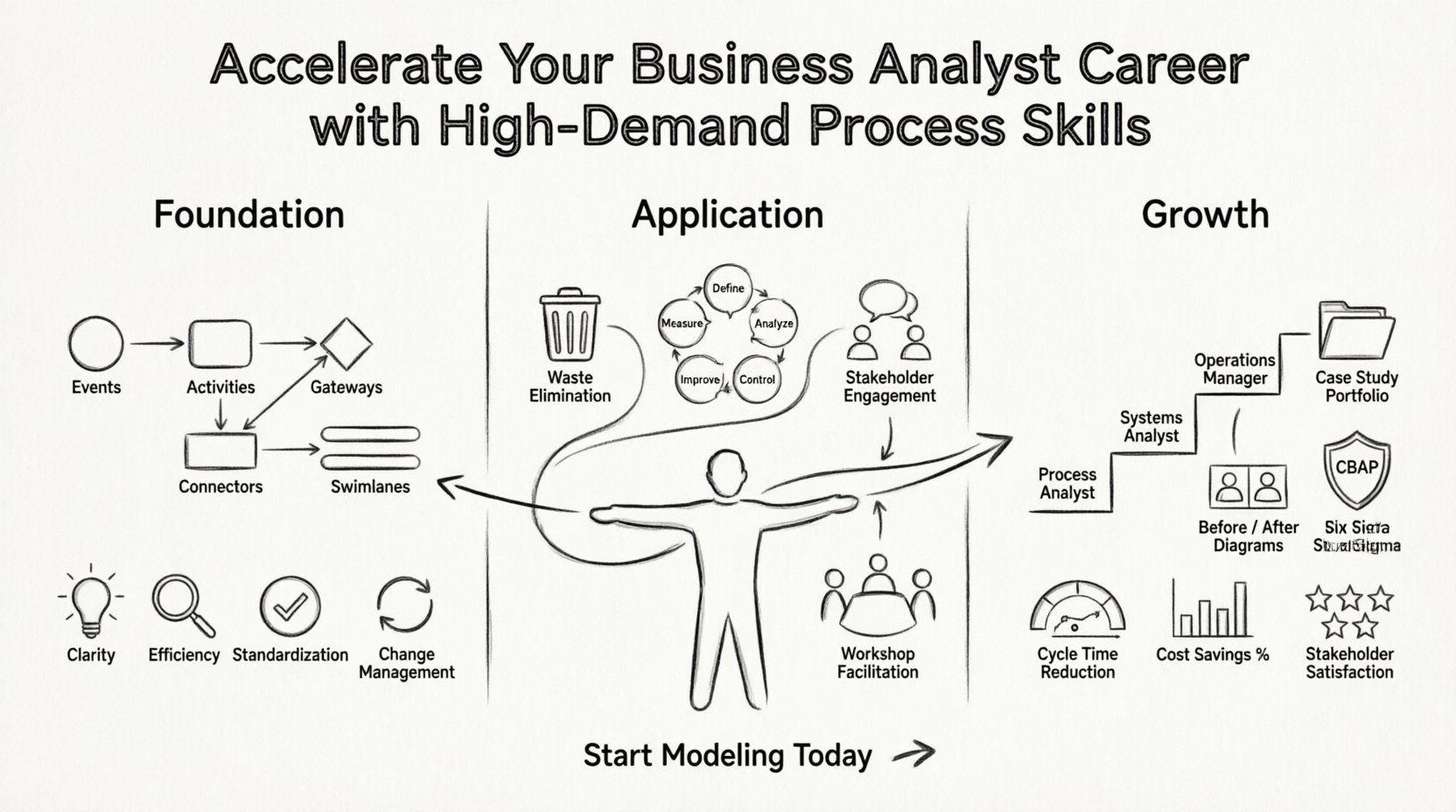
- Clarity and Precision: Written requirements can be ambiguous. Visual diagrams remove doubt regarding the flow of information and decision points.
- Efficiency Identification: Mapping a process highlights redundant steps, unnecessary approvals, and manual handoffs that waste time and resources.
- Standardization: Consistent process definitions ensure that different departments execute similar tasks in the same way, reducing errors.
- Change Management: When a process changes, a model provides a baseline. You can visualize the “as-is” state versus the “to-be” state to manage the transition smoothly.
Without these skills, a Business Analyst may find themselves stuck in a cycle of endless clarification meetings. With them, you become the architect of operational efficiency.
Understanding BPMN: The Industry Standard 📝
Business Process Model and Notation (BPMN) is the global standard for business process modeling. It is designed to be readable by both business users and technical developers. Unlike proprietary diagramming methods, BPMN provides a common set of symbols that convey meaning regardless of the software used to create them.
Core Components of BPMN
To work effectively with BPMN, you must understand the foundational elements. These elements allow you to construct diagrams that tell a story about how work gets done.
- Events: Represented by circles, events indicate something that happens during a process. They can be start, intermediate, or end events. Start events trigger the process, while end events mark completion.
- Activities: Shown as rounded rectangles, these are the tasks performed within the process. They can be simple tasks or complex sub-processes.
- Gateways: Diamond shapes represent decision points. They control the flow of the process based on conditions. A parallel gateway splits a flow into multiple paths, while an exclusive gateway chooses one path based on a rule.
- Connectors: Arrows link the elements together, showing the sequence of operations. Solid lines usually indicate sequence flow, while dashed lines may represent message flows between different participants.
- Pools and Lanes: Pools represent a major participant in a process, such as a company or an external organization. Lanes divide a pool into sub-roles or departments, clarifying who is responsible for each activity.
Benefits of Using a Standard Notation
| Feature | Benefit |
|---|---|
| Universality | Anyone trained in BPMN can read the diagram, regardless of their specific job title. |
| Tool Independence | Models can be moved between different platforms without losing meaning. |
| Execution Capability | Advanced BPMN diagrams can often be directly executed by workflow engines. |
| Stakeholder Alignment | Reduces misinterpretation between business and IT teams. |
Advanced Process Modeling Techniques 🔧
Beyond the basics, high-demand skills involve handling complexity. Real-world processes are rarely linear. They involve exceptions, parallel tasks, and interactions with external systems. Mastering these advanced concepts allows you to model scenarios that reflect actual operational reality.
Sub-Processes and Abstraction
Complex processes can become cluttered if every detail is visible at once. Sub-processes allow you to group a set of activities into a single, summarized box. You can drill down into a sub-process later to see the detailed steps. This keeps high-level diagrams clean while retaining the ability to show depth when needed.
Exception Handling
Processes often go wrong. Error events allow you to model what happens when something unexpected occurs. For example, if a payment fails, the process should route to a retry mechanism or a manual review lane. Modeling exceptions upfront prevents surprises during implementation.
Message Flows and Collaboration
Business processes often span multiple organizations. Message flows depict communication between pools. Understanding how data moves between an internal department and an external vendor is crucial for supply chain analysis and customer journey mapping.
Integrating Process Improvement Methodologies 📈
Modeling is not just about documentation; it is about improvement. A skilled Business Analyst uses process models as the foundation for optimization methodologies. Two common approaches integrate well with process modeling.
Lean Principles
Lean focuses on eliminating waste. When reviewing a process diagram, look for:
- Overprocessing: Steps that add no value to the customer.
- Waiting: Delays between activities where work sits idle.
- Motion: Unnecessary movement of people or information.
- Defects: Steps that result in errors requiring rework.
By highlighting these areas in the diagram, you provide concrete evidence for change.
Six Sigma and DMAIC
Six Sigma uses data to reduce variation. The Define, Measure, Analyze, Improve, Control (DMAIC) cycle relies heavily on process maps.
- Define: Create a high-level process map to scope the problem.
- Measure: Collect data on cycle times and error rates for each step.
- Analyze: Use the model to find root causes of delays or errors.
- Improve: Redesign the model to remove bottlenecks.
- Control: Implement monitoring to ensure the new process holds.
Communication and Stakeholder Management 🗣️
Technical skills are useless if you cannot communicate them effectively. Process modeling is a powerful communication tool. However, presenting a diagram requires strategy.
Know Your Audience
Not every stakeholder needs the same level of detail. Executives need high-level overviews showing value and cost. Operators need detailed steps showing inputs and outputs. Tailoring the diagram to the viewer ensures engagement.
Facilitating Workshops
Often, the best models come from workshops where stakeholders draw the process together. As a facilitator, your role is to ask the right questions:
- What triggers this step?
- What happens if this data is missing?
- Who approves this decision?
- Is there a rule that changes the path?
These questions drive the group toward a shared understanding. Your ability to guide this conversation builds trust and authority.
Career Pathways and Roles 🛤️
Process skills open doors to various roles within the organization. While the title “Business Analyst” remains common, your skill set qualifies you for specialized positions.
| Role | Key Focus |
|---|---|
| Process Analyst | Deep dive into workflow optimization and efficiency. |
| Systems Analyst | Focuses on how software supports the process logic. |
| Operations Manager | Uses process data to manage teams and daily output. |
| Change Manager | Guides organizations through the adoption of new processes. |
Developing these skills early allows you to pivot between these roles as your career progresses. It demonstrates a commitment to organizational value rather than just task completion.
Building a Professional Portfolio 📁
Experience speaks louder than a resume. Creating a portfolio of process work can showcase your abilities to potential employers. Since sensitive data must be protected, use anonymized examples.
- Case Studies: Describe a problem, the process model created, and the outcome achieved.
- Before and After: Show the “as-is” diagram and the optimized “to-be” version. Highlight the changes made.
- Methodology: Explain the techniques you used, such as value stream mapping or root cause analysis.
- Feedback: Include testimonials from stakeholders who benefited from your modeling work.
This tangible evidence proves you can deliver results. It moves the conversation from “what you say you can do” to “what you have already done.
Continuous Learning and Certification 🎓
The field of business analysis evolves. Keeping pace requires ongoing education. Several certifications validate your process skills globally.
Key Certifications
- Certified Business Analysis Professional (CBAP): Focuses on broad business analysis competencies, including process modeling.
- Certified Associate in Project Management (CAPM): Useful for understanding project lifecycles where processes are implemented.
- BPMN Specialist Certifications: Various bodies offer specific training on the notation itself.
- Six Sigma Green Belt: Validates your ability to lead process improvement projects.
Staying Current
Join communities and forums where professionals discuss modeling challenges. Read industry publications to see how other organizations apply process management. Continuous learning ensures you do not become obsolete as new tools and methods emerge.
Common Pitfalls to Avoid ⚠️
Even experienced practitioners make mistakes. Being aware of common errors helps you maintain high standards.
- Over-Modeling: Creating diagrams that are too detailed for the audience. This confuses stakeholders and wastes time.
- Ignoring Exceptions: Focusing only on the happy path leaves the process fragile when real-world issues occur.
- Lack of Version Control: Process models change. Failing to track versions leads to teams working off outdated diagrams.
- Isolation: Creating models without consulting the people who actually do the work. This results in diagrams that look good but do not match reality.
Measuring Success and Impact 📉
How do you know your process skills are making a difference? Look for metrics that improve after modeling and intervention.
- Cycle Time: Did the process take less time from start to finish?
- Cost Reduction: Did eliminating steps reduce operational costs?
- Error Rates: Did standardizing the process reduce mistakes?
- Employee Satisfaction: Did removing frustration lead to better morale?
- Customer Satisfaction: Did the customer experience become smoother?
Quantifying these outcomes strengthens your position as a strategic partner. It shifts the perception of your role from administrative to strategic.
Final Thoughts on Process Excellence 🌟
The journey to becoming a top-tier Business Analyst involves a commitment to understanding how work flows through an organization. Process skills provide the lens through which you view problems and solutions. By mastering BPMN and integrating improvement methodologies, you add tangible value to every project you touch.
Focus on clarity, communication, and continuous improvement. These are the pillars of a successful career in business analysis. As you apply these concepts, you will find that the complexity of business challenges becomes manageable. Your ability to visualize, analyze, and optimize processes will become your greatest asset.
Start modeling today. Review existing workflows in your current environment. Look for one small process that could be clearer. The practice builds confidence and competence. Over time, these skills compound, leading to greater opportunities and professional growth.
Remember, the goal is not just to draw diagrams. The goal is to improve the way work gets done. When you prioritize the flow of value over the flow of tasks, you align yourself with the core mission of the business. This alignment is what drives career advancement and long-term success.