


Project management is often romanticized as a role of constant control and visible leadership. In reality, the trajectory of a career often hinges on how a professional handles the invisible friction that accumulates when processes fail. This friction is chaos. It is not a single event, but a pattern of decisions that erode trust and efficiency over time. When a project manager consistently fails to manage the hidden costs of disorganization, their career path flattens. Organizations rely on stability, and without it, growth stalls.
This guide examines the specific behaviors that stall progression. We will look at the mechanics of failure, not to assign blame, but to identify patterns that can be corrected. By understanding where the breakdowns occur, you can build a career based on reliability rather than reputation management.
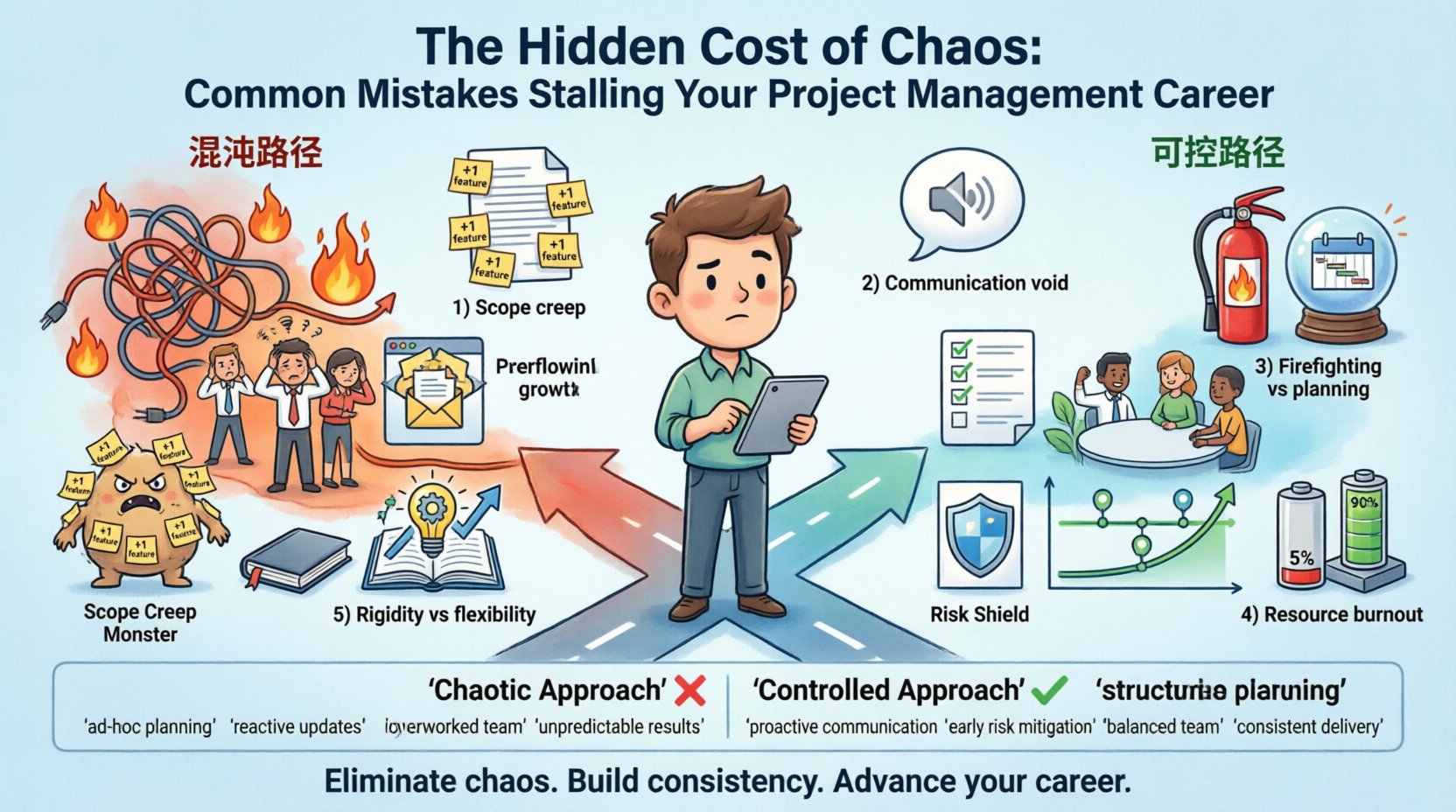
1. Ignoring the Foundation: Poor Scope Definition 📐
Scope creep is the silent killer of project budgets and timelines. It begins with a single request that seems harmless. A stakeholder asks, “Can we just add this one small feature?” or “Can we extend the deadline by a week to ensure quality?” Without a formal change control process, these requests accumulate. The immediate cost is budget overrun. The long-term career cost is being seen as someone who cannot say no or manage expectations effectively.
- The Behavior: Agreeing to every request without assessing impact.
- The Immediate Consequence: Missed deadlines and exhausted resources.
- The Career Impact: Loss of credibility with senior leadership.
When scope is not defined clearly at the outset, the project lacks a baseline. A baseline is necessary for measurement. Without it, you cannot prove success or failure objectively. This ambiguity forces the project manager into a defensive position where they must constantly explain delays. Over time, this erodes the confidence of sponsors who need assurance that their investment is secure.
To avoid this, establish a clear scope document that outlines what is included and, crucially, what is excluded. Require formal sign-off before work begins. When changes arise, assess the impact on time, cost, and quality before agreeing. Present the trade-offs to the decision-makers. This shifts the burden of decision-making back to the stakeholders and demonstrates your commitment to governance.
2. The Communication Void: When Silence Speaks Volumes 🤐
Communication is the lifeline of any initiative. Silence is dangerous. When stakeholders are left guessing, anxiety rises. The project manager becomes the bottleneck. Information hoarding or delayed reporting creates a vacuum that others fill with assumptions, often incorrect ones.
Many professionals mistake communication for sending updates. True communication involves active listening and ensuring alignment. If the team does not understand the priority, they will work on the wrong tasks. If the client does not know the status, they will assume the worst.
- The Behavior: Reporting only when asked or only when problems occur.
- The Immediate Consequence: Surprises at the end of the phase.
- The Career Impact: Perception of being out of touch or unreliable.
Effective communication requires a rhythm. Regular cadence meetings, status reports, and open channels for questions are essential. However, the quality of the message matters more than the frequency. A report that hides risks is worse than no report at all. Transparency about challenges allows the organization to support you. Hiding them forces you to solve problems alone, often resulting in failure.
Ensure that your communication strategy matches the audience. Executives need high-level summaries and red flags. The team needs detailed tasks and dependencies. Tailoring the message shows emotional intelligence and strategic thinking, skills that are critical for senior roles.
3. Reactive Firefighting Instead of Proactive Planning 🚒
There is a distinct difference between managing a project and putting out fires. A reactive approach focuses on fixing issues after they surface. A proactive approach anticipates them. Ignoring risk registers means waiting for fires to start. This creates a stressful environment where the team is constantly working under pressure.
Risk management is not just about listing potential problems. It is about preparing responses. If a key team member leaves, is there a backup? If a vendor delays, is there an alternative source? Without contingency plans, the project is fragile. Fragility leads to failure when the inevitable disruption occurs.
- The Behavior: Waiting for issues to arise before acting.
- The Immediate Consequence: Crisis mode and burnout.
- The Career Impact: Being viewed as a crisis manager rather than a leader.
Building a risk register is a standard practice, but it often becomes a checkbox exercise. To make it useful, assign owners to risks and define trigger points. Regular reviews ensure that new risks are captured as the project evolves. This proactive stance demonstrates foresight. Leaders value professionals who prevent problems rather than those who clean up messes.
4. Resource Mismanagement: The Burnout Trap 🔋
People are the most valuable asset in any project. Resource mismanagement occurs when work is assigned without considering capacity or skill. Overallocation is common. Managers push the team to work harder rather than smarter. This leads to burnout, turnover, and a decline in quality.
When you consistently ask for overtime without justification, you damage morale. The team learns that their well-being is secondary to the deadline. This culture of urgency is unsustainable. High performers will eventually leave for environments that respect their time and energy.
- The Behavior: Assigning work based on availability rather than capacity.
- The Immediate Consequence: High error rates and team attrition.
- The Career Impact: Reputation as a demanding or ineffective leader.
Accurate resource planning involves understanding the skills and limits of your team. It requires honest conversations about workload. If a deadline is unrealistic, advocate for it early. It is better to adjust the timeline than to break the team. Sustainable delivery builds a reputation for stability and care for the workforce, traits that are highly sought after in senior management.
5. Rigidity in a Dynamic Environment 🔄
The business landscape changes. Requirements shift. A rigid adherence to a single methodology can hurt a project. Dogmatic behavior prevents adaptation. While structure is good, flexibility is essential. If a new market opportunity arises, the project should be able to pivot if it aligns with strategic goals.
Blindly following a process without understanding the “why” behind it leads to inefficiency. Sometimes the process needs to change to fit the project. Sometimes the project needs to change to fit the process. Understanding this balance is a mark of a mature professional.
- The Behavior: Refusing to adapt processes to new information.
- The Immediate Consequence: Delivering the wrong product on time.
- The Career Impact: Being seen as inflexible or outdated.
Embrace methodologies that allow for iteration. Feedback loops are vital. They ensure that the output matches the need. If the team suggests a better way, listen. If the stakeholder changes the direction, adjust the plan. Adaptability shows that you prioritize the organization’s success over your own comfort with a specific plan.
6. Neglecting Professional Development 📚
The field of project management evolves. Standards change. Tools update. Stagnation leads to obsolescence. A professional who relies solely on past experience without learning new techniques will eventually hit a ceiling. Continuous learning is not just about certifications; it is about soft skills and industry knowledge.
Networking is also part of development. Engaging with peers allows you to learn from their failures and successes. Isolating yourself limits your perspective. You need to understand how your organization fits into the broader market.
- The Behavior: Doing the same thing year after year without change.
- The Immediate Consequence: Skill gaps compared to peers.
- The Career Impact: Missing out on promotions or new opportunities.
Seek feedback regularly. Ask what you could have done better. Read industry literature. Attend workshops. These actions show a commitment to growth. Organizations invest in people who invest in themselves. It signals that you are ready for more responsibility.
Comparison: Chaotic vs. Controlled Project Management
Understanding the difference between a chaotic approach and a controlled one can clarify where you stand. Use the table below to evaluate your current practices.
| Aspect | Chaotic Approach | Controlled Approach |
|---|---|---|
| Planning | Ad-hoc, based on urgency | Structured, based on requirements |
| Communication | Reactive, only when issues arise | Proactive, scheduled cadence |
| Risk | Ignored until it happens | Identified and mitigated early |
| Team | Overworked, unclear priorities | Balanced workload, clear goals |
| Outcome | Unpredictable results | Consistent delivery |
Final Thoughts on Consistency ⚖️
Success in project management is rarely about a single grand victory. It is about the consistency of your approach. When you eliminate chaos, you create space for innovation. When you build trust, you gain autonomy. These are the foundations of a lasting career.
Focus on the process. Trust that if the process is sound, the results will follow. Do not chase metrics at the expense of health. Do not chase speed at the expense of quality. The hidden cost of chaos is paid in time, reputation, and energy. By paying attention to these details, you secure your position as a leader who delivers value without the noise.
Start by identifying one area where chaos enters your work. Apply the strategies discussed here. Measure the change. Over time, these small adjustments compound into a significant career advantage. The goal is not perfection, but progress. Keep moving forward with intention.
Related posts:
 How Project Management Actually Works: A Definitive Overview for Intermediate Professionals
 Agile vs. Waterfall: A Real-World Comparison for Senior Project Managers Deciding Frameworks
 5-Step Quick Start Guide to Structuring Any Project Management Initiative from Scratch
 Deep Dive into Project Management Components: What Every Intermediate Leader Must Know