Starting a project without a defined framework often leads to confusion, missed deadlines, and budget overruns. Whether you are leading a small team or coordinating a large-scale initiative, the foundation of success lies in how you structure the work before execution begins. A well-organized project plan does not restrict creativity; rather, it provides the necessary guardrails to ensure resources are used efficiently and goals are met with precision.
This guide outlines a practical methodology for establishing a robust project structure. We will move from initial concept definition to risk management, ensuring that every phase of the initiative is accounted for. By following these steps, you create a clear path forward that reduces ambiguity and aligns all participants toward a shared outcome.
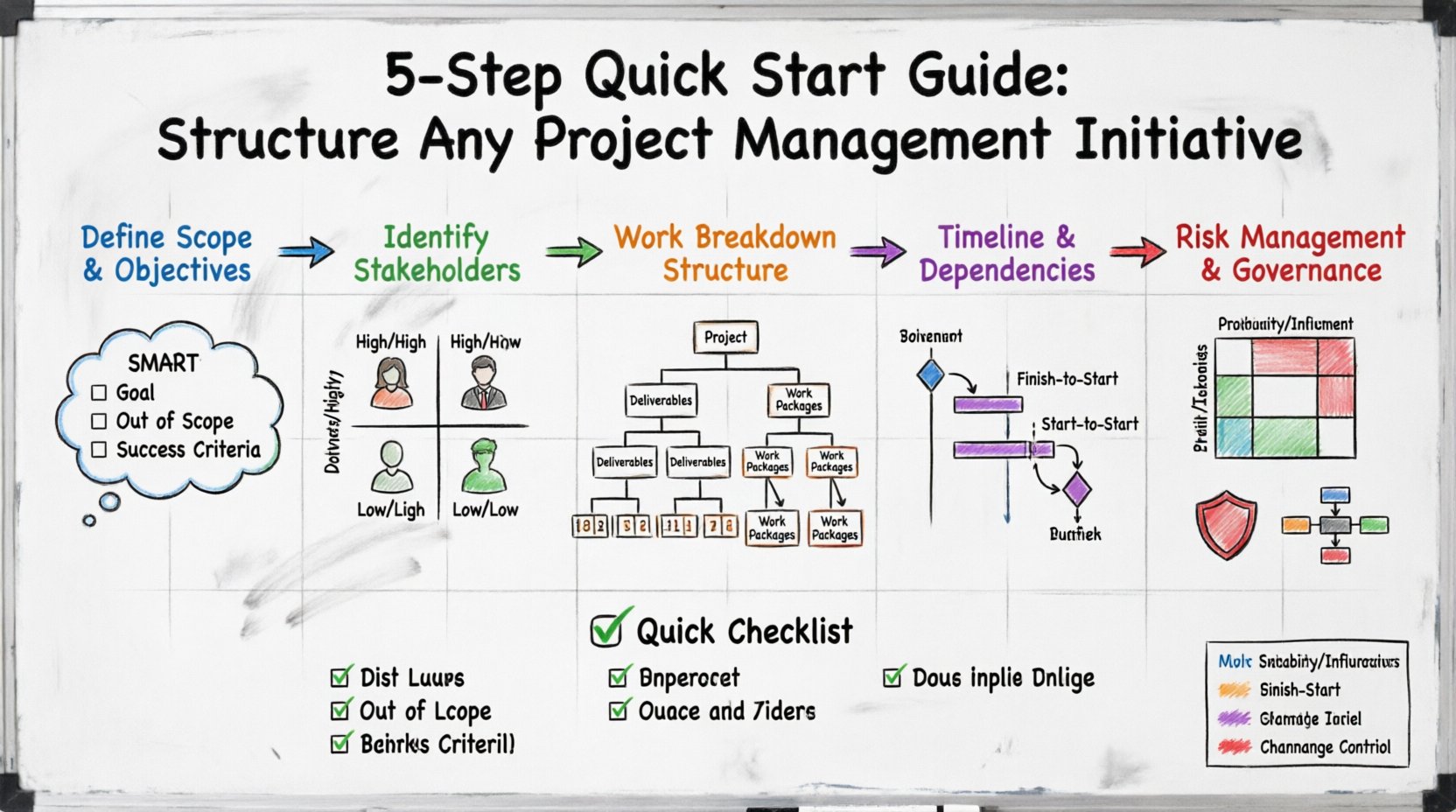
1️⃣ Define Scope and Objectives Clearly
The first step in structuring any initiative is establishing what the project actually entails. Vague intentions lead to vague results. You must translate high-level ideas into concrete, measurable statements. This phase prevents scope creep, a common issue where uncontrolled changes or continuous growth in a project’s scope can derail timelines and budgets.
To define the scope effectively, you need to answer specific questions regarding deliverables, constraints, and boundaries.
- What is the primary goal? Is it to launch a new product, improve an existing process, or migrate data? The goal must be specific.
- What is out of scope? Equally important is defining what the project will not do. This manages expectations among stakeholders and protects the team from unnecessary distractions.
- What are the success criteria? How will you know the project is complete? Quantifiable metrics are essential here.
Consider using the SMART framework to refine your objectives. Specific, Measurable, Achievable, Relevant, and Time-bound goals provide a clear target. For instance, instead of saying “improve customer satisfaction,” a structured objective would be “increase customer satisfaction scores by 10% within six months through a revised support ticket workflow.”
Documenting this information creates a baseline. If a request comes in later that falls outside these documented boundaries, you have a reference point to evaluate if it should be added as a change request or rejected to protect the initial timeline. This discipline is crucial for maintaining control over the initiative.
2️⃣ Identify Stakeholders and Communication Channels
Projects do not happen in a vacuum. They involve people, and people require information. Identifying who needs to be involved and how they should be informed is a critical structural component. Failing to map stakeholders often results in decisions being made without the right input or resistance during the implementation phase.
Create a comprehensive list of all individuals and groups affected by the project. This includes sponsors who provide funding, team members who execute the work, and end-users who will consume the final output.
Stakeholder Analysis Matrix
Not all stakeholders hold the same level of influence. Categorize them to prioritize engagement.
| Category | Description | Engagement Strategy |
|---|---|---|
| High Power / High Interest | Key decision-makers and active participants. | Manage closely. Regular updates and direct consultation. |
| High Power / Low Interest | Senior leadership who need assurance but not details. | Keep satisfied. High-level summaries and milestone reports. |
| Low Power / High Interest | End-users or subject matter experts. | Keep informed. Feedback loops and status newsletters. |
| Low Power / Low Interest | Peripheral groups or external observers. | Monitor. Minimal effort required unless status changes. |
Once stakeholders are identified, establish communication protocols. Define when meetings occur, what format they take, and where documentation is stored. Consistency in communication reduces noise and ensures that information flows reliably. A weekly status update email, for example, might be sufficient for sponsors, while the core team may require daily stand-ups or real-time collaboration channels.
Documenting these protocols in a Communication Plan prevents the “I didn’t know that was happening” scenario. It sets the rhythm of the project and ensures everyone knows where to find the latest information.
3️⃣ Develop a Work Breakdown Structure
With scope and people defined, the next step is organizing the work itself. A Work Breakdown Structure (WBS) is a hierarchical decomposition of the total scope of work. It breaks the project down into smaller, manageable pieces. This is where abstract goals become actionable tasks.
Start with the main deliverables as the top level. Break these down into phases or major components. Continue breaking these down until you reach work packages that can be assigned to a single person or a small team. The rule of thumb is that each task should be completable within a short timeframe, such as one to two weeks.
- Deliverable-Oriented: Focus on what is being produced, not just the activity. Instead of “Meeting,” list “Approved Design Document.”
- Mutually Exclusive: Ensure there is no overlap between tasks. If two people are working on the same task, it causes confusion.
- Collectively Exhaustive: All tasks combined must equal 100% of the scope. Nothing is left out.
This structure serves as the backbone for your schedule and resource allocation. It allows you to estimate costs and time more accurately because you are looking at granular components rather than the whole. If a task is too large to estimate, it needs to be broken down further. This process forces clarity on the actual effort required.
Additionally, assign a unique identifier to each task. This allows for precise tracking and reporting. When you refer to a task ID in a status report, there is no ambiguity about which work package is being discussed. This level of detail is vital for maintaining order as the project grows in complexity.
4️⃣ Establish Timeline and Dependencies
Tasks do not happen in isolation. Most work relies on the completion of previous work. Establishing a timeline involves sequencing these tasks and identifying dependencies. Understanding these relationships helps you predict the critical path—the longest stretch of dependent activities that determines the earliest possible completion date.
When building the schedule, distinguish between the following types of dependencies:
- Finish-to-Start: Task B cannot start until Task A is finished. This is the most common dependency.
- Start-to-Start: Task B can start once Task A starts. Useful for parallel work streams.
- Finish-to-Finish: Task B cannot finish until Task A finishes. Often used for quality assurance phases.
Once dependencies are mapped, assign durations to each task. Be realistic about capacity. Account for holidays, vacations, and other commitments that team members have. It is advisable to include a buffer for unforeseen delays. A project schedule that runs at 100% capacity is fragile; a schedule with built-in slack is resilient.
Identify key milestones. These are significant points in the timeline that mark the completion of a major phase or the delivery of a critical component. Milestones are useful for high-level reporting to sponsors and for motivating the team. They break the long journey into smaller victories.
Review the timeline for resource conflicts. If two critical tasks require the same person at the same time, the schedule is invalid. Adjust the sequencing or allocate additional resources to resolve these bottlenecks. A valid schedule must be achievable given the available resources.
5️⃣ Implement Risk Management and Governance
Even with a perfect plan, things can go wrong. Risk management is the proactive identification and mitigation of potential issues. It is not about predicting the future with certainty, but about preparing for uncertainty so that impacts are minimized.
Conduct a risk assessment session with the core team. Brainstorm potential risks that could affect scope, schedule, cost, or quality. For each risk, determine its probability of occurring and the severity of its impact. This helps prioritize which risks require immediate attention.
- High Probability / High Impact: These require a specific mitigation plan. You must have a strategy ready to deploy.
- Low Probability / High Impact: These are often called “black swans.” Prepare a contingency plan to address them if they occur.
- High Probability / Low Impact: These are nuisances. Address them through routine operational processes.
Define governance structures to oversee the project. Governance refers to the framework of decision-making, accountability, and control. Who has the authority to approve changes to the scope? Who makes the final call if a budget overrun occurs? Clarifying this authority prevents gridlock.
Establish a change control process. If a stakeholder requests a new feature, it should not be added immediately. It must go through a formal review to assess the impact on time and cost. This discipline ensures that the project remains aligned with its original objectives and does not drift into a different initiative.
Finally, set up a cadence for review. Regular checkpoints allow you to compare actual progress against the plan. If the project is deviating, you can take corrective action early. Governance is not just about control; it is about enabling the project to succeed by providing clear direction and accountability.
Ensuring Long-Term Sustainability
Structuring a project is not a one-time event. It requires ongoing attention and adaptation. As the initiative progresses, new information will emerge, and conditions may change. The structure you build in the beginning provides the stability needed to navigate these changes without losing focus.
Regularly revisit your scope, schedule, and risk register. Update them as the project evolves. This keeps the plan living and relevant. A static document becomes obsolete quickly. A dynamic plan guides the team through the reality of the work.
By adhering to these five steps, you create a professional environment where work flows logically. You reduce the friction that often plagues complex initiatives. This approach allows teams to focus on execution rather than trying to figure out the next move. It is the difference between reacting to chaos and driving toward a result.
Remember that the goal is not perfection, but clarity. A clear structure allows for better decision-making at every stage. It ensures that resources are directed where they matter most. Whether the project is small or large, the principles of scope, people, tasks, time, and risk remain the same. Mastering the structure is the key to consistent delivery.
Summary of Key Actions
To recap, here is a checklist to ensure your project structure is solid:
- ✅ Document scope, objectives, and success criteria.
- ✅ Map all stakeholders and define communication rhythms.
- ✅ Create a Work Breakdown Structure (WBS) with clear deliverables.
- ✅ Sequence tasks, identify dependencies, and set milestones.
- ✅ Assess risks and define governance and change control processes.
Implementing this framework takes time upfront, but it saves significant time during execution. It builds confidence among the team and stakeholders alike. When everyone understands the plan and their role within it, the path to completion becomes much clearer.